Reading the Flock: What a Shepherd's Hands Can Tell You About a Sheep's Health
Reading the Flock: What a Shepherd's Hands Can Tell You About a Sheep's Health
There's something almost quiet about the way a skilled shepherd walks into a pasture.
No clipboard. No lab results. No equipment to calibrate. Just eyes that know what to look for — and hands that have learned to listen.
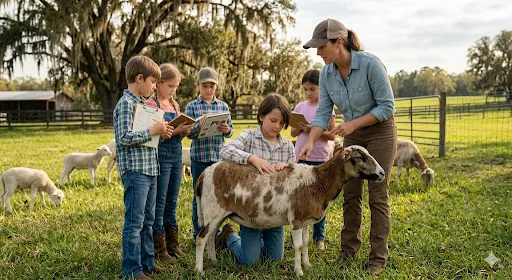
In a few seconds, those hands can tell a story: whether a ewe is thriving or struggling, well-nourished or quietly heading toward trouble. It's not magic. It's a technique. And this Saturday at Black Hammock Farm, students of all ages will learn how to do it themselves.
What Is Body Condition Scoring — And Why Does It Matter?
Body Condition Scoring (BCS) is a standardized, repeatable method for evaluating the fat and muscle on a sheep's frame. It gives farmers and veterinary professionals a shared, consistent language for describing an animal's nutritional status — without needing scales, ultrasound equipment, or bloodwork.
The assessment is performed entirely by touch. An evaluator runs their hands along specific bony landmarks on the animal's back and loin, and what they feel — sharp and prominent, smooth and rounded, or buried under fat — maps directly to a numerical score on a 1-to-5 scale.
This is hands-on livestock science education in its most direct form: a child placing their hands on a living animal and reading what the body is saying. Visit communotfarm.com to see how CommunOT Farm & Programming builds experiences like this one from the ground up.
The Numbers Behind the Technique
The standard U.S. BCS scale runs from 1 (emaciated) to 5 (obese), with half-scores used for greater precision in the middle range. In a well-managed flock, 90% of animals should score between 2 and 4.
Here's what each score looks and feels like in practice:
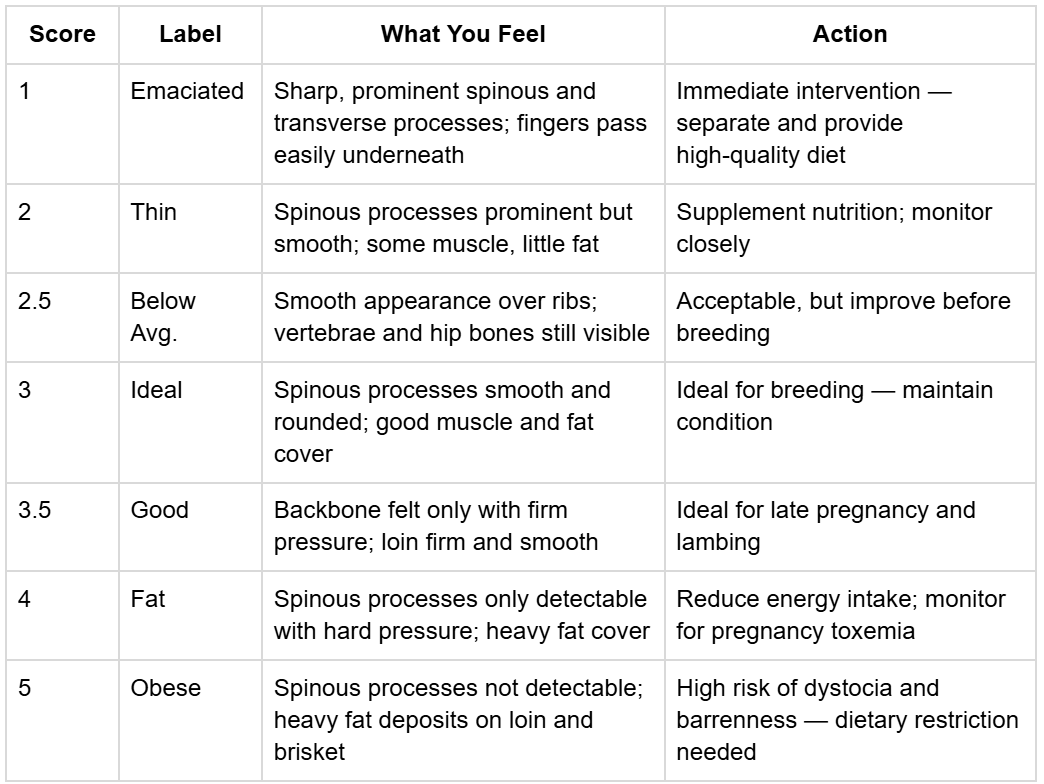
The difference between a 2.5 and a 3.5 isn't just a number on a chart. Research from Oregon State University found that ewes scoring in the 3.0–3.5 range at lambing weaned 82% more pounds of lamb per ewe compared to ewes at 2.5. A single BCS unit change represents roughly 13% of a ewe's live weight — about 20 pounds for a 150-pound animal.
That's the kind of real-world data that makes body condition scoring for sheep one of the most powerful tools in livestock management — and one of the best lessons a student can learn on a working farm.
How the Assessment Is Actually Performed
Visual appraisal alone is unreliable — especially in wooled breeds where fleece can obscure the animal's true condition. BCS must always be done by hand. The assessment focuses on three anatomical landmarks in the loin area, just behind the last rib.
1. The Backbone (Spinous Processes)
Run fingers along the top of the spine. At Scores 1–2, the processes are sharp and prominent. At Score 3, they're rounded and felt only with pressure. At Scores 4–5, they're buried and undetectable.
2. The Transverse Processes
These are the horizontal projections off the spine. Test whether you can slip your fingers underneath them. At Score 1, fingers pass easily under. At Score 3, smooth and rounded — pressure is needed. At Score 5, buried entirely in fat.
3. The Loin Eye (Muscle & Fat Cover)
This is the area between the last rib and the hip. In ideal condition, it feels firm and smooth without sharp edges. At low BCS, the muscle is shallow with no fat padding. At high BCS, the muscle is deep and cushioned with thick fat.
Students at Black Hammock Farm will walk through all three landmarks during the farm lab — guided step by step through the same assessment technique used by professional shepherds and veterinary staff across the country.
Managing BCS Across the Reproductive Cycle
Knowing a score is only meaningful if it triggers the right response. BCS management isn't static — it changes based on where a ewe is in her reproductive cycle.
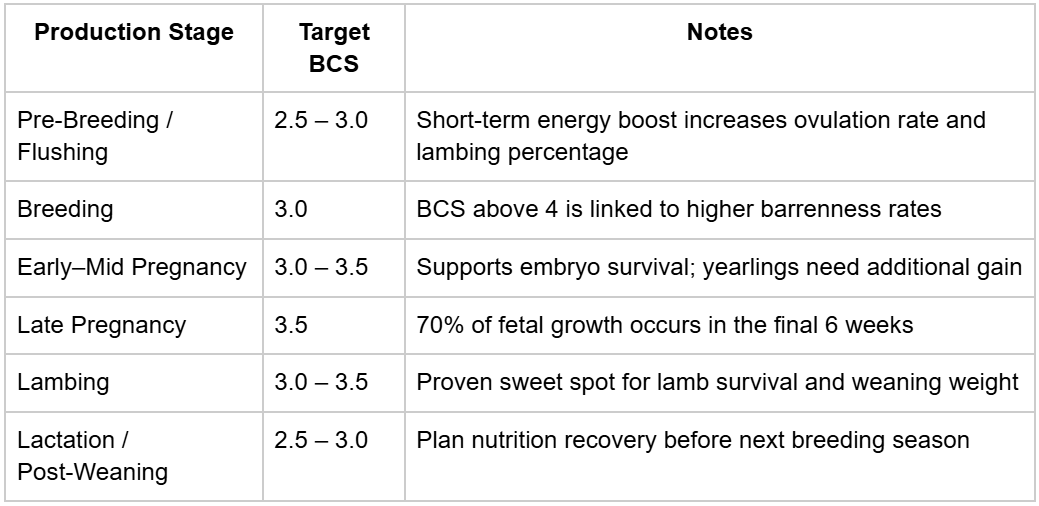
This is what makes hands-on farm science in Central Florida so compelling: it's not abstract. Every number on that table represents a decision a real farmer makes, on a real animal, with real consequences. That's the kind of science that sticks.
Learn more about how CommunOT structures farm-based science learning at communotfarm.com.
The OT Connection — What's Happening in the Body While Students Learn
Here's something that might surprise you. When a student performs a BCS assessment — pressing their hands along a sheep's spine, feeling for sharpness or roundness, applying deliberate pressure to locate a bony landmark — they're not just learning science.
They're using proprioception.
Proprioception is the body's awareness of pressure, resistance, and spatial positioning. It's the same sensory system occupational therapists target to support motor planning, body awareness, and self-regulation in children with sensory processing needs.
This is the heart of what CommunOT Farm & Programming does: design experiences where the therapeutic input and the educational outcome are the same activity. Hands-on animal interaction provides deep proprioceptive input that is both scientifically productive and therapeutically beneficial — for every learner in the pasture.
Join Us This Saturday at Black Hammock Farm
This is your child's chance to learn a real livestock health technique — not from a diagram, but from a sheep.
Space is limited, and this is a small-group hands-on experience. Once it fills, it fills.
Event Details:
Date: Saturday, March 14, 2026
Time: 10:00 – 11:30 AM
Location: Black Hammock Farm, Oviedo, FL
Cost: $30 per student
Ages: 2–18 · All learners welcome
👉 Reserve your spot at communotfarm.com
A good shepherd reads the flock. This Saturday, your child learns how.
CommunOT Farm & Programming is a pediatric occupational therapy organization based in Seminole County, FL, dedicated to integrating sensory-rich, nature-based experiences into developmental programming for children ages 2–18. Register and learn more at communotfarm.com.

