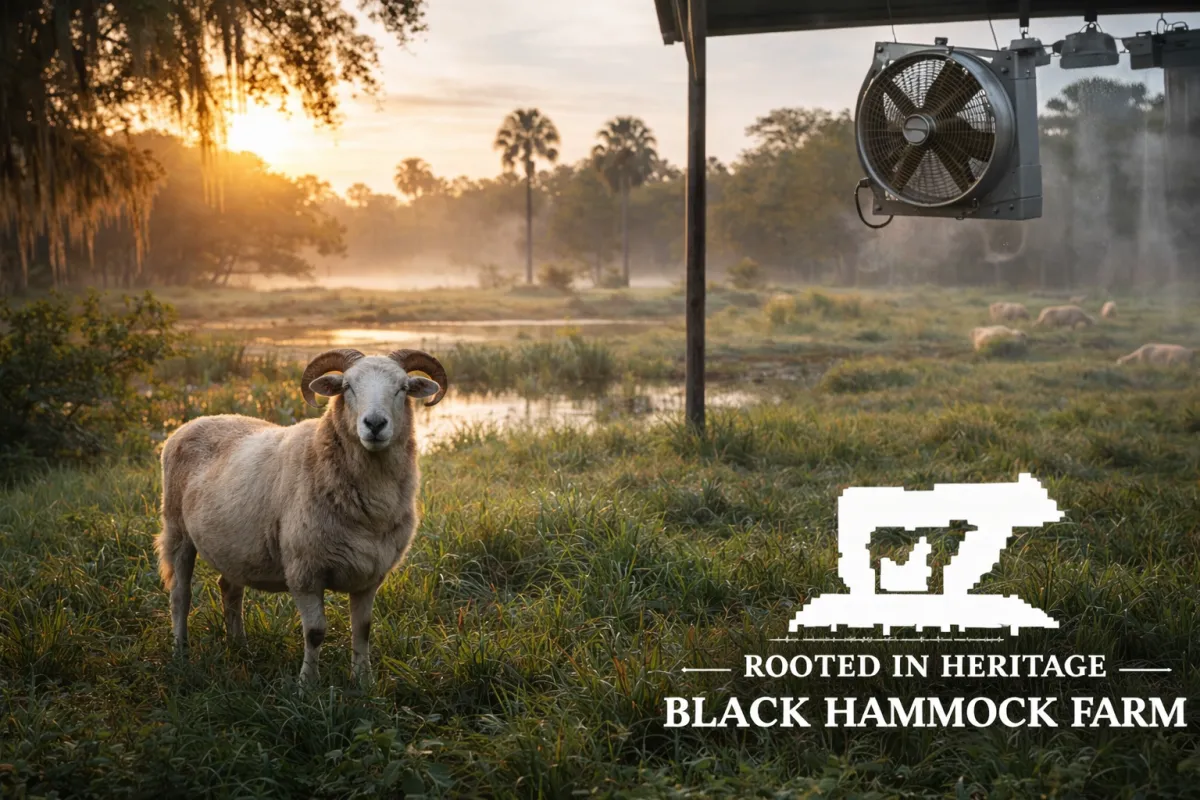
Built to Belong Here
Built to Belong Here
Part 3 of 14 in the “Rooted in Heritage, Growing for Tomorrow” Series
Some animals are forced to fit a place.
Others belong there.
Modern agriculture often treats livestock like interchangeable tools—moved from climate to climate, managed with inputs designed to compensate for mismatch. Fans, shade structures, medications, constant intervention. If the animal struggles, the solution is rarely to question whether it should be there at all.
At Black Hammock Farm, we started from a different premise:
What if the animal already knew how to live here?
When Breeds Lose Their Purpose
Not all livestock breeds are created equal—and many were never meant to survive everywhere.
Over the past century, agriculture has favored uniformity. Animals bred for rapid growth, predictable output, and compatibility with industrial systems. The result is efficiency on paper—but fragility in practice.
As environments change, many of these breeds struggle without heavy management:
Heat stress in hot climates
Parasite pressure requiring routine medication
Dependence on housing, machinery, and feed inputs
When animals lose their ability to function naturally in a landscape, farming becomes a battle instead of a partnership.
That’s not progress. That’s dependency.
The Quiet Disappearance of Heritage Livestock
While production breeds multiplied, something else quietly disappeared.
Heritage livestock—breeds developed for specific regions, soils, and climates—began to fade. Not because they failed, but because they didn’t fit industrial metrics.
They were:
Slower growing
Less uniform
Harder to standardize
But they were also resilient. Adaptable. Efficient without constant intervention.
These breeds carried genetic memory—the accumulated knowledge of generations surviving in real landscapes, not controlled environments.
When we lose those genetics, we don’t just lose animals.
We lose options.
Why Katahdin Sheep Belong in Florida
Katahdin sheep weren’t chosen for sentiment.
They were chosen for suitability.
Developed in Maine, Katahdins were bred to thrive under challenging conditions—poor forage, parasite pressure, variable weather. Unlike wool breeds, they carry a hair coat that sheds naturally, eliminating the need for shearing and reducing heat stress.
In Florida’s climate, that matters.
They tolerate heat and humidity
They show natural resistance to internal parasites
They maintain body condition on pasture
They require fewer inputs to stay healthy
This isn’t luck. It’s design.
Katahdins don’t fight the environment.
They work within it.
Farming That Works With the Land
When livestock belongs in a place, the land responds differently.
Grazing becomes lighter and more intentional. Pastures recover faster. Wetland edges stabilize instead of erode. The need for chemical controls diminishes because the system itself regains balance.
This is where stewardship becomes visible.
We don’t force production.
We observe patterns.
We adjust pressure.
We let the animals do what they’re designed to do.
That approach doesn’t scale quickly—but it scales correctly.
Genetic Diversity Is Insurance
In agriculture, diversity isn’t nostalgia.
It’s risk management.
Climate shifts. Parasites adapt. Markets fluctuate. When systems rely on narrow genetic pools, a single disruption can cause collapse.
Heritage breeds provide redundancy. They carry traits modern systems may need again—traits that can’t be recreated once they’re gone.
Preserving those genetics isn’t about the past.
It’s about resilience.
Built for This Place, This Time
Black Hammock Farm doesn’t exist to recreate history. It exists to apply its lessons.
The land remembers what works.
The animals remember how to survive.
Our responsibility is to listen—to match livestock to landscape, not the other way around.
Because farming succeeds most often when it stops trying to dominate nature and starts cooperating with it.
What Comes Next
In Part 4, we’ll take a closer look athow livestock can actively restore land, not just occupy it—exploring conservation grazing, wetland management, and why sheep may be one of Florida’s most underutilized environmental tools.
Built to belong here.
Not forced.
Not artificial.
Just right.
Next in Part 4: “More Than Grazing” — How sheep can restore wetlands, manage invasive species, and reduce the need for chemicals and machinery.

