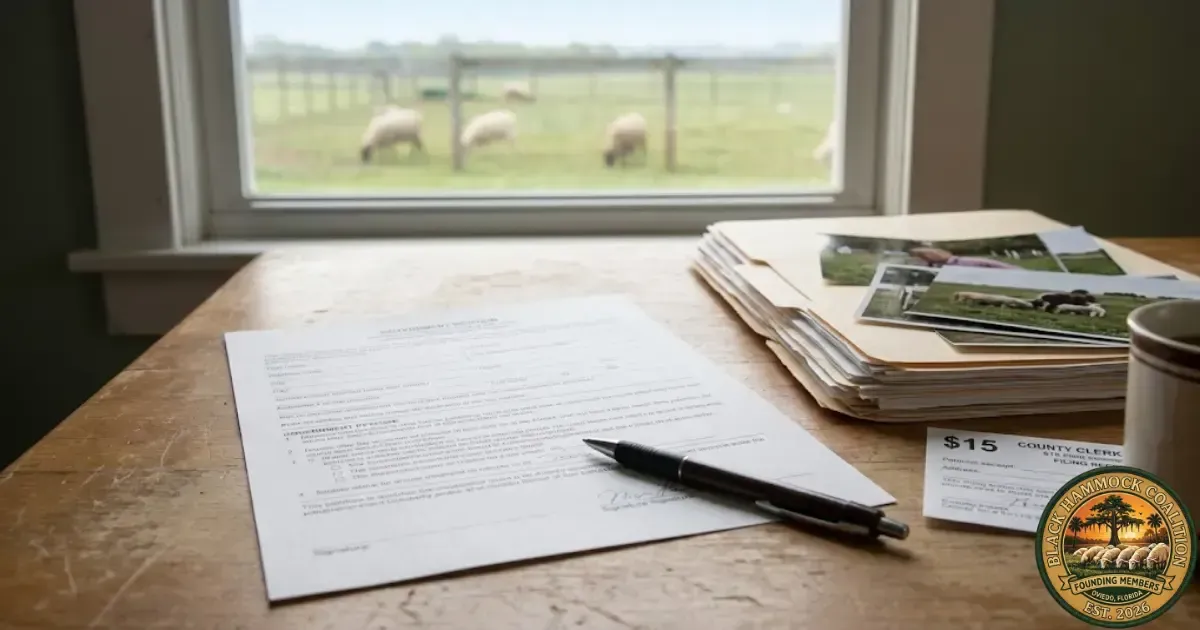
DR-486 VAB Petition Form: File Your Ag Appeal Step by Step
The DR-486 Petition Form Field by Field — How to File Your VAB Appeal Before the Deadline Closes
The denial letter is in your hands. You have read it. You have read the statute that governs it. You understand that the law is more favorable to the working farmer than the denial suggests. Now the question is mechanical: how do you convert that understanding into the piece of paper that preserves your right to be heard?
The piece of paper is Form DR-486— Petition to the Value Adjustment Board, Request for Hearing. It is published by the Florida Department of Revenue, prescribed under Florida Statute 194.011, and incorporated by reference in Rule 12D-16.002, Florida Administrative Code. It is three pages long. The first two are the petition itself. The third is an information sheet you keep for your own files. The form is the same in every county in Florida. The filing fee in Seminole County is $15.
This post walks every field on the form, explains what goes in each one, identifies the two decisions you need to make before you file, and then lays out the evidence binder structure — the organized documentation package that turns the one-page petition into a case the magistrate can rule on. The form gets you in the door. The binder wins the hearing.
This is Post 5 of The Denied G1 Series— a twelve-post field guide built from Black Hammock Farm’s own ongoing fight before the Seminole County Value Adjustment Board. Petition #2025-1003. We filled out this form ourselves. We built the binder ourselves. We are writing from the inside.
Quick Answer
How do I file a VAB petition to appeal my agricultural classification denial?
Download Form DR-486 from the Florida Department of Revenue or pick it up from your county’s Clerk of the Circuit Court. Fill in Part 1 (your name, address, parcel ID, phone, email), check “Denial of classification” in Part 2, check “Agricultural or classified use” under Type of Property, request 15 minutes for the hearing, sign Part 3 under penalties of perjury, and file it with the Clerk of the Circuit Court along with the $15 filing fee. The petition must be filed within 30 days of the date on your denial letter. Filing the petition preserves your right to a hearing — it does not commit you to anything beyond that. You can settle with the appraiser, withdraw, or proceed to the magistrate hearing. The hearing is typically scheduled 60 to 120 days after filing. Between now and then, you build the evidence binder: the denial letter, the appraiser’s internal file, date-stamped photographs, multi-year satellite imagery, business records, comparable properties, and the statutory and case law authority from Post 4 of this series. File first. Build second. The $15 fee is the cheapest insurance policy in Florida property tax law.
Before You Pick Up the Pen — Two Decisions
Before filling out the form, two decisions need to be made. Neither is complicated. Both are worth thinking about for thirty minutes before committing.
Decision 1: Self-represent or hire an attorney? Florida law allows any property owner to self-represent before the Value Adjustment Board. The hearing is informal — no rules of civil procedure, no opposing counsel cross-examining you, no jury. You present evidence to a special magistrate who reviews classification appeals regularly. Most denied farmers self-represent successfully. If your case involves multiple parcels, complex wetland delineation, or if you are not comfortable presenting to an unfamiliar audience, a Florida property tax attorney with VAB experience can help. But the form itself does not require an attorney to complete. If you do retain counsel, the attorney signs Part 4 of the form instead of you signing Part 3, and provides their Florida Bar number. If you use an unlicensed representative, Part 5 applies. For most single-parcel agricultural classification denials, self-representation is the standard approach.
Decision 2: Request the informal conference or skip it? The top of the DR-486 form notes that you have the right to an informal conference with the Property Appraiser before the hearing. This conference is not required and does not change your filing deadline. In practice, the informal conference is a sit-down with the appraiser’s office where you present your facts and they present theirs. Some cases settle at this stage — the appraiser’s office agrees to reclassify, and the petition is withdrawn. Some do not, and you proceed to the magistrate hearing. Whether to request the conference depends on the strength of your case and your comfort with the process. We chose to proceed directly to the magistrate hearing. Either way, file the petition first. The conference does not extend the 30-day deadline.
Part 1 — Taxpayer Information (Page 1)
Part 1 is the identification section. The form asks for six pieces of information.
Part 1 also contains three optional checkboxes. The first — “I am filing this petition after the petition deadline” — should not apply to you. If you are filing within 30 days of the denial date, leave it unchecked. The second — “I will not attend the hearing but would like my evidence considered” — is for petitioners who cannot appear in person. If you check this box, you must submit two copies of your evidence to the VAB clerk before the hearing. We strongly recommend attending. The magistrate hearing is where the case is won or lost, and being present to answer questions and respond to the appraiser’s arguments is the single most important advantage you have. The third is the Type of Property checklist. For agricultural classification denials, check “Agricultural or classified use.”
Part 2 — Reason for Petition (Page 1)
Part 2 asks you to check one reason for the petition. The form lists multiple options. For an agricultural classification denial, check the box labeled “Denial of classification.” That is the entire entry. You are not petitioning on value. You are not petitioning on exemption. You are petitioning because the Property Appraiser denied your agricultural classification, and you are requesting a hearing to challenge that denial under Florida Statute 193.461.
Part 2 also asks you to enter the time, in minutes, you think you will need to present your case. The form notes that most hearings take 15 minutes and that the VAB is not bound by your requested time. Request 15 minutes. If your case is more complex — multiple parcels, expert witnesses, extensive comparable-property analysis — request 20 or 30 minutes. The magistrate will adjust as needed. You will not be cut off mid-sentence if you run over, but having a realistic estimate helps the Clerk schedule the hearing calendar efficiently.
If more than one reason applies — for example, you are appealing both a classification denial and a valuation — you must file a separate petition for each reason. One form, one reason, one $15 fee. Most agricultural classification appeals involve only the classification denial.
Part 3 — Taxpayer Signature (Page 2)
If you are representing yourself — which most denied farmers do — you sign Part 3. The signature is under penalties of perjury, which means you are affirming that you are the owner of the property and that the facts in the petition are true. This is a standard legal affirmation. You are not swearing to the outcome of the hearing. You are swearing that the information on the form is accurate and that you are who you say you are.
If you are authorizing a representative, Part 3 is also where you check the box granting that representative access to confidential information from the Property Appraiser related to your petition. Print your name, sign, and date.
Parts 4 and 5 on the form are for licensed representatives (attorneys, appraisers, CPAs, brokers) and unlicensed representatives respectively. If you are self-representing, skip Parts 4 and 5 entirely.
Filing the Petition — Where, When, and What to Keep
The Evidence Exchange Requirement — New as of September 2025
This is the procedural change most denied farmers do not know about. Effective September 1, 2025, Florida law now requires mandatory evidence exchange between the petitioner and the Property Appraiser at least 15 days before the hearing. This is not optional. Both sides must provide their evidence to each other, without preconditions, on the statutory timeline.
What this means in practice: at least 15 calendar days before your hearing date, you must provide the Property Appraiser with your list of evidence, a summary of evidence to be presented by witnesses, and copies of all documentation you plan to present at the hearing. In return, the Property Appraiser must provide you with their evidence on the same timeline. To calculate the 15 days, count backward from the hearing date using calendar days, not including the hearing day itself. If the last day falls on a weekend or legal holiday, the period extends to the previous business day.
This requirement is significant because it means neither side can ambush the other at the hearing. You will see the appraiser’s evidence before you walk in. The appraiser will see yours. Build the evidence binder with this exchange in mind — everything you plan to present at the hearing should be organized, labeled, and ready to copy and deliver well ahead of the 15-day mark.
The Evidence Binder — What to Build Between Filing and the Hearing
Filing the petition takes fifteen minutes. Building the evidence binder takes the 60 to 120 days between filing and the hearing. The binder is where the case is made. The magistrate has seen hundreds of these hearings. What distinguishes a winning case from a losing one is organization, documentation, and the direct connection between the evidence and the statutory standard from Post 4 of this series.
Our evidence binder ran to 21 pages across these categories. The exact length depends on your operation and how much documentation you have. The principle is the same regardless: every claim in your summary should be supported by a document in the binder, and every document in the binder should connect to a specific requirement of Florida Statute 193.461. The magistrate is not impressed by volume. The magistrate is impressed by organization, accuracy, and the direct line between the evidence and the law.
The Partial Payment Requirement — Do Not Miss This
Page 3 of the DR-486 form contains a provision that catches many petitioners off guard. Under Florida Statute 194.014, if you have a VAB petition pending on or after the tax payment delinquency date — normally April 1 following the assessment year — you are required to make a partial payment of taxes. If you do not make the required partial payment before the delinquency date, the VAB will deny your petition regardless of its merits.
For classification denials (as opposed to valuation appeals), the partial payment must include all non-ad valorem assessments plus the amount of ad valorem taxes the taxpayer admits in good faith to owe, less applicable discounts. In practice, this means you pay the portion of the tax bill that would be owed if your agricultural classification were approved — the agricultural-rate portion — while the disputed differential remains unpaid pending the hearing outcome. Contact your county Tax Collector for the exact calculation. Do not wait until March to figure this out. Calendar the April 1 delinquency date the day you file the petition.
A special magistrate’s recommended decision is not a final decision of the VAB. Even if the magistrate has ruled in your favor, you are still required to make the partial payment before the delinquency date unless the VAB has issued a final decision. Do not assume the ruling protects you from the payment requirement.
What the Series Looks at Next
The next post in this series, publishing June 14, walks the evidence binder in depth — how to build each exhibit, how to organize the satellite imagery timeline, how to format the comparable-properties table, and how to write the one-page summary that the magistrate reads first. The form gets you in the door. The binder is what you carry through it.
Frequently Asked Questions
Can I file the DR-486 petition online in Seminole County?
Filing methods vary by county. Some Florida counties now accept DR-486 petitions through an online portal. Contact the Seminole County Clerk of the Circuit Court at 301 N. Park Avenue, Sanford, FL 32771, or check the Clerk’s website to confirm the available filing methods for the current year. Whether you file online, by mail, or in person, the petition is not complete until the $15 filing fee is paid and the Clerk assigns a petition number. Keep your receipt.
What if I miss the 30-day filing deadline?
If you file after the deadline, the DR-486 form includes a checkbox for late filing with a space to attach a statement explaining why you filed late. The VAB reviews late-filing petitions for “good cause.” However, good cause is not guaranteed, and the standard is discretionary. Missing the deadline is the single most expensive mistake a denied farmer can make. If you are reading this and the letter is already in your hands, count the days right now. If day 30 has not passed, file today. The petition takes fifteen minutes. The $15 fee is the price of preserving your hearing.
Do I need to attach evidence to the DR-486 when I file it?
No. The DR-486 is the petition — the form that preserves your right to a hearing. Evidence is presented separately, through the mandatory evidence exchange at least 15 days before the hearing and then at the hearing itself. File the petition clean, with just the form and the $15 fee. Build the evidence binder in the 60 to 120 days between filing and the hearing. The binder is the case. The form is the door.
Can I withdraw the petition after I file it?
Yes. Filing the petition does not commit you to anything beyond preserving your right to be heard. You can settle with the Property Appraiser’s office before the hearing and withdraw the petition. You can decide the case is not worth pursuing and withdraw. The $15 fee is nonrefundable, but $15 is the cost of keeping the option open. File first. Decide second.
What is the difference between the DR-486 and the DR-486MU?
The DR-486MU is an attachment form used when a single petition covers multiple substantially similar parcels — for example, a farmer with several adjacent parcels that were all denied classification in the same year. The DR-486MU lists the additional parcels and attaches to a standard DR-486. If you are appealing a single parcel, you only need the DR-486. If you are appealing multiple parcels, you file one DR-486 with the DR-486MU attachment and must obtain the Property Appraiser’s confirmation that the parcels are substantially similar.
Sources & References
Every assertion in this piece is sourced to official Florida Department of Revenue forms, statutory text, administrative code, or published VAB procedural guidelines. The links below open the original sources directly so the reader can verify any claim.
Florida DOR forms and procedural resources
Form DR-486— Petition to the Value Adjustment Board, Request for Hearing. Official Florida DOR form, revised 12/25.
Form DR-486MU— Attachment to a Value Adjustment Board Petition for Multiple Units, Parcels, and Accounts.
Uniform Policies and Procedures Manual for Value Adjustment Boards— Florida Department of Revenue, August 2025. The complete procedural reference for VAB hearings.
Florida DOR Property Tax Forms page— All VAB-related forms including DR-486, DR-486MU, DR-486POA (Power of Attorney), and DR-486A (Written Authorization).
Florida statutes and administrative code
Florida Statute § 194.011— Assessment notice; objections to assessments. Governs the VAB petition procedure, filing deadline, evidence exchange, and magistrate authority.
Florida Statute § 194.013— Filing fees for petitions; disposition.
Florida Statute § 194.014— Partial payment of taxes; penalty for nonpayment. The delinquency-date partial payment requirement.
Florida Statute § 194.032— Hearing procedures; exchange of evidence.
Florida Statute § 193.461— Agricultural lands; classification and assessment. The controlling statute for agricultural classification.
F.A.C. § 12D-9.015— Petition; form and filing fee. Prescribes the DR-486 form and filing requirements.
F.A.C. § 12D-5.003— Dwellings on Agriculturally Classified Land.
Seminole County filing references
Seminole County Clerk of the Circuit Court— VAB petition filing office. 301 N. Park Avenue, Sanford, FL 32771.
Seminole County Property Appraiser — main site. Record Search, Downloads, Agricultural Classification page.
SCPA Agricultural Classification page. Application procedures, Agricultural Specialist contact (Travis Walker, 407-665-7544).

