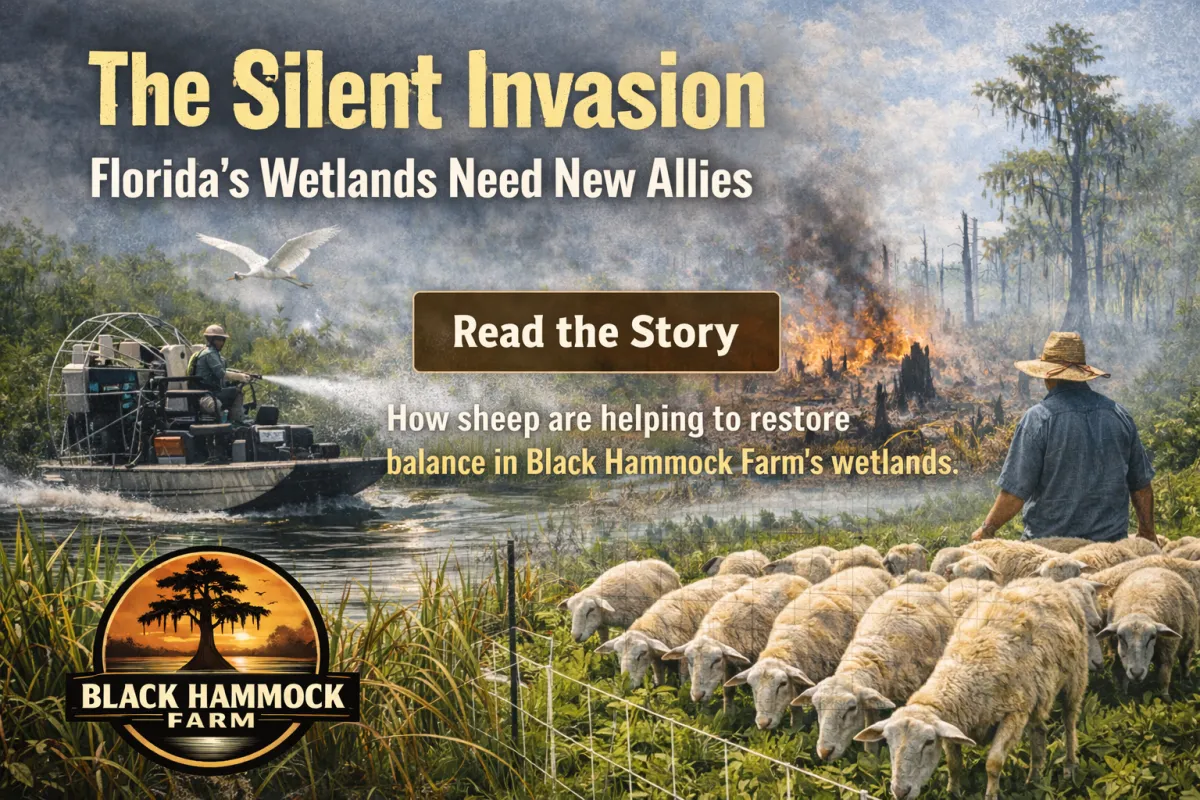
Florida Wetlands & the Silent Invasion
Sheep on the Front Lines: Targeted Grazing for Conservation
Part 7 of 14 in the "Rooted in Heritage, Growing for Tomorrow" Series
Last week, I wrote about the crisis facing Florida's wetlands—the silent invasion of aggressive plant species that's costing the state over $100 million annually and reshaping ecosystems faster than conventional management can respond.
This week, I want to get practical.
What does targeted grazing actually look like? How do sheep interact with wetland edges? What are we learning from our own land—the successes, the limitations, the surprises?
Because at Black Hammock Farm, this isn't theory. It's something we observe every day.
The Transitional Zone: Where Battles Are Won or Lost
If you want to understand why sheep matter for wetland conservation, you need to understand transitional zones.
These are the edges—the places where upland meets wetland, where dry ground gradually gives way to saturated soil, where terrestrial and aquatic ecosystems blur together. They're not as dramatic as open water or as familiar as pasture. Most people walk right past them without noticing.
But ecologically, transitional zones are everything.
These edges act as filters, capturing sediments and nutrients before they reach permanent water bodies. They provide critical habitat for species that move between environments—amphibians, wading birds, countless invertebrates. They buffer wetlands from upland disturbances. They're where much of the biological action happens.
They're also where invasive species establish their beachheads.
Think about it: transitional zones are, by definition, disturbed areas. Water levels fluctuate. Soil conditions vary. Native plant communities are adapted to this variability, but they're also vulnerable to competition. When an aggressive invader arrives—carried by wind, water, or wildlife—the transitional zone is often where it gains its first foothold.
Once established at the edge, invasive plants march systematically toward the wetland core, transforming each layer as they advance. Stop them at the transition, and you protect the whole system. Lose the transition, and the interior falls next.
This is where our sheep work.
What We're Seeing on Our Land
Black Hammock Farm includes transitional wetland areas—places where our pastures grade into seasonally saturated zones connected to the broader Lake Jesup watershed. For years, we've watched our Katahdin sheep interact with these edges. What we've observed has shaped everything we believe about conservation grazing.
The sheep naturally gravitate toward transitional vegetation.
This surprised us at first. We expected them to prefer the lush upland grasses, avoiding the wetter areas with their coarser plants. Instead, we found our Katahdins actively seeking out the transitional zones, grazing vegetation that conventional livestock often ignore.
Part of this is breed-specific. Katahdins were developed for challenging conditions and have more adventurous palates than many sheep breeds. Part of it is simply what sheep do—they're browsers as much as grazers, naturally inclined to sample diverse vegetation rather than fixating on a single forage type.
Whatever the reason, the behavior is consistent. Our sheep work the edges.
Invasive grasses get suppressed; native diversity rebounds.
We don't have formal research plots with controlled variables—we're a working farm, not a university. But we have eyes, and we have years of observation.
In areas where our sheep graze regularly, the aggressive grasses that tend to form monocultures get knocked back. The constant pressure prevents them from building the dense, light-blocking stands that crowd out everything else. And in the spaces that open up, we're seeing plants we hadn't noticed before: native groundcovers, forbs, the diverse low-growing species that characterize healthy transitional zones.
This matches what the scientific literature predicts. Grazing creates heterogeneity—patches of different heights, different densities, different stages of regrowth. That patchwork structure supports more species than either ungrazed monocultures or completely denuded ground.
The soil stays intact.
One of our biggest concerns when we started grazing transitional areas was soil damage. Wetland soils are sensitive. Compaction from heavy traffic—whether machinery or livestock—can destroy the structure that makes them function.
What we've found is that our sheep, at appropriate stocking densities, don't cause the damage we feared. They're light animals, typically 120-180 pounds, with relatively small hooves that distribute weight effectively. They don't churn the ground the way cattle can. They don't create the deep ruts that machinery leaves.
In fact, the minor soil disturbance from sheep hooves may actually benefit some native plants by creating germination opportunities—small bare patches where seeds can contact soil without competing against established vegetation.
The Katahdin Difference
I keep emphasizing that we raise Katahdin sheep specifically, and for conservation grazing, the breed matters enormously.
Heat tolerance. Florida's summers would devastate most wool breeds. Katahdins, with their hair coats that shed seasonally, handle our climate comfortably. They can work through conditions that would send other sheep into heat stress.
Parasite resistance. Wetland edges mean moisture, and moisture means parasites. Katahdins have documented resistance to many of the internal para

