Protecting the Youngest: How a Mother's First Milk Saves a Lamb's Life
Protecting the Youngest: How a Mother's First Milk Saves a Lamb's Life
A lamb born on a well-managed farm may never receive its first protection from a needle.
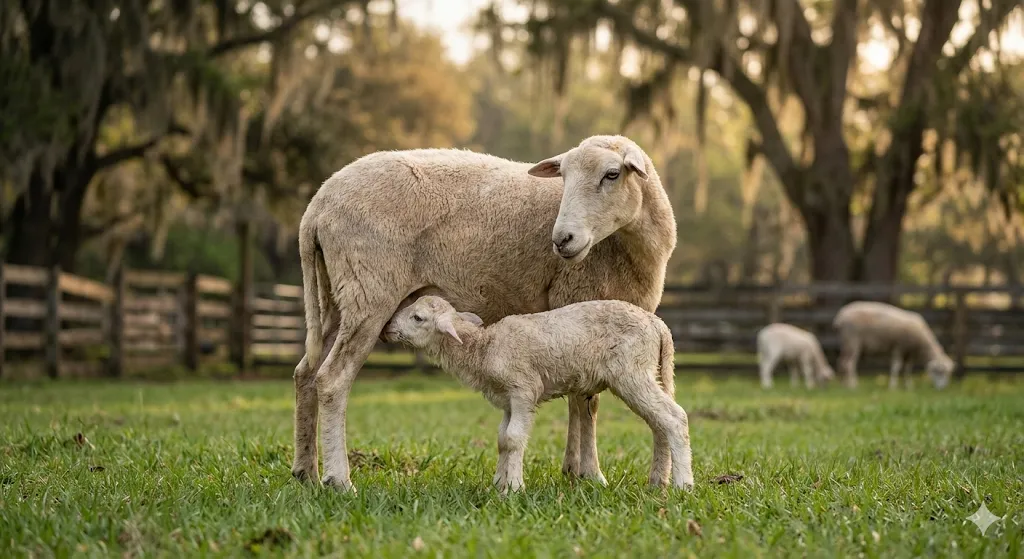
Its immunity arrives in a different form entirely — thick, golden, and warm — produced by its mother in the first hours after birth. If the lamb nurses in time, it absorbs something remarkable: a concentrated package of maternal antibodies, built through months of careful preparation, ready to defend a body that has never encountered the world before.
That's the science of colostrum. And this Saturday at Black Hammock Farm, students will learn exactly how it works — and why what happens in those first few hours after birth determines whether a lamb thrives or doesn't survive its first week.
The Only Vaccine Every Flock Needs — CDT
Of all the vaccines available for sheep, only one is universally recommended for every flock, everywhere: CDT.
CDT is a three-way vaccine that protects against two clostridial diseases and tetanus — all caused by bacteria that are already present in the environment. In soil. In feces. In the gut of healthy animals right now. Under normal conditions, these bacteria cause no harm. But under the right circumstances — a dietary shift, a wound, a sudden energy influx — they multiply explosively and produce fatal toxins with almost no warning.
Here's what CDT protects against:
C — Clostridium perfringens Type C: Causes hemorrhagic enteritis (bloody scours) in nursing lambs during their first weeks of life. Triggered by sudden feed changes or excess milk intake.
D — Clostridium perfringens Type D: Known as "overeating disease" or pulpy kidney. Affects lambs over one month old, often triggered by high-concentrate feeding.
T — Clostridium tetani: Tetanus, or lockjaw. Risk peaks at docking, castration, and disbudding — any procedure that creates an open wound. Can strike before any visible symptoms appear.
This is why lamb vaccination science is taught at CommunOT Farm & Programming farm labs — because understanding disease prevention in living systems is exactly the kind of real-world biology that makes learning stick.
The Colostrum Connection — The Most Powerful Protection Happens Before Birth
Here's the insight that changes how you think about lamb health management entirely: the most effective way to protect a newborn lamb is to vaccinate its mother before birth.
When a vaccinated ewe's immune system produces antibodies to CDT, those antibodies become concentrated in her colostrum — the thick first milk produced in the hours immediately following birth. When a newborn lamb nurses within that critical first-hour window, it absorbs those maternal antibodies directly through its gut wall. This passive immunity protects the lamb for its first six to eight weeks of life, covering the period when it is most vulnerable to Type C enteritis.
This is why ewe vaccination timing is one of the most important management decisions on a sheep farm. A lamb born to an unvaccinated or poorly vaccinated ewe enters the world without that protection already in place.
Visit communotfarm.com to learn more about how CommunOT uses real agricultural science like this to build meaningful learning experiences for children.
Timing Is Everything — The CDT Vaccination Schedule
Knowing what to vaccinate against is only half the picture. Knowing when is what determines whether it works.
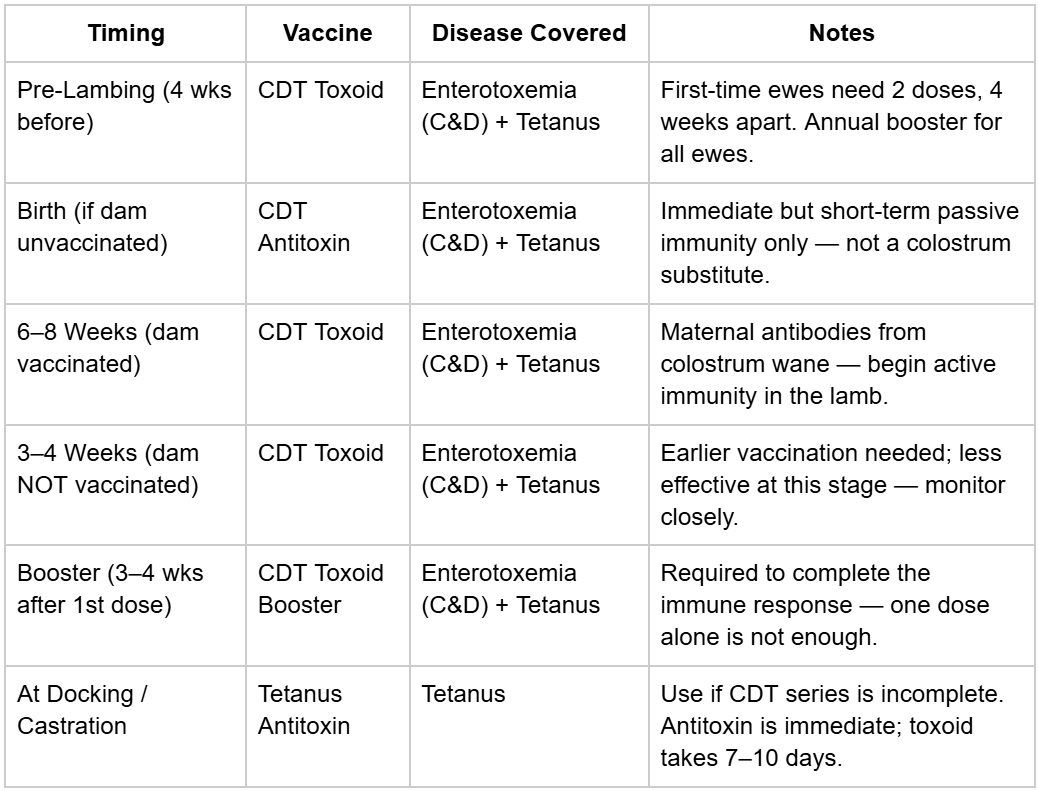
First-time mothers (primiparous ewes) require a two-dose primary series in late pregnancy, given four weeks apart. Their immune systems have not previously been primed, and a single dose won't generate sufficient antibody concentration in colostrum to reliably protect their lambs.
This is colostrum immunity and lamb vaccination science made tangible — and it's exactly what students explore during the Black Hammock Farm farm lab.
How Vaccines Are Delivered — SQ vs. IM Injection
How a vaccine is given matters just as much as what it contains. CDT and most clostridial vaccines are administered subcutaneously (SQ) — under the skin, not into the muscle. Using the wrong route reduces effectiveness and can cause unnecessary tissue damage.
Subcutaneous (SQ) — The Correct Route for CDT
The needle is inserted under the skin at the base of a "tent" of skin pinched up from the body. Slower absorption, but less tissue damage. Always confirm the route on the vaccine label.
Intramuscular (IM) — Used for Some Vaccines & Medications
The needle is inserted into muscle tissue, typically the neck or hindquarter. Faster absorption but higher risk of injection-site reactions and carcass blemishes. Never use IM for CDT unless the label specifically permits it.
A few other essentials for safe vaccine administration:
Needle selection: Use 18- or 20-gauge needles. Change needles frequently — ideally one fresh needle per animal.
Injection site: For market or show animals, the axilla (armpit area) avoids visible blemishes on commercially relevant tissue.
Storage: Refrigerated, protected from light and temperature extremes. Never use expired, frozen, or heat-damaged vaccines.
Record keeping: Document every administration — what was given, dosage, lot number, expiration date, and date administered.
When CDT Isn't Enough — Situational Vaccines
CDT is universal — but some flocks need more depending on regional disease pressure and flock history. These are never standard recommendations; they require veterinary guidance and knowledge of your specific situation.
Soremouth (Orf): A live vaccine for a viral skin disease affecting mouth and feet. Important: orf is a zoonotic disease that can spread from sheep to humans. Wear gloves.
E. coli Scours: A pre-breeding ewe vaccine that transfers immunity through colostrum, or an oral antibody product given directly to high-risk newborns at birth.
Abortion Vaccines (Vibrio / Chlamydia): Administered before breeding. Ewe lambs require a three-dose series for full protection in their first breeding season.
Foot Rot (FootVax): Best administered before the wet season — late winter to early spring in Florida.
8-Way Clostridial (Covexin-8): Expands coverage to include blackleg. For most Florida flocks, CDT alone is sufficient.
Learn more about how CommunOT Farm & Programming connects this kind of agricultural science to real learning outcomes for children in Central Florida.
The OT Connection — Systems Thinking in the Pasture
There's something else happening when a student traces the path from a ewe's vaccination to a lamb's immunity at birth. They're not just learning biology. They're practicing systems thinking — tracing a decision to an outcome across time, through a living system they can see and touch.
For children with developmental differences, this kind of sequential reasoning — if this happens now, then that happens later — supports executive function development, cause-and-effect comprehension, and scientific literacy. It also builds on themes of care, protection, and interdependence that are central to OT-informed social-emotional learning.
That's the quiet power behind every activity CommunOT Farm & Programming designs: the science and the therapy are the same experience.
See It for Yourself This Saturday
This Saturday, March 14th, students will explore lamb vaccination science and colostrum immunity firsthand — at Black Hammock Farm in Oviedo, guided by occupational therapists and a working farm family during the height of lambing season.
Event Details:
Date: Saturday, March 14, 2026
Time: 10:00 – 11:30 AM
Location: Black Hammock Farm, Oviedo, FL
Cost: $30 per student
Ages: 2–18 · All learners welcome
👉 Reserve your spot at communotfarm.com
A lamb's protection begins before it's even born — with a decision its mother's shepherd made weeks earlier. That's not just good farming. That's a science lesson worth showing up for.
CommunOT Farm & Programming is a pediatric occupational therapy organization based in Seminole County, FL, dedicated to integrating sensory-rich, nature-based experiences into developmental programming for children ages 2–18. Register and learn more at communotfarm.com.

