Denied Agricultural Classification in Seminole County
Denied Agricultural Classification in Seminole County? Read This First
Seminole County mailed our denial in September 2025.
A single page from the Property Appraiser’s office stating that 4.653 acres of active Katahdin sheep pasture at 1579 Walsh Street did not qualify as agricultural land under Florida Statute 193.461. That land has been grazed continuously since 2020. Satellite imagery confirms the presence of livestock dating back to 2014. The next-door parcel, with substantively identical characteristics, currently carries an agricultural classification. So do roughly 33 other parcels within a half-mile radius. We were not denied because the land does not qualify. We were denied because the standards were not applied to us the way they have been applied to our neighbors.
If you are reading this in late May or early June, the letter is probably already in your mailbox. The instinct is to react — to call the appraiser, to argue, to vent. None of that helps. The work ahead is documentary and procedural, not rhetorical. This piece is the map for the first 25 days — what the denial means, why it is happening more than it used to, what your three immediate legal options are, and what to do in the first 72 hours to protect your appeal.
This is the first installment of The Denied G1 Series— a twelve-post field guide built from Black Hammock Farm’s own ongoing fight before the Seminole County Value Adjustment Board. Petition #2025-1003 is still open as of this writing. We are not writing from theory. We are writing from inside the fight.
Quick Answer
What should I do if Seminole County denies my agricultural classification?
A denial from the Seminole County Property Appraiser is not a final ruling. Florida Statute 193.461 protects bona fide good-faith commercial agricultural use, and the statutory burden of justifying a denial sits with the county. You have 25 days from the date on the denial notice to file a Value Adjustment Board petition with the Seminole County Clerk of the Circuit Court. The filing fee is $15. Filing the petition preserves your right to a hearing in front of a special magistrate and does not commit you to anything beyond that. Most denials in Seminole County are appealable. Many are reversed when the property owner presents organized evidence of continuous agricultural use, comparable G1 parcels in the area, and the statutory and case-law authority that governs agricultural classification. The hearing is informal. Most farmers self-represent successfully. The 25-day window is the only deadline that cannot be recovered.
Why Agricultural Denials Are Rising in Seminole County
Seminole County is one of the fastest-developing counties in Florida. Every parcel with an agricultural classification represents tax revenue that the county is not collecting at the residential or commercial assessment rate. The math is not subtle. On a parcel like ours, the difference between agricultural and residential assessed value is in four-figure-multiple territory — comparable G1 parcels in our subdivision carry assessed values of $180 to $209, while our residential-rate assessment for the same year was $470,587. The differential on one parcel is over a thousand-fold. When multiplied across hundreds of borderline parcels in east Seminole, the cumulative revenue implications are significant enough to create institutional pressure.
The Property Appraiser’s office does not set that pressure. But it operates inside it. Commissioner meeting minutes, long-range comprehensive plan documents, and the steady eastward push of new development against the Black Hammock Wilderness Area boundary are all on the public record. The institutional incentives have shifted, and the easiest path for a Property Appraiser’s office facing growth-driven revenue pressure is to find a colorable reason to remove the agricultural classification from any parcel where one is even arguably available. The result is a documented pattern: parcels that would have been approved without question ten years ago are now being denied using arguments that, in many cases, contradict the appraiser’s own historical findings on the same land.
This is not paranoia, and it is not a conspiracy. It is the operating context every farmer in this county now needs to understand before opening that denial letter. The county is not denying you because you are a bad farmer. The county is denying you because the line between rural and developed Seminole has become contested ground, and the property tax classification is one of the levers being pulled on. Understanding that does not make you cynical. It makes you prepared. Florida law has not changed. The statute, the case law, the administrative code, and the constitutional protection for agricultural land are all the same as they were the day the agricultural classification was enshrined. The Value Adjustment Board exists precisely for the moment when an individual application of the law does not match the law itself.
What the Denial Notice Actually Says — And What Sits Behind It
The denial letter is short. It will reference Florida Statute 193.461. It will state that the Property Appraiser has determined your land is not being used primarily for bona fide good-faith commercial agricultural purposes. It will identify the parcel by its parcel ID. It will give you the date the determination was made — and that date is what starts your 25-day clock. Read it carefully, but do not over-read it. The short letter is the conclusion. The reasoning sits in a separate file.
Beneath that short letter is a much longer document that the Property Appraiser’s office builds for every denied parcel. That file typically includes satellite imagery, sometimes spanning a decade or more, marked up with the appraiser’s interpretation of what the imagery shows. It includes a narrative summary of the office’s reasoning. It will name the specific argument (s) used to support the denial. In our case, the SCPA file was a 24-page presentation submitted to the VAB magistrate. The arguments were detailed. The arguments were also, in significant part, contradicted by the office’s own evidence — a November 2023 infrared satellite analysis that confirmed 90 percent pasture usability after Hurricane Idalia, and a May 2021 internal note labeling the same parcels “Fully Grazeable.”
You are entitled to that file. Request it in writing from the Seminole County Property Appraiser’s office as soon as the denial arrives. Do not wait for it to be offered. The office will provide it upon request, and you will need every page to mount a serious response. Read it as evidence, not as judgment. The appraiser is making an argument. Arguments can be tested. Arguments can be refuted. Arguments can be contradicted by the appraiser’s own prior findings, which, in our case, is exactly what the record shows.
The 25-Day Petition Clock — What Happens If You Miss It
The 25-day window is the most important deadline in this entire process. Florida law gives every taxpayer the right to petition the Value Adjustment Board to review a Property Appraiser’s classification decision. That right exists for 25 days from the date the denial notice was issued. After 25 days, the right to appeal expires for that tax year. There is no extension. There is no good-cause exception. The clock starts the day the letter is dated, and it does not stop.
If you miss the window, the agricultural classification will be denied for the current tax year. You can reapply next year — agricultural applications are due to the Property Appraiser by March 1 annually — but you will pay the residential or commercial assessment for an entire tax year, you should not have to. On a parcel like ours, that differential is measured in tens of thousands of dollars per year. Missing the petition window is the single most expensive mistake a denied farmer can make.
Filing the petition itself is straightforward. You complete a one-page form (DR-486 from the Florida Department of Revenue, available through the Seminole County Clerk’s office), pay a $15 filing fee, and submit it to the Clerk of the Circuit Court. That is the entire mechanical act. Filing the petition does not commit you to anything beyond preserving your right to be heard. You can settle with the appraiser’s office later. You can withdraw the petition later. You cannot get the 25 days back. Treat the petition as a placeholder — it protects your seat at the table while you build the evidence binder and the argument that you will actually present at the hearing.
File first. Decide second. The $15 fee is the cheapest insurance policy in Florida property tax law — it buys you 60 to 120 days to figure out whether to settle, withdraw, or fight, all without losing the right to fight.
The Three Arguments Seminole County Will Use Against You
Every denial we have reviewed in Seminole County uses one or more of three standard arguments. They are predictable because the Property Appraiser’s office uses essentially the same template each year, adapted to the specifics of each parcel. Knowing them in advance lets you prepare evidence against each one before the hearing.
Subsequent posts in this series go deep on each of the three arguments. Post 7 dismantles the wetlands argument with the actual administrative code language and the Florida Department of Revenue productivity guidelines. Post 8 dismantles the primary-use argument with the statute and appellate case law that explicitly state that homestead and agricultural classification coexist. Post 10 covers comparable property analysis — how to use the appraiser’s own approvals of neighboring parcels to demonstrate that the same standards have not been applied uniformly to yours.
What Seminole County Did to Black Hammock Farm
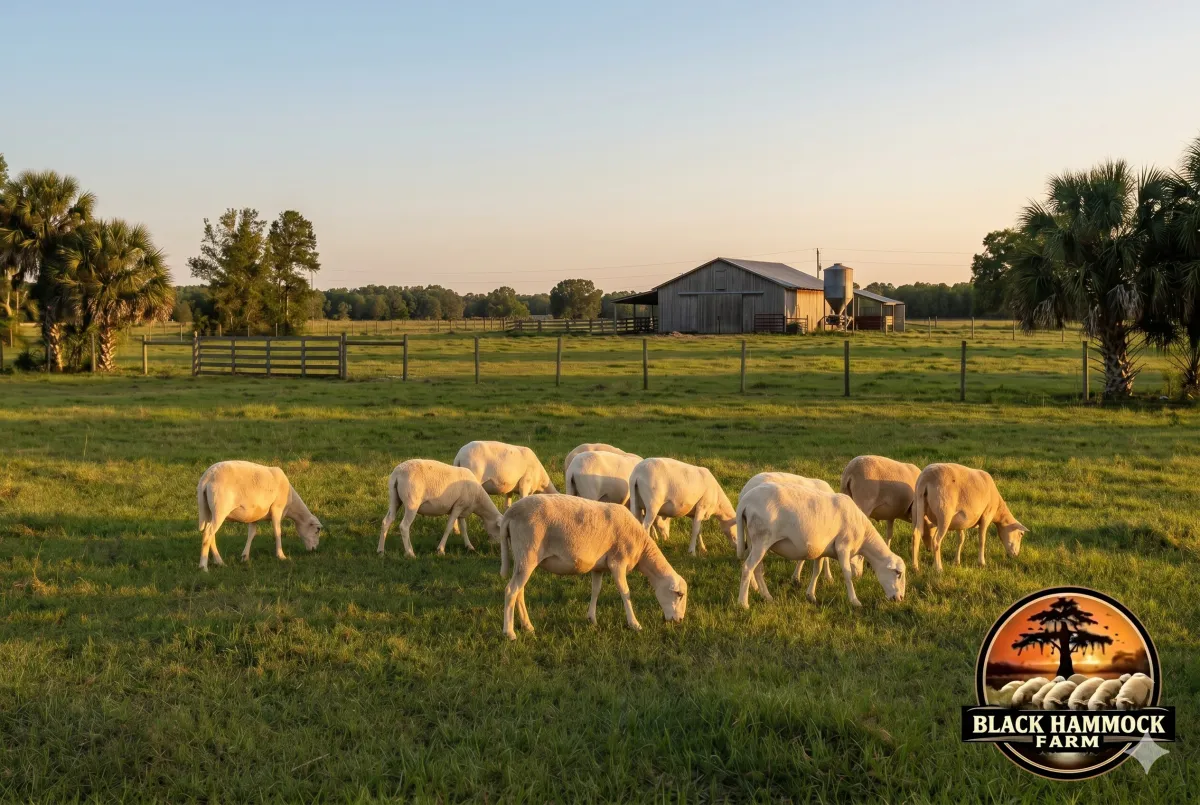
In September 2025, the Seminole County Property Appraiser denied agricultural classification on Parcel 05-21-32-5CD-0000-049B at 1579 Walsh Street, Oviedo. The parcel is 4.653 acres. It is part of Black Hammock Farm — a working Katahdin sheep operation with pigs, poultry, and active rotational grazing across more than 10 acres of managed pasture, some owned and some leased from neighboring landowners. We were not new to the operation. We had been grazing the property continuously since 2020. Satellite imagery documenting livestock presence went back to 2014.
The denial used all three of the standard arguments. The appraiser claimed that the residential homestead was the property's primary use. The appraiser claimed the operation lacked commercial viability. The appraiser claimed more than half the property was wetland that was, in the office’s words, “literally underwater a significant portion of the time.” Each of those claims was contradicted by the appraiser’s own evidence. The office’s own November 2023 satellite imagery — taken in the aftermath of Hurricane Idalia — showed 90 percent usability across the property. The office’s own historical record from May 2021 labeled the pastures “Fully Grazeable.” The 4.653-acre parcel carried roughly one acre of residential footprint against four acres of active grazing, an 80 percent agricultural footprint that the office somehow read as residential primary use.
Then there was the comparison problem. The parcel immediately adjacent to ours, with substantively identical characteristics, currently carries an agricultural classification. So do roughly 33 other parcels within a half-mile radius — 26 of them with G1 Grazing Land status, five with HX Cutout AG Homestead status, and two with G1 Ornamental. The parcel directly behind us was assessed at $180 in agricultural value. Our parcel, denied that same classification despite identical use, was assessed at $470,587. A 1,007-fold differential on physically equivalent land. We were not denied because our land does not qualify. We were denied because the standards were not applied uniformly to us. That inconsistency is itself a legal argument — under Florida’s uniformity-of-taxation requirements and the equitable estoppel doctrine the appellate courts have applied to property tax cases — and it is one of the strongest arguments a denied farmer can bring to the Value Adjustment Board.
We are still in the fight. Petition #2025-1003 is filed. Our evidence binder runs to 21 pages of documented use across more than a decade — eleven satellite images from 2014 to 2025, eight ground-level photographs spanning 2020 through 2025, multi-year viability metrics for each pasture, and a comparable-properties map identifying every approved G1 parcel within a half-mile radius. The hearing is scheduled. The outcome is not yet decided. But the playbook in this series is the playbook we are using ourselves, in real time, with the actual filings going to the actual magistrate. We are not writing this from theory. We are writing it from the inside.
The First 72 Hours After the Denial Letter Arrives
The first three days set the tone for everything that follows. The instinct is to react — to call the appraiser’s office, to argue, to vent. None of that helps. The work is documentary, not rhetorical. The sequence below is the one we used ourselves, refined from our own case and from conversations with other Seminole County farmers who have been through this before. Notice what is not on the list: arguing with the appraiser’s office over the phone, posting publicly about the denial, and hiring an attorney before reading the appraiser’s file. Each of those instincts is understandable. Each of them gives away ground. Save the energy for the magistrate.
By Day 25 the petition is filed, the appraiser’s internal file is in your hands, and the foundation of the evidence binder is built. The hard work, assembling the evidence into a magistrate-ready presentation, drafting the legal argument, preparing for the hearing itself, happens in the 60 to 120 days between filing and the scheduled hearing date. The 25-day window is just the gate. Pass through it, and the real fight has room to breathe.
What the Series Looks at Next
The next blog in The Denied G1 Series, publishing June 1 — the day Seminole County mails its denial notices — is the close-up on the letter itself. What the January 1 assessment date actually means, how to read every line of the notice, what to do the morning the envelope arrives, and why the timing of June 1 is structural rather than coincidental. The eleven posts that follow walk the full statute, the VAB petition mechanics, the evidence binder, the three denial arguments in depth, the magistrate hearing, the comparable-property tactic, the real tax math behind every denial, and the broader case for keeping rural Florida rural. For Seminole County farmers reading this in the days before or after their own denial letter arrives, the series is the field guide we wish we had when ours landed in September 2025.
Frequently Asked Questions
Do I need a lawyer to appeal a denial of agricultural classification in Seminole County?
No. Florida law allows any property owner to self-represent before the Value Adjustment Board, and most denied farmers do. The hearing is informal — there are no rules of civil procedure, no opposing counsel cross-examining you, no jury. You present evidence to a special magistrate who reviews property classification appeals as a regular part of their work. A lawyer can help if your case is unusually complex, involves multiple parcels, or if you are not comfortable presenting in person. For most denied farmers, the $15 petition fee plus a few weekends of preparation is enough. If you do retain counsel, hire a Florida property tax attorney with VAB experience specifically — not a general practitioner.
How much does it cost to file a VAB petition in Seminole County?
The filing fee is $15 per petition. You file with the Seminole County Clerk of the Circuit Court, which administers the Value Adjustment Board for the county. There are no additional county fees to schedule the hearing or to receive the magistrate’s decision. The only other costs are whatever you spend preparing evidence — printing photos, ordering certified records, optionally hiring an expert if your case involves specialized issues like wetland delineation. The $15 fee is the gate. Everything beyond it is preparation, not cost.
What is the difference between agricultural classification and homestead exemption?
They are two different tax mechanisms that can apply to the same parcel simultaneously. Homestead exemption reduces the taxable value of your primary residence. Agricultural classification changes how the land portion of your parcel is assessed — from market value to agricultural use value, which is often a small fraction of market value. Florida Administrative Code 193.461(3)(b) explicitly states that a dwelling occupied by the owner does not disqualify a parcel from agricultural classification. The two coexist by design, and any argument that they cannot is contrary to the law. Post 8 in this series walks through the statute and the appellate case law in detail.
How many animals do I need to qualify for agricultural classification in Florida?
There is no statutory minimum number of animals or minimum acreage for agricultural classification in Florida. The University of Florida IFAS Extension has confirmed this in published guidance. What matters is whether the land is used primarily for bona fide good-faith commercial agricultural purposes — meaning the operation produces something agricultural, that production is intended for commercial use, and the use is made in good faith. A small operation with documented sales records, consistent management, and continuous use qualifies. A token operation set up to capture tax benefits does not. For grazing operations, IFAS recommends a stocking rate of 2 to 5 sheep per acre for Florida pastures.
Can the Property Appraiser deny me again next year if I win this appeal?
Agricultural classification is granted annually, and the appraiser reviews classifications each year. However, a successful VAB ruling creates a documented record that the operation qualifies under the statute as applied to your parcel. A subsequent denial that contradicts a recent VAB ruling, without a material change in the operation, would be vulnerable to a new appeal on substantially the same evidence. Florida case law also recognizes equitable estoppel — a doctrine that limits a government’s ability to reverse positions in ways that cause financial harm to citizens who relied on the original position. Win once, document well, and the second denial becomes harder for the appraiser’s office to sustain.

