Why Seminole County Really Denies Agricultural Claims
The Real Reason They Denied You (And It Isn’t Your Farm)
Here is the question that almost no denied farmer asks out loud, even though it is the only question that explains what is happening.
If the farm has been here for thirty years, if the pasture is still pasture, if the livestock are still grazing, if the agricultural use of the land has not changed in any meaningful way — why is the agricultural classification being denied now?
The answer that the Seminole County Property Appraiser’s office will offer, in the one-page denial notice and in any subsequent correspondence, is that the property no longer meets the statutory standard for “bona fide good-faith commercial agricultural purposes” under Florida Statute 193.461. That answer is the legal scaffolding. It is not the explanation.
The explanation is on the public record. It is in the county’s certified assessment roll. It is in the FY 2025–26 budget the Board of County Commissioners adopted last September. It is in the two-decade fight over the Rural Boundary on the east side of the county. It is in the legislative session that just ended in March 2026, where two state senators tried to use Tallahassee to do what local development applications and lawsuits have so far failed to do. The institutional context for what is happening to Florida farms inside fast-developing counties is documented, public, and not particularly subtle. The point of this post is to lay that context out plainly — with sources — so the farmer reading the denial notice understands that the denial is not really about the farm.
Quick Answer
Why has Seminole County been denying agricultural classifications at an elevated rate over the past few years?
The institutional incentives have shifted, even though Florida Statute 193.461 has not. Seminole County’s 2026 population is approximately 495,000 with projected growth of more than 100,000 residents over the next two decades. The county’s east-side Rural Boundary— 74,413 acres voter-approved in 2004 — sits in the path of that growth, and developer challenges through proposed projects like River Cross, the Pappy’s Strawberry Patch application, and the 2026 legislative session’s Senate Bill 208 have so far been turned back. With the legislative and zoning routes blocked, agricultural classification status becomes the practical lever: a working farm classified residential rather than agricultural pays property tax on the parcel’s full market value rather than its agricultural use value, often a 100-fold or higher increase in assessed value. The result is documented across the eastern part of the county — long-established working farms receiving denials on land that has not materially changed. The pattern is not subjective. It is in the assessment roll, the budget, and the public record. The legal remedy is the same regardless of why the denial was issued: file the Value Adjustment Board petition within the 30-day window, build the evidence binder, and answer Florida Statute 193.461 with the actual facts on the ground.
The Numbers the County Publishes About Itself
A working farm denied agricultural classification does not simply lose a tax benefit. It crosses a line in the county’s revenue model. The math is published, every year, in budget documents and assessment roll certifications that any property owner can read. We will lay out what the Seminole County government has said about itself in 2025, then come back to what that says about classifications.
Seminole County’s certified FY 2025–26 budget totals $1,215,087,959. The total certified valuation of property — real and personal — subject to assessment for that fiscal year is $57,409,983,507. To balance that budget, in September 2025 the Board of County Commissioners voted 4–1 to increase the countywide general fund millage rate from 4.8751 to 5.3571 mills — the first increase in approximately 16 years and, per Oviedo Community News, the first since 1995 in some accounts. The Local Option Gas Tax was raised from six cents to eleven cents per gallon. The Utility Services Tax was increased in unincorporated areas. The millage rate increase alone was projected to generate approximately $27 million in additional annual revenue. The county was working to close a $35 million deficit.
County Manager Darren Gray, in his budget message, framed the choice this way: “That disconnect forces difficult choices. We must either reduce our services or identify new revenues that allow us to keep up with demand.” Commissioner Andria Herr, supporting the millage increase, said the county “can’t cut our way out of this.” The Board voted 4–1 to raise the rate. The mechanics of property tax revenue in Florida are straightforward: the Property Appraiser certifies the assessed value of every parcel in the county on or before July 1, the Board of County Commissioners sets the millage rate, the two numbers multiply to determine the property tax owed.
Here is what that means in practical terms for any rural parcel under agricultural classification. Florida agricultural classification, established by Florida Constitution Article VII, Section 4(a) and implemented through Florida Statute 193.461, assesses qualifying agricultural land “solely on the basis of its character or use” rather than its market value. A parcel of grazing pasture might carry an assessed value of $200 per acre under agricultural classification. The same parcel, classified residential or commercial, might carry an assessed value of $100,000 per acre or higher depending on the development potential and the surrounding market. The math on the difference is straightforward, and it is the same math the county itself does when it certifies the tax roll. A working farm denied agricultural classification on a 4-acre parcel can see the assessed value of that parcel increase from a few hundred dollars to several hundred thousand dollars — a 100-fold to 1,000-fold change in the tax base for that single property.
The Rural Boundary and Two Decades of Pressure on It
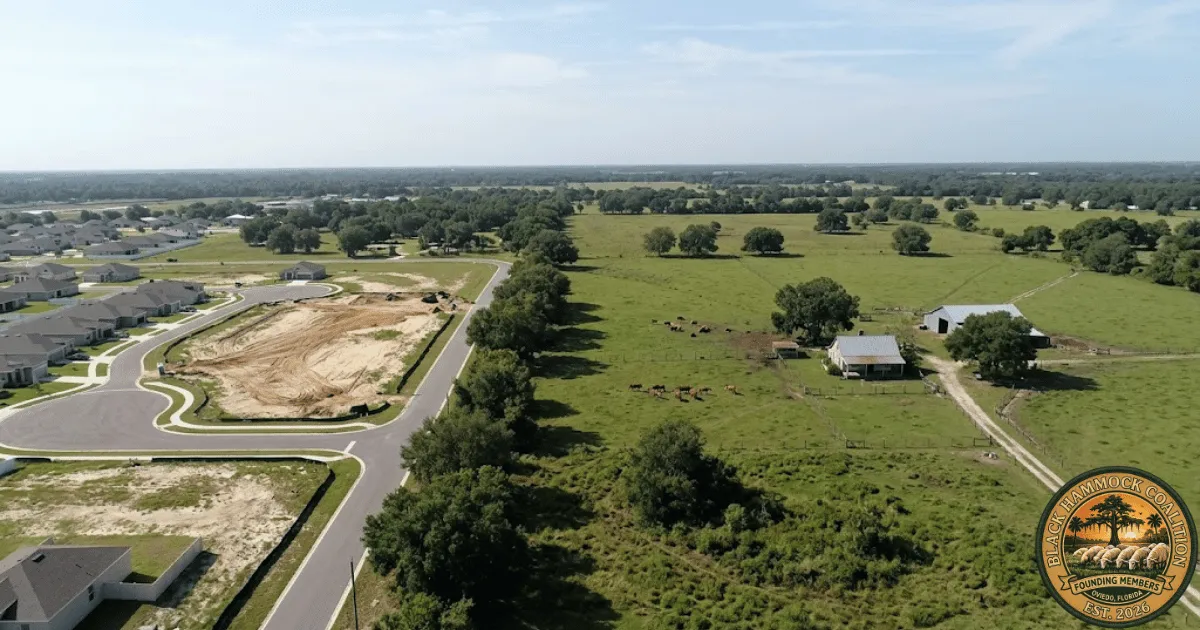
The east side of Seminole County is not just rural in character. It is rural by direct voter mandate. In 2004, voters approved the Seminole County Rural Boundary— a defined area of 74,413 acres encompassing the Black Hammock Wilderness Area, the Geneva Wilderness Area, the Lake Procter Wilderness Area, the Lake Harney Wilderness Area, the Chuluota Wilderness Area, and a network of working farms, prairie, pasture, and rural homesteads. The boundary set the zoning at one home per three acres or one home per ten acres. The vote was decisive. The boundary has been a structural fact of the county’s zoning ever since.
The boundary has also been under continuous developer pressure for most of the last decade. A short timeline of the public record:
This is not commentary. This is the timeline of attempts — through development applications, through litigation, through legislation — to convert protected rural acreage on the east side of Seminole County into developable land. Each attempt has been beaten back. The voter-approved boundary remains in place. The legal fights continue.
What this timeline does not show, because no single year of records would show it, is the slower, less visible mechanism that operates in parallel: the per-parcel reclassification of working farms inside the rural boundary from agricultural to residential status. A rural boundary does not lose its protected status when an ag classification is denied. The zoning is unchanged. But the economic pressure on the small farmer changes overnight. A 4-acre parcel that paid $40 in property tax under agricultural classification might pay $4,000 under residential classification — not because the land changed, but because the assessed value changed. Over time, that pressure can produce willing sellers where the legislature, the lawsuit, and the development application could not.
The Rural Boundary is one of the strongest land-use protections in Central Florida. It survived 2018. It survived 2021. It survived 2026. But a boundary is only as strong as the working farms inside it. When the farms become economically untenable, the boundary becomes scenery. The classification fight is the boundary fight on a different terrain.
What “Documented Pattern” Actually Means Here
Two clarifications are important. First, this post is not a claim of intentional misconduct by any individual in the Seminole County Property Appraiser’s office. The Property Appraiser is a separately elected constitutional officer who sets his own budget under the supervision of the Florida Department of Revenue. The employees doing the agricultural classification reviews are following internal guidelines, internal interpretation of the statute, and the priorities set by elected leadership. No allegation here is about individual bad faith. The pattern is institutional, and the institutional incentives are the subject.
Second, when this series uses the phrase “documented pattern,” it means exactly that — a pattern visible in public records and not inferred from suspicion. The records are these:
The annual Seminole County Property Appraiser tax roll certifications, available for download through the SCPA Downloads section in Excel, MS Access, and GIS formats, updated daily.
Individual parcel records, searchable on the SCPA Record Search by parcel ID, address, or owner, which show the classification history of every parcel year by year.
The county’s certified FY 2025–26 budget documents, available on the Seminole County government website, including the full $57.4 billion assessment roll figure and the millage rates by taxing authority.
The Seminole County Board of County Commissioners’ voting record on the millage rate increase, in the public record of the September 2025 budget hearings.
Published reporting on the rural boundary fights from Oviedo Community News, ClickOrlando, and the Orlando Sentinel, dating back to the 2018 River Cross application.
The 2026 Florida Senate Bill 208 / House Bill 399 amendment and the floor debate transcripts archived in the Florida Senate’s legislative history.
In our own VAB case — Black Hammock Farm, Petition #2025-1003 — we identified 33 parcels carrying current agricultural classification within a half-mile radius of our denied parcel. Twenty-six carried G1 Grazing Land classification. Five carried HX Cutout AG Homestead classification. Two carried G1 Ornamental classification. The Black Hammock parcel is physically equivalent in pasture acreage to the closer comparables and is geographically inside the same growing conditions, the same soils, and the same hydrology. The comparable parcels carry assessed values in the $180 to $209 range. Our parcel, reclassified residential after a continuous agricultural use back to at least 2014, was assessed at $470,587. The differential is approximately 1,007-fold on physically equivalent land. The 33 comparable parcels are described in detail in Post 10 of this series. The methodology for finding the comparables on your own parcel is in the Battle Pack.
What This Means for Your Appeal
None of the institutional context above changes the legal standard that governs your Value Adjustment Board hearing. The hearing magistrate will not be persuaded by an argument that the county needs revenue, that the rural boundary is under pressure, or that developers have tried for years to crack the east side. Those facts are real, but they are not the right argument at the magistrate hearing. The right argument at the magistrate hearing is Florida Statute 193.461, the Florida Administrative Code, the specific facts of the parcel, and the documented comparable properties.
What the institutional context does change is the disposition of the farmer reading the denial. There is a difference between fighting a denial as a personal failure — as if the appraiser is somehow telling you that your operation is not real, that your years of work do not count, that you are not a real farmer — and fighting a denial as a procedural matter inside a system whose incentives have nothing to do with you. The first framing is corrosive. The second framing is correct, and it is the framing the magistrate hearing actually rewards.
When you walk into the VAB hearing, you walk in as a working farmer with a documented operation, a parcel that meets the statutory standard, an evidence binder built around the actual record of agricultural use, and a list of comparable properties. You do not walk in carrying the institutional incentives of a county budget process. Those incentives exist. They are real. They explain a great deal of what is happening at the system level. But they are not your problem to solve in the hearing room. The hearing room is where the law gets applied, parcel by parcel, on the basis of the evidence you put in front of the magistrate. That is the venue. That is the language. That is the work.
The Quiet Constitutional Question
There is one more piece of public record worth mentioning before this post closes. Florida Constitution Article VII, Section 4(a) does not describe agricultural classification as a tax expenditure, a benefit, or a discretionary state subsidy. The constitutional text authorizes the legislature, by general law, to provide that agricultural land “may be classified by general law and assessed solely on the basis of character or use.” The implementing statute — Florida Statute 193.461 — uses mandatory language: “The property appraisershall, on an annual basis, classify for assessment purposes all lands within the county.” The relevant regulation, Florida Administrative Code 12D-5.003, uses mandatory language: “The property appraisershall notdeny agricultural classification solely because of the maintenance of a dwelling on a part of the lands used for agricultural purposes.”
Agricultural classification is not a favor the county does for farmers. It is a constitutional commitment, implemented through mandatory statute and mandatory administrative rule. The county has the burden of demonstrating that a specific parcel does not meet the statutory standard. The farmer does not have the burden of proving that the constitutional commitment should be honored. When the institutional incentives push in a direction that begins to treat that commitment as discretionary, the corrective venue is the Value Adjustment Board hearing, the circuit court if necessary, and the public record. The next post in this series, publishing June 7, walks Florida Statute 193.461 line by line in plain English — what it requires, what it does not require, and how the words on the page can be used in the magistrate hearing to answer the denial.
Frequently Asked Questions
Is the Property Appraiser deliberately targeting working farms inside the rural boundary?
There is no public record evidence of an explicit instruction to deny applications inside the rural boundary specifically. The Seminole County Property Appraiser is a separately elected constitutional officer, accountable to county voters and supervised by the Florida Department of Revenue. What the public record does show is that institutional incentives at the county budget level have shifted, that agricultural classification denials produce significantly more tax revenue per parcel than approvals, and that working farms inside the rural boundary have experienced denials at an elevated rate in recent years. The pattern is documented at the parcel level through the SCPA’s own public records, which any property owner can search. Whether the pattern reflects intentional policy, internal interpretation of the “primary use” standard, or some combination of factors is a question for the public record, the magistrate hearings, and ultimately the courts. The series treats it as documented institutional context, not as personal misconduct by any individual.
If the Rural Boundary is still in place, why does this matter for my parcel?
The Rural Boundary controls zoning — what can be built on the land, in what density, with what infrastructure. The Rural Boundary does not control how land is classified for assessment purposes. A parcel inside the Rural Boundary can carry zoning that permits only one home per three acres while simultaneously being denied agricultural classification by the Property Appraiser. The two systems operate in parallel. When agricultural classification is denied, the parcel’s assessed value reverts to a market-based calculation, which in fast-developing areas can be one hundred times higher than the agricultural use value. The Rural Boundary protects the land from being subdivided and developed. It does not protect the working farmer from being assessed as if the land could be subdivided and developed. Both protections are necessary. The classification appeal preserves the second one.
Should I raise the institutional context at my VAB hearing?
No, not directly. The magistrate’s authority under Florida Statute 194.011 and the Florida Department of Revenue’s Chapter 12D Property Tax Rules is limited to determining whether the parcel meets the statutory standard for agricultural classification. The magistrate cannot adjudicate county budget priorities, rural boundary politics, or the broader institutional pattern. What the magistrate can adjudicate is whether the specific parcel meets the “primary use” standard, whether the comparable properties are being treated consistently, and whether the appraiser’s reasoning aligns with Florida Administrative Code 12D-5.003 and the related rules. Frame the case in those terms. The institutional context belongs in the public conversation, in newsroom coverage, and in the longer record. It does not belong in the magistrate hearing room.
Where do I find the comparable properties to support my appeal?
The Seminole County Property Appraiser’s Record Search tool at scpafl.org allows you to search parcels by address, parcel ID, or owner name. The SCPA also publishes daily-updated downloads in Excel, MS Access, and GIS formats through the Downloads section, which allow you to filter parcels by classification, acreage, neighborhood, and other criteria. The Battle Pack download referenced at the end of this post includes a detailed methodology for identifying comparable parcels within a half-mile radius, documenting the classification of each, and producing the comparison table that becomes a central exhibit in the VAB filing. Post 10 in this series walks the comparable-properties exhibit in detail.
What is the role of the Florida Department of Revenue in all of this?
The Florida Department of Revenue (DOR) is the state agency responsible for administering Florida property tax law, including the agricultural classification framework. The DOR publishes the official Form DR-486used for VAB petitions, the VAB Calendar of statutory deadlines, the Chapter 12D Property Tax Rules that govern county appraiser procedures, and the audits of county appraiser offices for compliance. The DOR does not directly review individual parcel classifications. It does establish the framework that county appraisers must operate within. When county-level practice diverges from the framework, the DOR’s rules and forms are the procedural baseline that VAB hearings, circuit courts, and ultimately the public record measure that divergence against. The Florida statutes are the law. The DOR rules are the operating manual. The county appraiser’s office is the implementer.
Sources & References
Every assertion in this piece is sourced to a publicly available document or published news report. The links below open the original sources directly so the reader can verify any claim. The discipline of this post is that the institutional context is itself a matter of public record — not opinion, not speculation, not allegation. The reader can confirm every word independently.
Florida statutes, regulations, and constitutional authority
Florida Statute § 193.461 — Agricultural lands; classification and assessment. The controlling statute. Mandatory language: “The property appraisershall, on an annual basis, classify for assessment purposes all lands within the county.” (Florida Senate, official statute text.)
Florida Statute § 194.011 — Assessment notice; objections to assessments. Governs the Value Adjustment Board petition procedure and magistrate authority.
F.A.C. § 12D-5.003 — Dwellings on Agriculturally Classified Land. The regulation prohibiting denial “solely because of the maintenance of a dwelling on a part of the lands used for agricultural purposes.”
Florida Constitution, Article VII, Section 4(a). The constitutional foundation for agricultural classification: assessment “solely on the basis of character or use.”
Florida Department of Revenue Property Tax Rules (Chapter 12D). The complete administrative rule framework governing county property appraiser conduct.
Form DR-486 — Petition to the Value Adjustment Board. The official Florida DOR VAB petition form.
Seminole County budget and tax roll documents
Seminole County FY 2025–26 Final Budget Document (PDF). The county’s certified $1.215 billion budget and $57.4 billion assessment roll figure. Includes the millage rate adoption resolutions, the Board voting record, and the County Manager’s budget message.
Seminole County FY 2025–26 First Public Hearing Document (PDF). Tentative budget and millage rate, September 10, 2025.
Seminole County Proposed FY 2025–26 Millage page. Plain-language explanation of the millage rate increase from 4.8751 to 5.3571.
Seminole County Property Appraiser — main site. Record Search by parcel ID, address, or owner. Downloads area provides daily-updated tax roll data in Excel, MS Access, and GIS formats.
SCPA Agricultural Classification page. Application procedures, contact information for the Agricultural Specialist (Travis Walker, 407-665-7544).
SCPA Guidelines for Agricultural Classification of Lands (PDF). The SCPA’s published internal guidelines.
Rural Boundary — legislative and litigation history
Oviedo Community News — The Rural Boundary, Explained (2022). The most comprehensive plain-language explainer of the 2004 voter-approved 74,413-acre boundary, the wilderness areas it encompasses, and the development history.
Oviedo Community News — Rural Boundary Survives the 2026 Legislative Session (March 2026). Coverage of Senate Bill 208 / House Bill 399 and the floor debate. Sen. Brodeur and Sen. Wright named as sponsors. Attorney David Bear quoted on the implications of the failed amendment.
ClickOrlando — Residents Sign Petition to Prevent Development on Rural Grounds (December 2021). Coverage of the Pappy’s Strawberry Patch 70-acre application.
ClickOrlando — Group Fights Development of Seminole County’s Rural Boundary (June 2018). The original River Cross application coverage. ~670 acres, ~600 homes, 500 apartments, 1.5 million sq ft retail.
Save Rural Seminole County — The Controversy. Documentation of the River Cross litigation timeline, court rulings, and the residential opposition movement.
Budget reporting — published news coverage
Oviedo Community News — Facing $35M Deficit, Seminole County to Vote on Increasing Property Taxes (July 2025). The $35 million deficit framing and the County Manager’s budget message.
ClickOrlando — ‘Difficult Choices:’ Property Tax Increase Looms for Seminole County Homeowners (July 2025). The 4–1 vote to approve the millage rate increase. Commissioner Herr’s statement that the county “can’t cut our way out of this.”
ClickOrlando — Property Tax Increase Public Hearing Coverage (September 2025). The $27 million additional annual revenue projection.
ClickOrlando — Initial Tax Increase Coverage (June 2025). The first reporting on the proposed rate increase and the breakdown of the $1.2 billion budget.
News 13 — Seminole County Commissioners Consider Property Tax Increase (June 2025). Coverage of the County Manager’s framing and the “first since 1995” statement.
Demographic and growth data
U.S. Census Bureau QuickFacts — Seminole County, Florida. Population and demographic baseline.
Florida Office of Economic and Demographic Research — Seminole County Area Profile (PDF). State-level demographic and economic projections for Seminole County.
Federal Reserve Economic Data — Resident Population in Seminole County, FL. Federal Reserve time series for population data, sourced from U.S. Census Bureau.

