Grazing for the Greater Good
Rent-A-Herd: When Sheep Work for the Community
Part 5 of 14 in the "Rooted in Heritage, Growing for Tomorrow" Series
The first thing people notice is the silence.
No diesel engines. No screaming leaf blowers. No wood chippers grinding vegetation into mulch. Just the soft tearing sound of sheep methodically working their way through overgrown brush, and occasionally, the contented bleating of animals doing exactly what they were designed to do.
The second thing they notice is the neighbors.
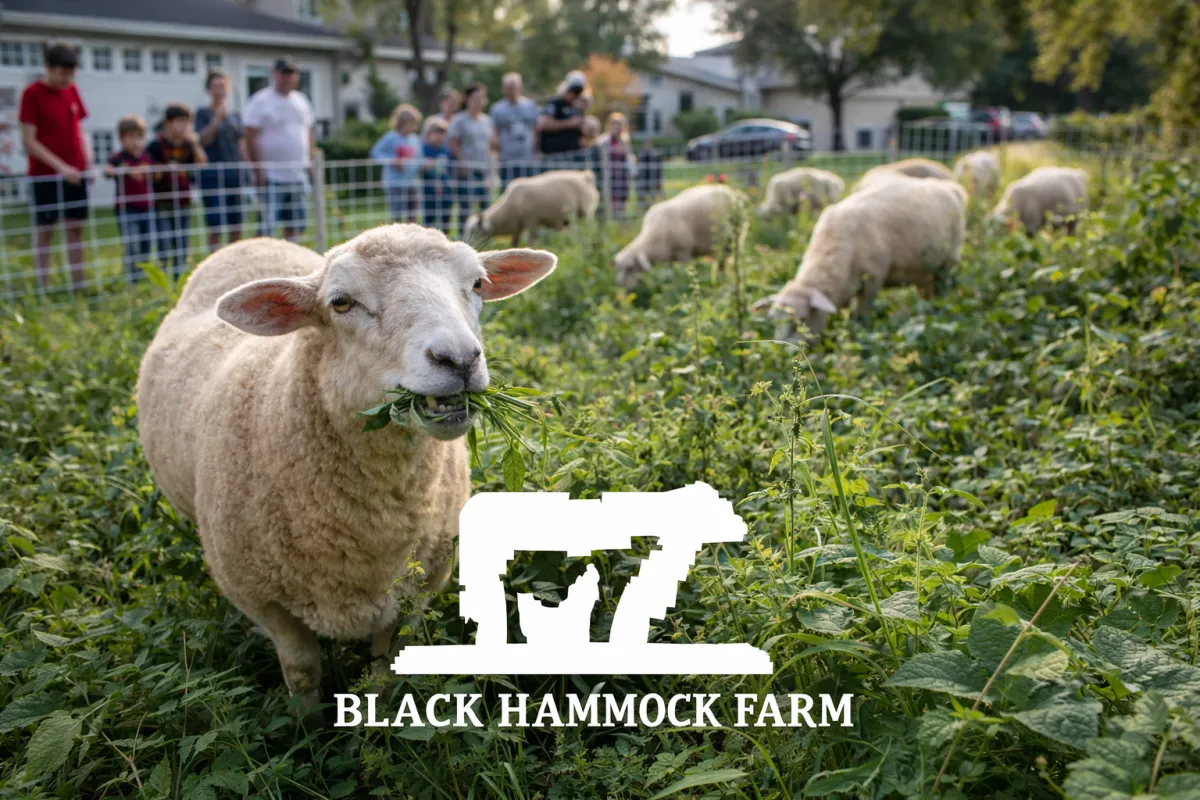
Within an hour of our sheep arriving at a property, people start appearing. They come out of houses, pause on sidewalks, pull over in cars. Children materialize as if summoned by some frequency only they can hear. Questions start flowing: What are they? Can I pet them? How long will they be here? Do they really eat all of that?
Land clearing becomes a community event. Vegetation management transforms into something people actually want to watch.
This is Rent-A-Herd.
The Problem We Solve
Every property owner in Central Florida knows the battle: vegetation that grows faster than you can cut it. Overgrown lots. Neglected fence lines. Brush that creeps in from every direction, especially during the rainy season when everything explodes into green chaos.
The traditional solutions all have drawbacks.
Chemical herbicideswork, but they poison the soil, risk contaminating groundwater, and leave dead brown patches that take months to recover. Many homeowners are increasingly uncomfortable spraying toxins where their children and pets play.
Mechanical clearingis effective but expensive. The machinery is loud enough to anger neighbors and disruptive enough to compact soil and destroy beneficial organisms. You're left with piles of debris to haul away or burn.
Manual labor—machetes, loppers, your own aching back—is admirable but limited. There's only so much any person can clear, and the vegetation will be back before you've recovered from clearing it.
What if there was another way?
How Rent-A-Herd Works
The concept is beautifully simple: we bring our Katahdin sheep to your property, set up portable fencing to contain them in the area you want cleared, and let them do what sheep have done for ten thousand years.
They eat.
Not just grass—though they certainly handle that. Katahdin sheep have remarkably diverse palates. They'll consume weeds that other animals ignore. They attack brush and brambles. They devour invasive species like kudzu and lespedeza that have colonized vast swaths of Florida.
Their narrow muzzles and unique dental structure let them graze plants close to the ground, managing undergrowth in ways that machinery simply can't replicate. They get into corners, along fence lines, around trees—anywhere vegetation grows.
And while they're eating your overgrowth, they're fertilizing your soil. Every sheep is a walking composting system, converting vegetation into natural fertilizer and depositing it directly where it's needed. No bags. No spreading. No synthetic chemicals.
When they're done—typically five to seven days for a residential lot, two to three weeks for larger properties—we pack up the fencing and take them home. You're left with cleared land, healthier soil, and the memory of the most entertaining lawn care crew you've ever employed.
No Chemicals. No Machinery. No Fossil Fuels.
I want to emphasize what Rent-A-Herd doesn't involve:
No herbicides.Not a single drop of chemical spray. The sheep handle vegetation through digestion, not poison. Your soil biology stays intact. Your groundwater stays clean. Your children and pets can play on the cleared land immediately.
No heavy machinery.No tractors compacting your soil. No mowers disturbing nesting wildlife. No trucks hauling debris to landfills. The sheep walk in on their own feet and walk out the same way.
No fossil fuels.The only energy consumed is the solar energy stored in the plants the sheep eat. Our transportation to and from your property is the only carbon footprint, and we're working to minimize even that.
In an era when we're all increasingly aware of environmental impact, Rent-A-Herd offers something rare: land management that actually improves the ecosystem rather than degrading it.
The Katahdin Advantage
Not just any sheep could do this work in Florida.
Traditional wool breeds suffer in our humidity. They overheat. They're susceptible to parasites that thrive in our climate. They require constant intervention just to survive, let alone work.
Katahdin sheep were developed specifically for challenging conditions. Their hair coat—not wool—sheds naturally with the seasons. They tolerate heat that would prostrate other breeds. They've evolved resistance to the parasites and diseases that plague livestock in the Southeast.
This means our Rent-A-Herd crews arrive healthy, work comfortably, and leave healthy. No stressed animals. No welfare concerns. Just sheep doing what sheep do best, in conditions that suit them.
And their temperament matters too. Katahdins are remarkably docile—curious about people, calm in unfamiliar settings, unbothered by the activity of residential neighborhoods. When your neighbors come to watch (and they will), the sheep don't panic. They might wander over to investigate, but they're more interested in the next patch of vegetation than in the audience.
This friendliness makes Rent-A-Herd feasible in settings where other livestock couldn't work. We've cleared properties in suburban subdivisions, near busy roads, adjacent to schools. The sheep take it all in stride.
Beyond Backyards
Residential properties are where Rent-A-Herd started, but we're thinking bigger.
Commercial propertiesoften have extensive grounds that require constant maintenance. Office parks, industrial facilities, storage yards—all face the same vegetation challenges as homeowners, just at larger scale. Sheep can handle acreage that would take crews of workers days to clear.
Municipal applicationsrepresent perhaps the greatest potential—and increasingly, local governments across America are waking up to this reality.
The Municipal Shift Is Happening
Something is changing in how cities and counties think about public land management.
From California to Georgia, municipalities are discovering what farmers have known for millennia: grazing animals can manage vegetation more sustainably—and often more cost-effectively—than traditional methods. Cities like San Francisco, Atlanta, and dozens of smaller communities have deployed goats and sheep on public lands. The results are compelling enough that the practice is spreading rapidly.
Why the shift? The math is starting to favor four legs over four wheels.
Roadside vegetation managementis a perpetual budget drain for every municipality. Miles of right-of-way requiring constant mowing, crews and equipment tied up for weeks, fuel costs that fluctuate unpredictably, and the liability exposure of workers operating near traffic. Targeted grazing offers an alternative: sheep work steadily regardless of fuel prices, they don't require workers in high-visibility vests dodging cars, and they leave behind fertilized soil rather than exhaust fumes.
Several Florida counties are already exploring pilot programs. The conversation is happening.
Wetland and retention pond managementmay be an even more natural fit. These areas are notoriously difficult to maintain with machinery—soft soils that won't support heavy equipment, slopes that are dangerous to mow, sensitive ecosystems where herbicide runoff causes more problems than it solves.
Sheep, by contrast, are light-footed. They navigate slopes easily. They consume vegetation without disturbing soil structure. And unlike chemicals, their "runoff" is organic fertilizer.
Seminole County maintains thousands of acres of conservation lands, retention areas, and public spaces. The current approach—mowers where accessible, herbicides where not, and benign neglect in the hardest-to-reach areas—is expensive and imperfect. Invasive species gain ground every year in places where traditional management can't reach.
We're Ready When They Are
I want to be clear: we're not criticizing how the county currently manages public lands. Municipal workers do difficult jobs with limited budgets, and they do them well.
What we're saying is that another tool exists. It's proven. It's sustainable. And it's available locally.
Black Hammock Farm has the herd. We have the portable fencing systems. We have the expertise in Katahdin sheep specifically suited to Florida's climate and terrain. We have the liability coverage and the professional systems to operate on public land.
If Seminole County—or any municipality in Central Florida—wanted to pilot a targeted grazing program on a retention pond, a park edge, a difficult-to-mow roadside section, or a wetland buffer zone, we could have sheep on site within weeks.
We're not asking for contracts or commitments. We're simply saying: the conversation is worth having. Other communities are having it. The results elsewhere have been positive. And the local capacity to try it here already exists.
Sometimes innovation means inventing something new. Sometimes it means rediscovering something ancient. Sheep have been managing landscapes since before humans had writing. Maybe it's time to let them help again.
Seminole County could be part of this movement. The infrastructure exists—right here at Black Hammock Farm. The expertise exists. The animals exist. All that's missing is the will to connect the pieces.
The Community Effect
I keep coming back to what happens when the sheep show up.
Property owners tell us about neighbors they'd never met coming over to introduce themselves. Kids who spend most of their time on screens suddenly can't be dragged away from the fence line. Elderly residents who haven't left their houses in weeks walking over to watch.
Something about the presence of working animals cracks open our isolation.
Maybe it's novelty—most people have never seen sheep in person, let alone sheep working in their neighborhood. Maybe it's nostalgia—a reminder of a time when animals were part of daily life. Maybe it's simply the pleasure of watching creatures do what they're good at, with no screens or intermediaries required.
Whatever the psychology, the effect is real. Rent-A-Herd doesn't just clear vegetation. It creates moments of connection. It gives neighbors something to talk about. It brings a little wonder into the ordinary landscape of suburban life.
One client told me she learned more about her neighborhood in the week our sheep were there than in the previous five years of living there. People she'd never spoken to stopped by. Conversations happened. A small community formed, temporarily, around a flock of grazing sheep.
You can't put that in a cost-benefit analysis. But it's real value nonetheless.
What We're Building
Rent-A-Herd is still growing. Every job teaches us something—about logistics, about client needs, about what our sheep can and can't handle. We're refining our systems, expanding our capacity, building toward a future where this service is available to anyone who wants it.
But we're also building something less tangible: proof of concept.
Proof that agriculture can integrate into suburban and urban landscapes rather than existing only in distant rural areas. Proof that livestock can provide services beyond food. Proof that sustainable practices can be economically viable, not just environmentally virtuous.
Every successful Rent-A-Herd job is evidence that another way is possible. Every cleared lot is a small demonstration that we don't have to choose between maintained landscapes and environmental responsibility.
We're not going to transform land management overnight. But job by job, property by property, we're showing what's possible.
And occasionally, we're bringing neighbors together over a flock of hungry sheep.
That's not a bad day's work.
Next week in Part 6: "The Silent Invasion: Why Florida's Wetlands Need New Allies"—we'll explore the environmental crisis threatening Florida's ecosystems and how targeted grazing might offer solutions that chemicals and machinery cannot.
From the Pasture:Our Rent-A-Herd team just completed a residential clearing in Oviedo—half an acre of overgrown brush reduced to manageable pasture in six days. The client reported that his HOA received more positive comments about the sheep than about any landscaping project in the neighborhood's history.
Interested in Rent-A-Herd?
Our service is available for:
Residential yards and lots
Commercial properties
Larger acreage and pastures
Overgrown fence lines and easements
Invasive species management
The sheep do the work. You watch the show. Your land gets healthier.
Contact us through blackhammockfarm.com to schedule an assessment. We'll evaluate your property, discuss your goals, and let you know if Rent-A-Herd is right for your situation.
A Question for Property Owners:What's your biggest vegetation management challenge? Overgrown lot? Invasive species? An area that's just too difficult to mow? Tell us in the comments—we'd love to hear what problems our community is facing.
#RootedInHeritage #BlackHammockFarm #RentAHerd #EcoFriendlyLandClearing #SheepAtWork

