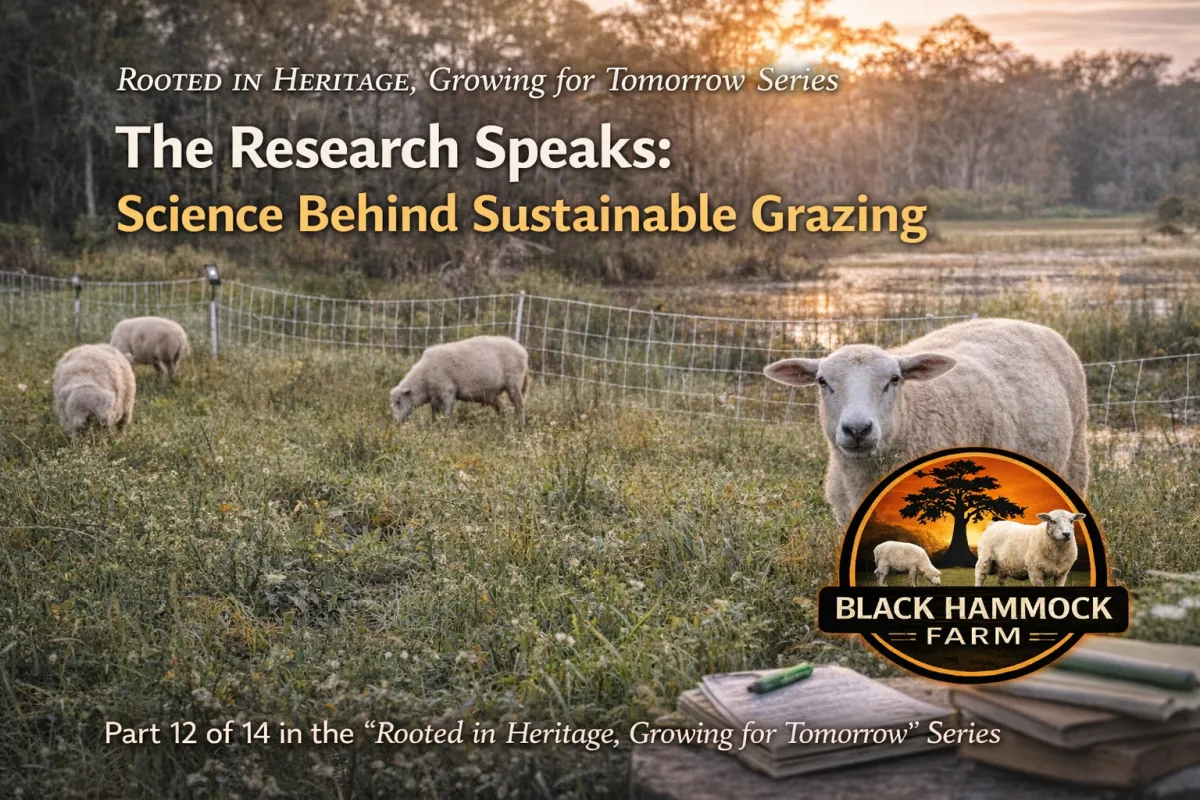
When Science Meets Sheep
The Research Speaks: Science Behind Sustainable Grazing
Part 12 of 14 in the "Rooted in Heritage, Growing for Tomorrow" Series
Throughout this series, I've made claims about what sheep can do for land management and conservation. Targeted grazing controls invasive species. Sheep can restore wetland health. Livestock offer alternatives to chemicals and machinery.
Those aren't just opinions. They're conclusions supported by decades of peer-reviewed research from universities and scientific institutions around the world.
This week, I want to share some of that research—not to impress you with citations, but to show that what we're doing at Black Hammock Farm isn't experimental or fringe. It's grounded in science. And it's already working in communities across the globe.
The 14-Year Florida Study
Let's start close to home.
Researchers at the Archbold Biological Stationstudying Florida seasonal wetlands conducted a 14-year experiment comparing grazed and ungrazed areas. The question was simple: what happens to wetland plant communities when you remove livestock?
The answer surprised people who assumed that excluding grazing would automatically benefit ecosystems.
When cattle were removed from wetland areas, invasive species like West Indian marsh grass (Hymenachne amplexicaulis) didn't decline. They exploded. Without grazing pressure, these aggressive plants formed dense monocultures—single-species stands that crowded out everything else.
The grazed wetlands told a different story. They maintained plant diversity. They supported more complex vegetation structure. They remained resilient in ways the ungrazed areas didn't.
The researchers concluded that grazing, when managed appropriately, actually helped maintain the ecological health that conservationists want to protect.
This wasn't a study conducted by livestock industry advocates. It was peer-reviewed research published inEcological Applications, examining real Florida wetlands over more than a decade.
The implications are significant: removing grazing isn't automatically good for wetlands. In some cases, it's demonstrably harmful.
6,000 Years of Evidence
Florida research is compelling, but the evidence for grazing as a land management tool goes back much further.
Europeans have used livestock to manage wetlands for approximately 6,000 years. This isn't ancient history we've moved beyond—it's ongoing practice that continues todaybecause it works.
In the United Kingdom, researchers consistently find that grazed ponds have higher conservation value than ungrazed ones. The grazing creates what scientists call "habitat heterogeneity"—variation in vegetation height, density, and structure that supports diverse wildlife communities.
Think about what a grazed wetland edge looks like: some areas cropped short, others left taller, patches of bare ground interspersed with dense growth. That patchwork isn't messiness—it's exactly what many wetland species evolved with and depend on.
Ungrazed areas, by contrast, tend toward uniformity. Tall, dense vegetation dominates. The structural diversity disappears. And with it, the species that needed those varied microhabitats.
As the U.S. Geological Survey notes, "Cattle grazing drives successional change in wetland vegetation by removing tall grasses and other vegetation. As a disturbance, cattle grazing in some ways resembles natural disturbances such as native mammal grazing and lightning-strike fire."
European land managers figured this out millennia ago. Modern science has confirmed what traditional practice discovered through observation and experience.
Phragmites: A Case Study in Grazing Control
Few invasive species cause more concern than Phragmites australis—the common reed that has transformed wetlands across the eastern United States into impenetrable monocultures.
Phragmites grows up to 19 feet tall. It spreads up to 16 feet per year. Once established, it blocks light to all other plants, eliminates habitat diversity, and fundamentally changes wetland ecosystems. Traditional control methods—herbicides, cutting, burning—require repeated application and rarely provide lasting results.
Researchers decided to try something different: grazing.
Experimental trials using rotational goat grazing on Phragmites stands produced remarkable results. In areas where goats had no choice but to graze the reeds, Phragmites coverage dropped from 100% to approximately 20%.
Not through chemicals. Not through machinery. Through animals eating plants.
The research confirmed that Phragmites is palatable to multiple livestock species—goats, sheep, cattle, and horses all readily consume it. The key is management: concentrated grazing pressure during the growing season, when the plants are most vulnerable and most nutritious.
What's particularly striking is the economics. Herbicide applications require repeated treatments, specialized equipment, and trained applicators. Grazing animals work continuously, reproduce themselves, and can eventually be sold for meat. The cost curves point in opposite directions over time.
Companies offering targeted grazing services for Phragmites control have emerged across the country—from New York City's urban wetlands to the Chesapeake Bay's tidal marshes to riverbanks throughout the Midwest. This isn't theory anymore. It's business.
Why Grazing Works: The Science
Understandingwhygrazing controls invasive species helps explain when and how to apply it effectively.
Selective pressure.Grazing animals don't eat everything equally. They have preferences—and those preferences can be leveraged. When invasive species happen to be palatable (as many grasses are), grazing creates selective pressure that disadvantages the invaders and gives native plants competitive room.
Timing vulnerability.Plants are most vulnerable during active growth phases, when they're investing energy in new tissue. Grazing during these periods forces plants to repeatedly expend resources on regrowth rather than reproduction and root storage. Strategic timing amplifies impact.
Continuous management.Herbicide applications happen periodically, then stop. Between treatments, invasive plants recover. Grazing animals, by contrast, apply continuous pressure throughout their deployment. There's no recovery window.
Physical disturbance.Moderate trampling creates small-scale soil disturbance that can benefit native plant germination. Seeds need soil contact to sprout; light hoof action can provide it without the compaction that heavy machinery causes.
Nutrient cycling.What goes into a grazing animal comes out as fertilizer—deposited directly on the land being managed. Unlike chemical treatments that may degrade soil biology, grazing enhances nutrient cycling and supports the soil food web.
No chemical residue.In sensitive wetland environments, herbicide runoff is a genuine concern. Grazing produces no chemical residue. The only "runoff" is organic matter that benefits rather than harms aquatic systems.
What the Universities Say
The University of Florida's Institute of Food and Agricultural Sciences (IFAS) Extension has documented that Katahdin sheep have a "smooth hair coat and other adaptations [that] allow them to tolerate heat and humidity well"—a finding that directly addresses skepticism about sheep in Florida's climate. Their selection guide for sheep meat breeds specifically notes Katahdin's "tolerance of internal and external parasites" and suitability for Florida conditions.
UF/IFAS research supports sustainable stocking rates and rotational grazing practices that maintain both livestock health and land productivity. The UF/IFAS Sheep Unit raises Katahdin sheep specifically, recognizing the breed's adaptation to Florida's challenging environment. The guidelines we follow at Black Hammock Farm aren't invented by us—they're derived from university research specific to our region.
Across the country, land-grant universities have studied targeted grazing applications:
University of Idaho maintains the definitive Targeted Grazing Handbook and research center
University of Californiahas extensive research on grazing for fire fuel reduction and vegetation management
Texas A&Mhas documented grazing impacts on brush control and rangeland health
Montana Statehas studied grazing for weed control in sensitive areas
The academic consensus is clear: managed grazing is a legitimate, effective tool for vegetation management and conservation. The questions aren't whether it works, but how to optimize it for specific contexts.
Even the Bureau of Land Management has endorsed the Targeted Grazing Handbook as "current state-of-the-art" for addressing vegetation management needs on public lands.
Florida's $100 Million Question
Florida spends over $100 million annually fighting invasive species. That's not a typo—one hundred million dollars, every year, with the problem still growing.
The current approach relies heavily on herbicides, mechanical removal, and prescribed fire. These tools have their place. But they're expensive, they require repeated application, and they come with environmental trade-offs.
What if even a fraction of that spending went toward targeted grazing programs?
The infrastructure exists. Florida has livestock producers. Florida has grazing lands. Florida has academic institutions that could design and monitor pilot programs.
What's missing is the policy vision to connect these pieces—to recognize that conservation and agriculture aren't opposing forces, but potential partners.
Seminole County alone protects over 8,500 acres of wetlands around Lake Jesup. The St. Johns River Water Management District manages thousands more acres of floodplain. These are exactly the landscapes where targeted grazing could make a difference.
The research supports it. The economics favor it. The environmental benefits are documented. The capacity is available locally.
The only missing ingredient is the will to try.
What This Means for Black Hammock Farm
We're not a research institution. We're a working farm. But everything we do is informed by science.
Our choice of Katahdin sheep wasn't random—it was based on documented breed characteristics and university research on climate suitability. Our grazing management follows IFAS Extension guidelines for sustainable stocking and rotational practices. Our observations of transitional wetland grazing align with published research on habitat management.
When we propose conservation grazing partnerships with the county or water management district, we're not asking anyone to take a leap of faith. We're asking them to consider an approach that has:
Peer-reviewed researchsupporting its effectiveness
Millennia of traditional practiceconfirming its viability
Documented case studiesfrom communities across America
Local expertiseavailable to implement it
Cost structuresthat favor it over conventional methods long-term
We're not experimenting on public land. We're offering to apply proven techniques with local knowledge and professional management.
The Opportunity Ahead
Science has done its part. The research exists. The evidence is published. The conclusions are available to anyone willing to read them.
What happens next is a matter of policy and will.
Will Florida continue spending $100 million annually on approaches that aren't winning? Or will we integrate proven alternatives into our conservation toolkit?
Will Seminole County continue managing wetlands with only chemicals and machinery? Or will we explore partnerships with local agricultural operations that could provide sustainable, cost-effective services?
Will the gap between conservation and agriculture remain unbridged? Or will we recognize that livestock and land management have been partners for thousands of years—and could be again?
At Black Hammock Farm, we've made our choice. We're building expertise. We're documenting results. We're ready to contribute.
The science speaks clearly. The question is whether we're ready to listen.
Next week in Part 13: "Our Commitment: Good Stewardship in Action"—we'll share the specific practices that guide our operation, from animal welfare protocols to land management standards, demonstrating what responsible small-scale agriculture looks like in practice.
From the Pasture:We've been adjusting our rotational grazing schedule based on pasture growth rates—faster rotation during rapid spring growth, slower during drier periods. This responsive management is exactly what the research recommends: matching grazing pressure to vegetation conditions rather than following rigid calendars.
Further Reading:For those interested in the science behind targeted grazing, the University of Idaho's Targeted Grazing Handbook is an excellent resource. The University of Florida IFAS Extension offers Florida-specific livestock management guidelines, including their guide to sheep breed selection. For information on Florida's invasive species challenge, visit the Florida Fish and Wildlife Conservation Commission.
A Question for Readers:Has scientific research ever changed your mind about something? Have you encountered cases where traditional practices turned out to be backed by modern science? Share your experiences in the comments.
#RootedInHeritage #BlackHammockFarm #ScienceOfGrazing #ConservationGrazing #ResearchBacked

