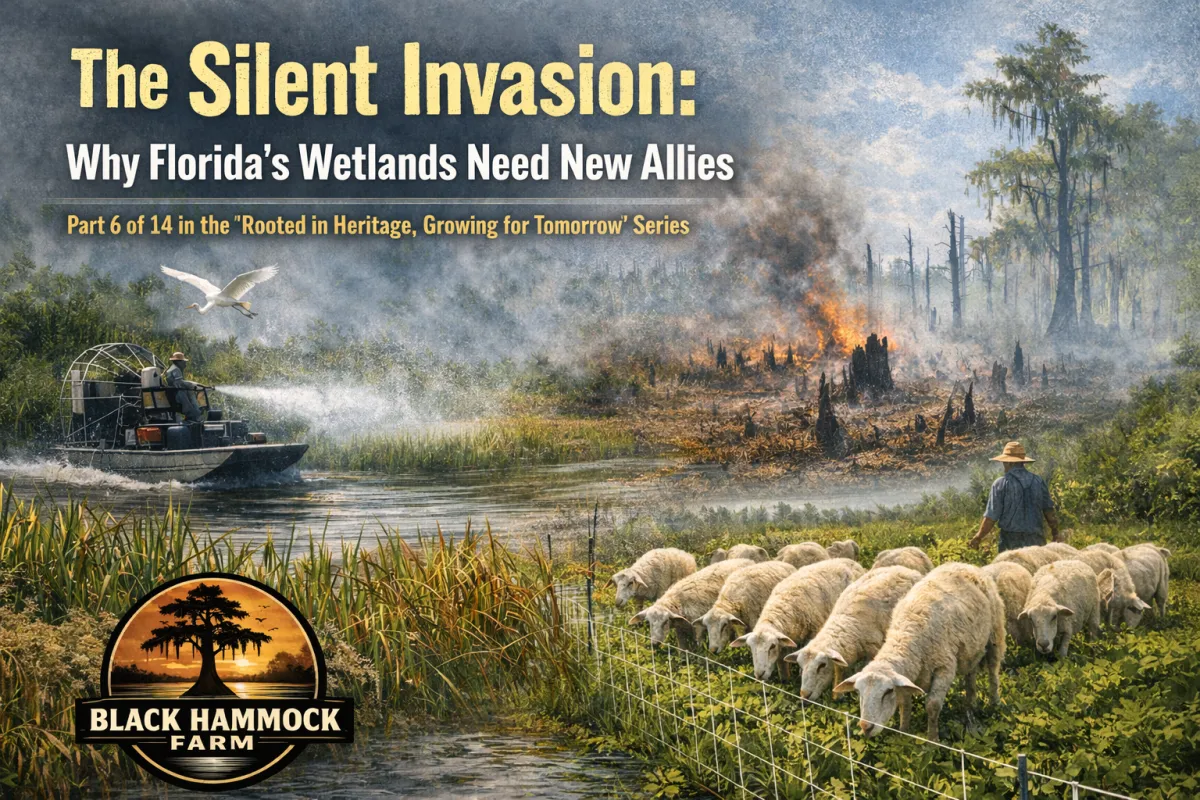
Sheep and Florida wetland
The Silent Invasion: Why Florida's Wetlands Need New Allies
Part 6 of 14 in the "Rooted in Heritage, Growing for Tomorrow" Series
There's a war being fought in Florida, and we're losing.
You won't see it on the evening news. There are no dramatic images, no breaking alerts, no politicians holding press conferences. But the casualties are mounting every year, and the cost—both ecological and financial—is staggering.
The enemy? Plants.
Not the native sawgrass and cypress and pond apple that defined Florida's wetlands for millennia. The invaders: aggressive species from other continents that arrived in shipping containers, escaped from ornamental gardens, or were deliberately planted by people who didn't understand what they were unleashing.
These plants are rewriting Florida's landscape. And our current arsenal isn't stopping them.
The Numbers Tell the Story
According to the Florida Fish and Wildlife Conservation Commission, more than 1.7 million acres of Florida's natural areas have been colonized by invasive plant species. That's an area larger than Delaware—consumed not by development or agriculture, but by biological invasion.
The state spends over $100 million annually trying to control these invaders. The South Florida Water Management District alone treats 185,000 acres every year. Herbicide applicators, airboats, mechanical harvesters, prescribed burn crews—an entire industry exists to fight a battle that never ends.
And yet the invaders keep gaining ground.
This isn't a failure of effort or funding. It's a recognition that we're using twentieth-century tools against a twenty-first-century problem. Spray, cut, burn, repeat—the cycle continues, but the plants keep coming back.
Maybe it's time to try something different.
Understanding What We're Losing
To grasp what's at stake, you need to understand what Florida wetlands actually are—and what they do.
These aren't simple, uniform landscapes. Florida wetlands exist along sophisticated gradients, with different zones supporting distinct communities of plants and animals. The transitional edges where dry land meets wet. The seasonally flooded marshes that fill and drain with the rains. The permanently saturated swamps where cypress knees rise from dark water.
Each zone serves critical functions. The transitional areas filter sediments and nutrients before they reach permanent water bodies. They provide habitat for species that move between aquatic and terrestrial environments. The seasonal wetlands store floodwaters, recharge aquifers, support extraordinary biodiversity. The permanent wetlands regulate temperature, maintain water quality, shelter fish populations.
This intricate architecture took thousands of years to develop. Invasive species can dismantle it in a decade.
How Invasion Works
Invasive plants don't just crowd out native vegetation. They fundamentally restructure ecosystems.
Take Melaleuca, the Australian punk tree that arrived in Florida in the early 1900s. Settlers thought it might help drain swampland for development. It succeeded beyond anyone's expectations—or fears.
Melaleuca doesn't simply grow in wetlands. It transforms them. The trees consume and transpire water at rates that literally drain the surrounding area. They alter fire patterns that native species depend on. They change soil chemistry. Where treeless sawgrass marshes once stretched to the horizon, dense Melaleuca forests now stand.
Or consider Phragmites, the common reed that has invaded wetlands across the eastern United States. A single stand can spread sixteen feet per year, forming impenetrable thickets that block light to everything beneath. Native plants can't compete. Wildlife can't navigate the dense stems. The diverse wetland becomes a monoculture.
The pattern repeats with species after species: Brazilian pepper, Old World climbing fern, torpedograss, West Indian marsh grass. Each has its own strategy, but the result is the same. Complexity collapses into uniformity. Biodiversity plummets. The wetland stops functioning as a wetland.
Why Traditional Methods Aren't Enough
The standard toolkit for invasive species management includes three main approaches: chemical, mechanical, and fire. Each has a role. None is sufficient.
Herbicidescan knock back invasive plants effectively, but they come with costs. Chemical runoff into waterways affects non-target species. Repeated applications are required as plants regrow from roots and seed banks. Some wetland areas are too sensitive—or too difficult to access—for safe herbicide use. And there's growing public concern about long-term chemical accumulation in ecosystems.
Mechanical removal—cutting, mowing, dredging—works for some species in some locations. But heavy equipment can't access soft soils without causing damage. Machinery compacts earth, destroys soil structure, disrupts the very ecosystems we're trying to protect. And like herbicides, mechanical removal rarely provides permanent control. The plants return.
Prescribed fireis essential for maintaining many Florida ecosystems, but it requires specific conditions, extensive preparation, and carries risks. Not all invasive species are fire-sensitive. And fire can't be applied in areas adjacent to development or during certain weather conditions.
We keep using these tools because they're what we have. But spending $100 million a year to fight a losing battle should prompt us to ask: what else could we try?
An Ancient Solution
Here's something remarkable: a 14-year study of Florida seasonal wetlands found that strategic cattle grazing actually maintained plant diversity better than fencing out livestock entirely.
When researchers excluded grazing animals from wetland areas, invasive species like West Indian marsh grass formed dense monocultures. The ungrazed wetlands became less diverse, less complex, less resilient.
The grazed wetlands? They stayed healthier.
This isn't an anomaly. Research from the United Kingdom consistently shows that grazed ponds have higher conservation value than ungrazed ones. European studies document how strategic wetland grazing benefits both conservation and traditional land use. Australian research confirms similar patterns in ephemeral wetlands.
The science points to something farmers have known for millennia: grazing animals and wetlands evolved together. Remove the grazers, and the system falls out of balance.
How Grazing Fights Invasion
Livestock combat invasive plants through mechanisms that chemicals and machinery can't replicate.
Selective pressure.Sheep and other grazers preferentially consume certain plants, reducing the competitive advantage of invasive species and giving natives room to recover.
Continuous management.Unlike herbicide applications or mechanical clearing—which happen periodically and then stop—grazing animals work continuously. They don't give invasive plants recovery windows.
Soil health.Grazing animals fertilize as they go, depositing organic matter that supports soil biology. They don't compact soil the way machinery does. Their hooves create small disturbances that can actually benefit seed germination for native species.
Low impact access.Sheep can work in areas where trucks and tractors can't go—soft soils, steep slopes, sensitive edges. They navigate terrain without the damage that heavy equipment causes.
No chemical residue.What goes into a sheep comes out as fertilizer. There's no runoff concern, no accumulation in the food chain, no risk to non-target species.
Research on Phragmites control found that rotational goat grazing reduced reed coverage from 100% to 20%—without chemicals, without machinery, without repeated expensive interventions. Europeans have suppressed Phragmites through seasonal livestock grazing for 6,000 years. We're not inventing something new. We're rediscovering something old.
What This Means for Seminole County
Seminole County protects over 8,500 acres of wetlands around Lake Jesup alone. The county's Natural Lands Program manages conservation areas throughout the region. The St. Johns River Water Management District oversees thousands more acres of floodplain and wetland.
All of this land faces pressure from invasive species. All of it requires ongoing management. And all of it is currently managed primarily through conventional methods—methods that, as we've seen, have significant limitations.
What if there was another option?
Black Hammock Farm sits in the heart of this landscape. Our Katahdin sheep are specifically suited to Florida's climate and terrain. We have experience with targeted grazing through our Rent-A-Herd program. We understand the logistics of moving animals safely, containing them appropriately, and managing their impact on the land.
We're not suggesting that sheep can replace all conventional invasive species management. Herbicides, mechanical removal, and prescribed fire all have their place. But grazing could be another tool in the toolkit—one that works continuously, costs less over time, and actually improves soil health rather than degrading it.
The conversation hasn't happened yet. But we believe it should.
A Vision Worth Considering
Imagine a pilot program: a few acres of county-managed wetland edge, an area currently choked with invasive grasses, difficult to access with machinery, too sensitive for heavy herbicide application.
A small flock of Katahdin sheep, contained by portable fencing, grazing the invasive vegetation down over several weeks. Researchers monitoring plant composition before and after. County staff evaluating logistics and costs. Everyone learning together what works and what doesn't.
If it succeeds, the program could expand. Other sites. Larger areas. A genuine partnership between local agriculture and public land management.
If it doesn't work as hoped, we've lost little. A few weeks of grazing on a test plot. Some data about what sheep can and can't accomplish in Florida wetland conditions. Knowledge that informs future decisions.
The downside is minimal. The potential upside is significant: a sustainable, cost-effective, locally-sourced approach to one of Florida's most persistent environmental challenges.
Other states are already exploring this. Other counties are running pilots. The question isn't whether targeted grazing can work—the research says it can. The question is whether we're willing to try it here.
The Sheep Are Ready
Every day, our Katahdins graze the pastures at Black Hammock Farm. They don't know anything about invasive species policy or wetland management budgets. They just eat.
But in that simple act—repeated millions of times across thousands of years of agricultural history—lies a potential solution to a very modern problem.
Florida's wetlands are under siege. The current approach isn't winning. An ancient alternative exists, backed by contemporary science, ready to be deployed by local farms with the expertise and animals to make it work.
The sheep are ready. The question is whether we are.
Next week in Part 7: "Sheep on the Front Lines: Targeted Grazing for Conservation"—we'll look more closely at how strategic grazing actually works in practice, and share early results from our own efforts to restore balance to transitional wetland zones.
From the Pasture:The seasonal rains have begun, and the pastures are responding. Our ewes are grazing on fresh growth while the lambs—now several weeks old—are starting to sample grass alongside their mothers. The cycle of renewal continues.
Dig Deeper:Want to learn more about invasive species in Florida? The Florida Fish and Wildlife Conservation Commission maintains excellent resources at MyFWC.com. The University of Florida's Center for Aquatic and Invasive Plants (CAIP) offers detailed information on specific species and control methods.
A Question for Readers:Have you noticed invasive plants taking over natural areas in your neighborhood? Seen wetlands or pond edges choked with vegetation that wasn't there a decade ago? We'd love to hear your observations in the comments.
#RootedInHeritage #BlackHammockFarm #FloridaWetlands #InvasiveSpecies #SustainableSolutions

