What Defines a Real Farm in Florida?
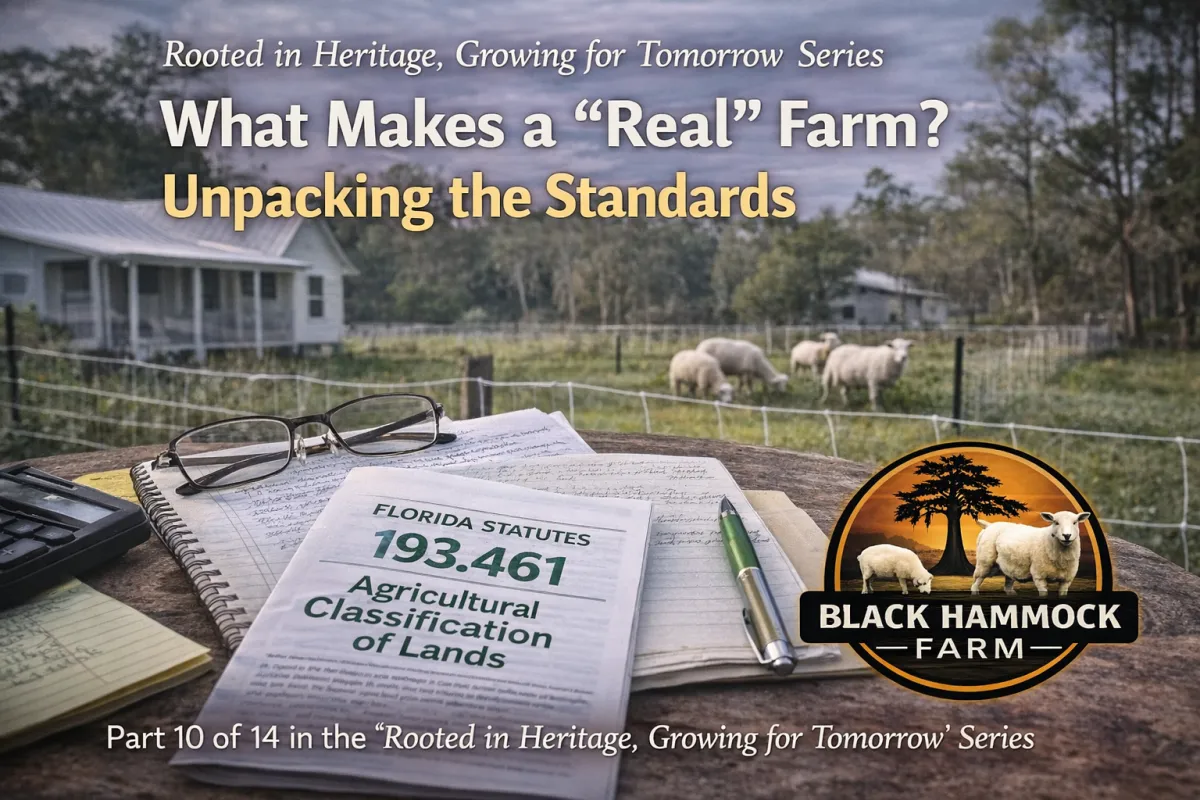
What Makes a "Real" Farm? Unpacking the Standards
Part 10 of 14 in the "Rooted in Heritage, Growing for Tomorrow" Series
When I tell people I'm a farmer, I can see the image forming in their minds.
Hundreds of acres. Red barns. Tractors rolling across endless fields. Maybe some cattle grazing on distant hillsides, or combines harvesting wheat under a golden sunset.
Then they visit Black Hammock Farm.
They see a few dozen acres. Katahdin sheep grazing in paddocks. Chicken coops. Portable fencing. A scale of operation that fits in the space between subdivisions rather than sprawling to the horizon.
And I can see the recalculation happening: Is this really a farm?
It's a fair question. The images we carry of agriculture come from movies and advertisements, from a century of industrialization that made "big" synonymous with "real." If farming means thousands of acres and millions of dollars, then what do you call what we do?
I call it farming. Florida law agrees. And this week, I want to explain why.
What the Law Actually Requires
Florida Statute 193.461 establishes the criteria for agricultural classification. It's the legal standard that determines whether land qualifies for assessment based on agricultural use rather than development potential.
The statute doesn't mention acreage minimums. It doesn't require specific revenue thresholds. It doesn't demand that operations look like industrial agriculture.
What it requires is "bona fide commercial agricultural purposes."
Let's break that down:
Bona fide means genuine. Good faith. Not a sham or a pretense, but a real commitment to agricultural use. The question isn't whether your farm looks impressive—it's whether your agricultural activity is authentic.
Commercial means oriented toward profit. Not a hobby pursued for personal enjoyment regardless of economics. A commercial operation intends to generate revenue, manages toward that goal, and has a reasonable expectation of achieving it.
Agricultural purposes cover a broad range of activities: raising livestock, producing crops, breeding animals, and cultivating plants. The statute includes explicitly "livestock" and "poultry" among qualifying uses—exactly what Black Hammock Farm produces.
That's the legal standard. Genuine. Commercial. Agricultural.
Notice what's missing: scale.
The Factors That Actually Matter
When a Property Appraiser evaluates an agricultural classification application, Florida law directs them to consider specific factors. These aren't suggestions—they're statutory requirements.
The length of time the land has been used for agricultural purposes. Not "how big is the operation" but "how long has this been happening?" Continuous agrarian use over the years demonstrates a commitment that casual hobby use doesn't.
Whether the use has been continuous, agriculture isn't a one-time thing. Animals need care every day. Pastures need management every season. Continuous use shows that the operation is real, not a convenient claim made at tax time.
The purchase price paid for the land. This factor helps distinguish between land bought for agricultural use and land bought for investment or speculation with agriculture as a cover story.
The size of the tract. Yes, size is a factor—but it's one factor among many, not a disqualifying threshold. The statute explicitly contemplates that agricultural operations come in different sizes.
Has an effort been made to adequately care for the land, and are you actually managing the property? Maintaining fences, rotating pastures, and controlling invasive species? Or is the land neglected while you claim agricultural use?
Whether the land is under lease and the terms of the lease, formal lease arrangements demonstrate commercial intent. They show that the operation extends beyond casual personal use into business relationships with legal obligations.
Whether the land is being valued at its agricultural use by any state or federal agency. Other governmental recognitions of agricultural status support classification.
Read through that list. Now ask: which of those factors requires industrial scale?
None of them.
What Black Hammock Farm Actually Does
Let me be specific about our operation, because specificity matters.
Systematic breeding program. We maintain an 18-ewe breeding flock managed in documented rotation. Group A ewes bred at specific intervals. Group B ewes are on a different schedule. Group C follows after. Each animal is tracked individually with identification systems. Breeding dates recorded. Lambling outcomes documented.
This isn't "we have some sheep." This is livestock production with protocols.
Multiple lease agreements. Black Hammock Farm operates across approximately 17 acres through formal lease agreements with neighboring properties. These aren't handshake deals—they're written contracts with professional management provisions that specify responsibilities, terms, and agricultural purposes.
Lease arrangements at this scale demonstrate commercial intent. You don't execute formal legal agreements for a hobby.
Diversified revenue streams. Our operation generates income through multiple channels:
Livestock sales (lambs, breeding stock)
Rent-A-Herd vegetation management services
Poultry and egg sales
The U-Pick Up program for holiday livestock
The Backyard Chicken Program supports new poultry keepers
This isn't a single-product operation hoping one thing works out. It's a diversified agricultural business pursuing multiple market opportunities.
Professional documentation. We maintain body condition scores for our animals—the systematic evaluation of livestock health that serious producers use to guide management decisions. We follow University of Florida IFAS Extension guidelines for our region and species. We keep records that would satisfy any agricultural auditor.
Reasonable expectation of profit. Our business plan projects profitability as the operation matures. We're in the building phase that any agricultural startup experiences, but the trajectory is toward commercial viability. Every decision we make is oriented toward that goal.
The Small Farm Reality
Here's something that often gets lost in conversations about agricultural classification: most farms in America are small.
According to USDA data, 89% of U.S. farms are classified as "small"—generating less than $350,000 in gross cash farm income annually. The majority generate far less than that.
Family operations. Part-time farmers who also hold other jobs. Specialty producers serving local markets rather than commodity chains. Diversified operations that don't fit neatly into industrial categories.
These farms matter. They provide local food. They maintain agricultural land. They preserve rural character in communities facing development pressure. They offer alternatives to industrial production for consumers who want them.
If agricultural classification only protected large operations, we'd be writing policy that excludes the vast majority of American farms. That can't be what Florida's legislature intended when it created these protections.
The "Hobby Farm" Accusation
I know what skeptics think: small farms are just hobbies for wealthy landowners who want tax breaks.
I think that accusation should be a direct response.
A hobby is something you do for personal enjoyment, regardless of whether it makes economic sense. You don't care if it loses money because the pleasure justifies the cost.
A commercial operation is something you do with the intention of earning a profit. You make decisions based on economics. You track income and expenses. You adjust practices based on what's working and what isn't.
The distinction isn't size. Its orientation.
A wealthy person with 500 acres who keeps a few horses for personal riding and claims agricultural classification? That's a hobby. The horses don't generate revenue. There's no business plan. The "agricultural use" is really personal recreation.
A family with 17 acres who maintains formal breeding programs, executes commercial lease agreements, provides fee-based services to the community, sells livestock and eggs, and documents everything with professional protocols? That's a commercial operation. The intention, structure, and management all point toward the business purpose.
Black Hammock Farm isn't a lifestyle amenity. It's a business—built with profitability in mind, managed according to commercial principles, and documented like any serious agricultural enterprise.
We've invested over $10,000 in legal fees alone defending this classification. Nobody spends that kind of money on a hobby.
What We're Really Asking
When we stand before the Value Adjustment Board on March 28th, we're not asking for special treatment. We're not asking them to bend the rules for a sympathetic story.
We're asking them to apply the law as written.
Florida Statute 193.461 establishes criteria for agricultural classification. An independent Magistrate reviewed our operation against those criteria and found that we meet every requirement. The evidence supports our case.
The question isn't whether Black Hammock Farm is as big as an industrial operation. It isn't. Neither are 89% of American farms.
The question is whether we're engaged in bona fide commercial agricultural activity. The breeding programs say yes. The lease agreements say yes. The revenue streams say yes. The documentation says yes. The Magistrate said yes.
We're asking the Value Adjustment Board to say yes to.
Why This Matters Beyond Us
If the standard for agricultural classification becomes "look like industrial agriculture," small farms across Florida face an impossible bar.
The family raising pastured poultry on ten acres? Not a real farm.
The specialty vegetable grower serving farmers' markets? Not a real farm.
Is the heritage livestock breeder preserving rare genetics? Not a real farm.
The beginning farmer building an operation from scratch? Not a real farm—at least not until they somehow achieve scale without the classification that makes building possible.
That's not what Florida's agricultural classification law was designed to do. It was designed to keep working farms working—all sizes, all types, all the families trying to produce something valuable from the land.
Black Hammock Farm is one of those families. We've built something real. We've documented it thoroughly. An independent reviewer confirmed that we meet the legal standard.
A farm isn't measured by its acreage alone. It's measured by the intention, the care, and the commitment to producing something of value for the community.
By that measure—the measure that actually matters—Black Hammock Farm is as real as it gets.
Next week in Part 11: "Neighbors, Not Adversaries: A Call for Collaboration"—we'll explore how agricultural operations and county governments can work together rather than at cross-purposes, and share our vision for a more productive relationship.
From the Pasture: Breeding season continues on schedule. We're monitoring Group B ewes closely as they approach lambing—body condition scores are strong, and we're seeing healthy weight gain, which predicts good outcomes. The systematic approach works, season after season.
By the Numbers: Black Hammock Farm currently manages 22 animals (3 rams, 8 ewes, 11 lambs) with individual identification across approximately 17 acres of owned and leased property. Every animal is tracked. Every breeding is documented. This is commercial agriculture.
A Question for Readers: What do you think makes a "real" farm? Is it size? Revenue? Intention? We'd love to hear your perspective in the comments.
#RootedInHeritage #BlackHammockFarm #SmallFarmsMatter #BonafideAgriculture #FamilyFarm

