The Moment a Child Understands the Land
A Place Where Families Reconnect with the Land
Part 4 of 14 in the "Rooted in Heritage, Growing for Tomorrow" Series
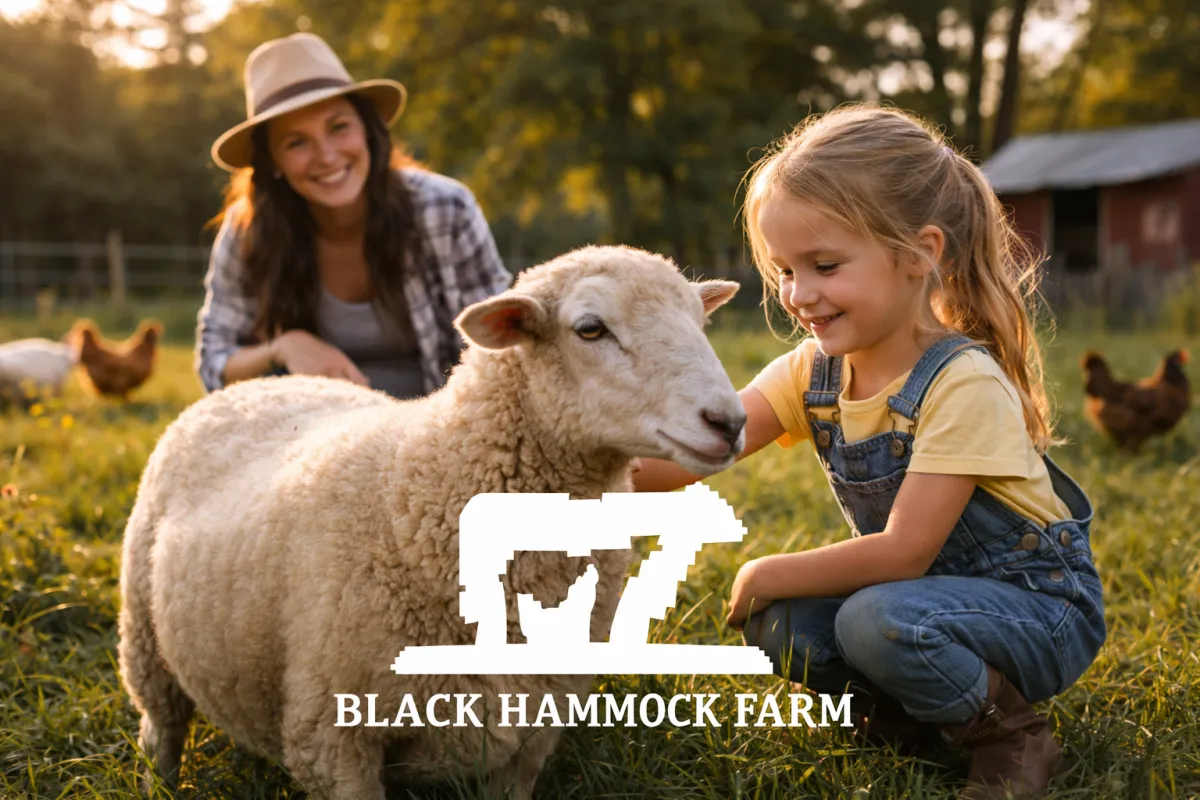
A few months ago, a mother brought her daughter to the farm for the first time. The girl was maybe five years old—old enough to be curious, young enough to be fearless.
She'd never touched a chicken. Never seen a sheep up close. Never held an egg that was still warm.
I watched her crouch beside our Katahdin ewes, her small hand reaching out tentatively. One of the older ewes—patient as always—ambled over and let the girl stroke her woolless coat. The child's face transformed from uncertainty to wonder to something I can only describe as recognition. Like she was remembering something her body had always known but her suburban life had never taught her.
Her mother called me a week later.
"She asks where everything comes from now," she said. "Every meal. She wants to know: did this come from an animal? Did someone grow this? How did it get to our table?"
That conversation—that moment of awakening in a five-year-old—is why we do this.
The Disconnection Crisis
Here's a statistic that should trouble every parent: studies consistently show that a significant percentage of children don't know that hamburgers come from cows, that pickles start as cucumbers, or that French fries begin as potatoes growing in soil.
This isn't their fault. It's the predictable result of a food system that has become invisible. When everything arrives wrapped in plastic, when meals appear through windows and delivery apps, when the journey from farm to table happens entirely out of sight—how would children learn otherwise?
But knowledge isn't all we've lost. Something deeper has disappeared: the felt sense of being part of a living system. The understanding that our survival depends on soil and water and the labor of growing things. The humility that comes from knowing food doesn't originate in grocery stores.
This disconnection doesn't just affect children. Adults feel it too—a vague unease, a nostalgia for something we can't quite name, a hunger that supermarkets can't satisfy.
What Happens at the Farm
When families visit Black Hammock Farm, we don't give them a show. We give them reality.
The chickens aren't performing. They're doing what chickens do: scratching, pecking, establishing their mysterious hierarchies, occasionally producing an egg in the most unlikely places. The sheep aren't props. They're grazing, resting, watching visitors with their characteristic blend of curiosity and wariness.
Children learn to move slowly around animals. They discover that trust is earned. They find out that eggs are warm when they're fresh, that sheep smell like lanolin and grass, that a rooster's crow is much louder in person than on a recording.
Parents often tell me they learn as much as their kids. Many have never been on a working farm. The rhythms of agricultural life—the early mornings, the dependence on weather, the patience required for animals to do what animals do—are as foreign to them as to their children.
That's not a criticism. It's the world we've built. But it's also something we can change, one family at a time.
The U-Pick Up Program
One of our most popular programs is deceptively simple: U-Pick Up.
Families come to the farm and select their own livestock—whether lamb for a holiday celebration, chickens for their backyard flock, or turkeys for Thanksgiving. They don't just order from a website. They meet the animals. They see how they've been raised. They make a choice based on direct experience rather than marketing.
For many, this is the first time they've connected a living animal to the food on their table. It's not always comfortable. Sometimes it raises questions—especially from children—that don't have easy answers.
But I believe those questions matter. Understanding that meat comes from animals that lived, breathed, and had personalities isn't meant to create guilt. It's meant to create respect. When you know where your food comes from, you're less likely to waste it. You're more likely to appreciate the farmers, the animals, and the land that produced it.
The families who participate in U-Pick Up often become our most committed supporters. Not because we've convinced them of anything, but because they've experienced something. Connection creates advocates in ways that arguments never can.
Building Backyard Farmers
Three years ago, we launched our Backyard Chicken Program, and it's grown beyond anything we expected.
The premise is straightforward: we help Central Florida families start and maintain their own small flocks. We provide chicks from our hatchery—heritage breeds selected for temperament, hardiness, and egg production. We offer guidance on coop setup, predator protection, feeding, and health. And we remain available as an ongoing resource when questions arise.
What we've learned is that people are hungry—sometimes desperately—for this knowledge.
First-time chicken owners call us with questions that might seem basic: why is my hen making this noise? Is this egg supposed to look like that? How do I protect them from hawks? Each question represents someone taking responsibility for producing their own food, often for the first time in their family's living memory.
The eggs are almost beside the point.
What matters is the daily ritual: going outside, checking on living creatures that depend on you, collecting something tangible that you'll eat for breakfast. What matters is children learning that responsibility is real, that animals need care regardless of whether it's convenient, that food comes from work.
We call them "backyard farmers" because that's what they're becoming. Not hobbyists—farmers. Small-scale, yes. Part-time, certainly. But genuinely engaged in the ancient work of raising animals for food.
Every backyard flock in Seminole County is a small step toward food resilience. It's a family that understands, in their bones, something about where sustenance comes from. It's a few dozen eggs a week that don't require industrial production, packaging, and shipping.
And perhaps most importantly, it's a generation of children who will grow up knowing that eggs come from chickens, that chickens need care, and that producing food is honorable work.
The Unexpected Visitors
Not everyone who comes to Black Hammock Farm is looking for livestock.
Sometimes people show up just to... be here. To stand in a pasture and watch sheep graze. To breathe air that smells like something other than exhaust and air conditioning. To remember.
Older visitors often have the strongest reactions. They'll tell me about grandparents who farmed, about childhood summers on relatives' properties, about a connection to the land that got paved over somewhere along the way.
"I didn't know I missed this until I was here," one woman told me, tears unexpectedly welling up as she watched our ewes move across the pasture.
I don't fully understand the psychology of it. But I've come to believe that humans have a need for contact with living systems—plants, animals, soil, weather—that our built environment doesn't satisfy. We evolved for hundreds of thousands of years in intimate relationship with the natural world. A century of industrialization and urbanization can't erase that.
When people come to the farm and feel something shift inside them, they're not being sentimental. They're responding to something real.
An Open Door
Black Hammock Farm isn't a petting zoo or a theme park. It's a working agricultural operation with all the mess and unpredictability that implies.
But our door is open.
If you've never seen a lamb take its first wobbly steps, you're welcome here.
If you've forgotten what it feels like to hold a just-laid egg, still warm in your hand, you're welcome here.
If your children think food comes from apps, or if you've lost touch with something your grandparents knew, or if you simply want to spend an hour in a place where the rhythms are slower and the connections are tangible—you're welcome here.
We're not trying to turn everyone into farmers. We're trying to rebuild something that shouldn't have been lost in the first place: the understanding that we are part of the living world, not separate from it.
That understanding starts with experiences. With moments. With a five-year-old reaching out to touch a sheep for the first time.
And it continues, one family at a time, as long as farms like ours exist to provide them.
Next week in Part 5: "Rent-A-Herd: When Sheep Work for the Community"—discover how our Katahdin sheep provide eco-friendly vegetation management across Central Florida, proving that farms can serve neighborhoods in ways that go far beyond food production.
From the Pasture:Our Black Australorp hens are in peak production this month, delivering rich brown eggs daily. These heritage birds—originally developed in Australia for both eggs and meat—are among the most reliable layers we've raised. If you're considering a backyard flock, this breed deserves a spot on your list.
A Question for Parents:Have your children ever been to a working farm? What was the experience like—for them and for you? We'd love to hear your stories in the comments.
Getting Involved:Interested in our Backyard Chicken Program? Want to schedule a family visit? Contact us through blackhammockfarm.com or stop by. We'd love to meet you.
#RootedInHeritage #BlackHammockFarm #LiveFreshLocal #FarmKids #BackyardChickens

