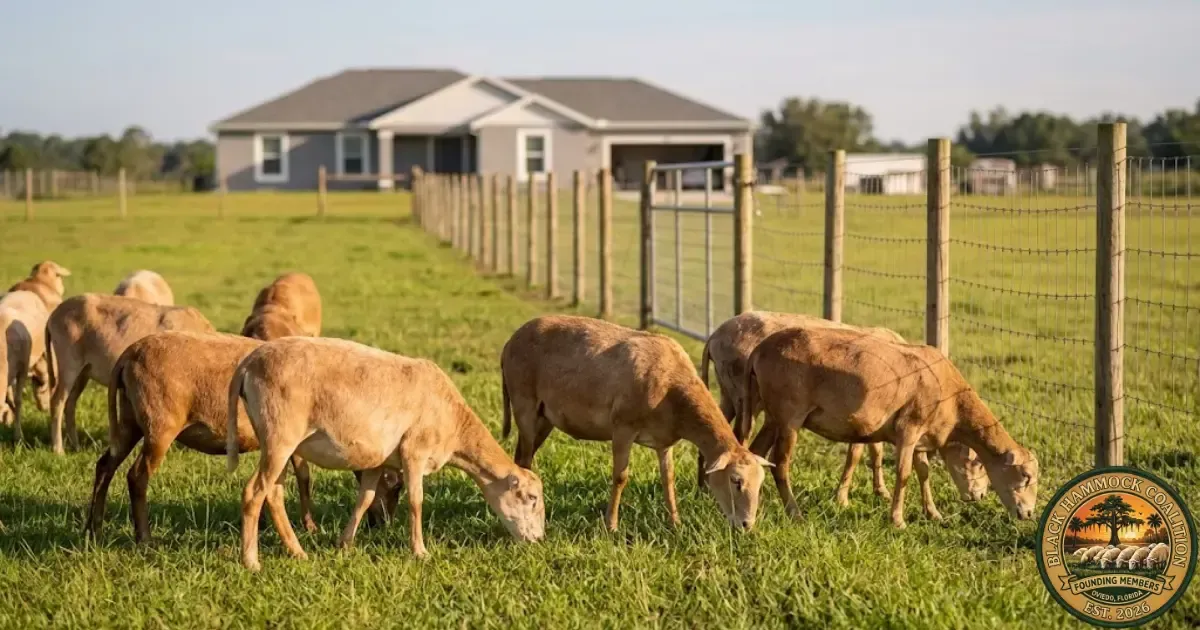
Primary Use Argument Dismantled: Dwelling & Ag Class FL
The Primary Use Argument Dismantled — What “Primarily” Actually Means Under Florida Agricultural Classification Law
If you live on your farm, the Property Appraiser has a ready argument for denial: your home is on the property, the home is worth more than the livestock, therefore the primary use of the land is residential, not agricultural. Denial.
This is the primary use argument. In Seminole County, it appears in denial letters alongside the wetlands argument covered in Post 7. The two arguments often work together: the appraiser photographs standing water and says the land is not usable, then points to the dwelling and says the land is not primarily agricultural. Between the two, most denied farmers assume they have no case.
They do. The primary use argument is contradicted by the statute it claims to enforce, the administrative code that implements the statute, and three Florida appellate court decisions spanning three decades. This post walks each layer.
This is Post 8 of The Denied G1 Series— a twelve-post field guide built from inside the fight.
Quick Answer
Does a dwelling on the property disqualify land from agricultural classification?
No. Florida Statute 193.461(3)(c) states it directly: “The maintenance of a dwelling on part of the lands used for agricultural purposes does not in itself preclude an agricultural classification. ”Florida Administrative Code 12D-5.003 goes further: the property appraiser shall not deny agricultural classification solely because of the maintenance of a dwelling on a part of the lands used for agricultural purposes. The Florida Supreme Court held in Straughn v. Tuck that classification is based on agricultural use, not the presence or absence of residential improvements. The Fifth District Court of Appeal held in Gianolo v. Markham that “primarily” means the agricultural use must be “the most significant activity on the land” — not the most valuable structure on the land. The Florida Supreme Court held in Amrep Corp. that classification depends on land use, not the value of non-agricultural improvements. Homestead and agricultural classification coexist. Living on your farm does not disqualify it.
What the Appraiser Argues
The primary use argument takes several forms, but they reduce to the same logic: the residential use of the property is more significant than the agricultural use, so the land does not qualify as “primarily” agricultural. In our case, the Seminole County Property Appraiser made three specific claims.
Claim one — revenue versus home value. The appraiser cited agricultural revenue of $3,000 to $4,000 annually against an approximate home value of $500,000. The implied argument: the home is worth more, so the home is the primary use. (For the record, the actual revenue is $17,000 to $44,000 annually, documented through Schedule F filings and livestock sales records. The appraiser’s revenue figure was off by 425 to 1,467 percent.)
Claim two — residential homestead is the primary use. The denial letter framed the property as a homestead with incidental agriculture rather than a farm with a residence. The appraiser cited Florida Statute 193.461(3)(b)— the “primarily” requirement — as the legal basis.
Claim three — incidental use precedent. The appraiser cited Walden v. Borden Co.(Fla. 1970) and First America Dev. Corp. v. Volusia County(Fla. 1st DCA 1974) for the proposition that incidental agricultural use does not qualify for classification. Both cases involved token livestock and hobby or speculative land use — materially different from a five-year commercial sheep operation with documented sales, Schedule F filings, and $150,000 to $260,000 in agricultural infrastructure.
The primary use argument sounds convincing to a landowner reading a denial letter for the first time. It is not supported by the legal framework it claims to apply.
What the Statute Says
The statute the appraiser cited —F.S. 193.461— contains its own answer to the primary use argument. Three provisions address the dwelling question directly.
Read those three subsections together. The statute says only land used primarily for bona fide agricultural purposes qualifies. The statute says a dwelling does not preclude classification. The statute provides the assessment mechanism for parcels with both a residence and agricultural land. The primary use argument treats the dwelling as a disqualifier. The statute the argument cites treats the dwelling as a separate assessment category that coexists with agricultural classification.
What the Administrative Code Says
Florida Administrative Code 12D-5.003 is titled “Dwellings on Agriculturally Classified Land.” The title alone tells you the Department of Revenue anticipated the question. The rule provides:
The property appraiser shall not deny agricultural classification solely because of the maintenance of a dwelling on a part of the lands used for agricultural purposes, nor shall the agricultural classification disqualify the land for homestead exemption. So long as the dwelling is an integral part of the entire agricultural operation, the land it occupies shall be considered agricultural in nature.
Three operative principles in one rule. First: the property appraiser shall not deny classification solely because of a dwelling. The word “shall” makes this mandatory, not discretionary. Second: the agricultural classification does not disqualify the land for homestead exemption. The two designations coexist — by rule. Third: if the dwelling is an integral part of the agricultural operation, the land it occupies is considered agricultural. A farmhouse on a working farm is not a residential intrusion. It is part of the agricultural operation.
The administrative code also addresses the assessment mechanics. Dwellings and other improvements on the land shall be assessed under Section 193.011, F.S., at their just value and added to the agriculturally assessed value of the land. The rule anticipates that a classified parcel will have both agricultural land and non-agricultural improvements. It provides the assessment formula. It does not provide for denial.
What Three Florida Appellate Courts Ruled
The statute and the administrative code are clear. The case law is definitive. Three appellate decisions, from three different courts, across three decades, address the exact questions raised by the primary use argument.
One additional case reinforces the framework. In Citrus County v. Halls River Development, 520 So.2d 682 (Fla. 5th DCA 1988), the Fifth District Court of Appeal held that agricultural classification applies regardless of the owner’s primary occupation or residence on the property. A farmer who also holds a day job does not lose classification. A farmer who lives on the farm does not lose classification. The question is what the land is used for, not who the landowner is or where the landowner sleeps.
The Acreage Question — What the Numbers Actually Show
The primary use argument often relies on an implicit assumption: that the dwelling dominates the parcel. In our case, the parcel is 4.653 acres. The land use breakdown tells a different story.
Ninety percent of the land is in agricultural use — active pasture and agricultural infrastructure. Ten percent is residential. Under the Gianolo test, the agricultural use must be “the most significant activity on the land.” On a parcel where 90 percent of the acreage is in agricultural use and the only physical activity is livestock grazing, the question answers itself.
When the multi-parcel operation is considered — Pasture A (4.653 acres, the subject parcel) plus Pasture B (approximately 5 acres, leased from a neighbor) plus additional adjacent parcels under lease — the total managed acreage exceeds 16 acres. The residential footprint represents less than 3 percent of the operation. The primary use argument fails on acreage alone, before reaching the legal analysis.
Why the Revenue Comparison Is the Wrong Test
The appraiser compared agricultural revenue ($3,000–$4,000 in the denial letter, actually $17,000–$44,000 per documented Schedule F filings) to approximate home value ($500,000). The comparison implies that whichever number is larger determines the primary use.
This is not the test under Florida law. The Amrep Corp. decision addressed this directly: agricultural classification depends on the use of the land, not the value of non-agricultural improvements. The statute does not compare revenue to home value. The statute asks whether the land is used primarily for bona fide agricultural purposes — meaning good faith commercial agricultural use. Every beginning farmer in Florida generates more home equity than agricultural revenue in the early years. The statute was not written to exclude them. It was written to include them — which is why “bona fide” means “real, actual, of a genuine nature,” not “more profitable than your mortgage.”
If the test were revenue versus home value, no beginning farmer, no small livestock operation, and no family farm with a homestead would ever qualify for agricultural classification in Florida. The Legislature knew that when it wrote subsection (3)(c): the maintenance of a dwelling does not in itself preclude classification.
The Comparable Property That Proves the Point
Within the same subdivision — Florida Groves Company’s First Addition to Black Hammock — Property 045B at 1755 Walsh Street (Meagher) carries G1 agricultural classification. It is 1.7 acres. It has “HOMESTEAD” written explicitly in the legal description. It received G1 approval from 2019 through 2021. A property with homestead in the legal description received agricultural classification from the same Property Appraiser’s office that denied our parcel on the basis that the dwelling constitutes the primary use.
Of the 33 G1-classified parcels within a half-mile radius of our property, five carry the AG Homestead HX Cutout designation. That designation exists because the SCPA itself processes parcels where homestead and agricultural classification coexist — using the exact mechanism F.S. 193.461(3)(d) provides. The appraiser denies our parcel on the theory that homestead and agriculture cannot coexist on the same property. Five other parcels in the same radius have both. The comparable-properties analysis is the subject of Post 10 in this series.
How to Respond to the Primary Use Argument in Your Binder
If your denial letter cites primary use, the dwelling, or the revenue-versus-home-value comparison, the response belongs in multiple tabs of the evidence binder from Post 6.
Tab E — Business Records. Schedule F filings, livestock sales receipts, feed and veterinary invoices, breeding records. Document the commercial agricultural operation. The “bona fide” test requires evidence of good faith commercial use — this tab supplies it.
Tab F — Comparable Properties. Identify G1-classified parcels in your radius that also have homestead designations. If the appraiser approved classification for parcels with dwellings, the appraiser cannot logically deny yours on the same basis.
Tab G — Legal Authority. Print F.S. 193.461(3)(b), (3)(c), and (3)(d). Print F.A.C. 12D-5.003 in full. Include a brief case summary table for Straughn v. Tuck, Gianolo v. Markham, and Amrep Corp. The magistrate should be able to read the statutory text, the administrative code, and the case holdings in Tab G and see that the primary use argument does not survive the legal authority the appraiser is required to apply.
What the Series Looks at Next
The next post in this series, publishing June 25, examines the tax math behind every agricultural classification denial — what the appraiser assessed, what the assessment should be under the statute, what the tax differential is, and what it costs the landowner every year the denial stands. Dollar amounts, from our own case and from the comparable properties in the half-mile radius, that show exactly what is at stake.
Frequently Asked Questions
Can I have a homestead exemption and agricultural classification on the same property in Florida?
Yes. Florida Statute 193.461(3)(c) provides that the maintenance of a dwelling does not preclude agricultural classification. Subsection (3)(d) provides the assessment mechanism: the residence and curtilage are assessed separately at just value under F.S. 193.011, and the remaining agricultural land is classified and assessed at agricultural use value. Florida Administrative Code 12D-5.003 explicitly states that the agricultural classification shall not disqualify the land for homestead exemption. The two designations coexist by both statute and administrative rule.
What does “primarily” mean under Florida agricultural classification law?
The Fourth District Court of Appeal defined “primarily” in Gianolo v. Markham(564 So.2d 1131, Fla. 4th DCA 1990) as the agricultural use being “the most significant activity on the land where the land supports diverse activities.” The test is about the dominant activity — what you do on the land — not the dominant dollar value of structures or improvements.
Can the Property Appraiser compare my home value to my farm revenue to deny classification?
No. The Florida Supreme Court held in Department of Revenue v. Amrep Corp.(358 So.2d 1343, Fla. 1978) that agricultural classification depends on the use of the land, not the value of non-agricultural improvements. Comparing home value to farm revenue conflates two legally distinct concepts — the value of an improvement and the use of the land. They are separate inquiries under the statute.
Does my job or occupation affect my eligibility for agricultural classification?
No. In Citrus County v. Halls River Development(520 So.2d 682, Fla. 5th DCA 1988), the court held that agricultural classification applies regardless of the owner’s primary occupation or residence on the property. The test is the use of the land, not who the landowner is, what their day job is, or where they live.
What about the Walden v. Borden case the Property Appraiser cited?
Walden v. Borden Co.(Fla. 1970) involved token livestock and hobby or speculative land use — land held for future development with minimal agricultural activity as a tax strategy. It stands for the proposition that incidental agricultural use does not qualify. But “incidental” means nominal, token, not genuine. A five-year commercial sheep operation with documented sales of $17,000 to $44,000 annually, $150,000 to $260,000 in infrastructure, Schedule F filings, breeding records, rotational grazing protocols, and 2.07 sheep per acre (within the UF recommended range of 2–5) is not a Walden operation. It is a working farm. The distinction matters.
Sources & References
Every assertion in this piece is sourced to official Florida statutory text, administrative code, appellate case law, or the documented experience of Black Hammock Farm’s own VAB case. The links below open the original sources directly.
Florida statutes
Florida Statute § 193.461— Agricultural lands; classification and assessment. Subsection (3)(b): “primarily for bona fide agricultural purposes.” Subsection (3)(c): dwelling provision. Subsection (3)(d): separate assessment mechanism.
Florida Statute § 193.011— Factors to consider in deriving just valuation.
Florida Administrative Code
F.A.C. § 12D-5.003— Dwellings on Agriculturally Classified Land. The property appraiser shall not deny agricultural classification solely because of the maintenance of a dwelling.
Florida appellate case law
Straughn v. Tuck, 354 So.2d 368 (Fla. 1977)— Physical activity test. Classification based on use, not structures.
Gianolo v. Markham, 564 So.2d 1131 (Fla. 4th DCA 1990)— “Primarily” means the most significant activity on the land. (Note: also cited as Gianolio v. Markham in some court documents.)
Dept. of Revenue v. Amrep Corp., 358 So.2d 1343 (Fla. 1978)— Classification depends on land use, not value of non-agricultural improvements.
Citrus County v. Halls River Development, 520 So.2d 682 (Fla. 5th DCA 1988) — Classification applies regardless of owner’s primary occupation or residence.
Seminole County property records
Seminole County Property Appraiser— Record Search, parcel data, comparable property classification records.
Series cross-references
Post 4: Florida Statute 193.461 in Plain English— The full statutory framework.
Post 6: How to Build the Evidence Binder— Tab structure for the VAB hearing.
Post 7: The Wetlands Argument Dismantled— Companion denial argument.

