
Small Call to Action Headline
Black hammock farm'S Out Reach Programs
From Destruction to Creation and Healing
Black Hammock Farm extends beyond commercial agriculture into three community outreach programs, each reflecting our core belief that working the land offers pathways to peace, belonging, and resilience.
Fields of Peace Program
A Day with Brothers and Animals
Fields of Peace provides veteran service members a space for recovery, connection, and purpose through hands-on agricultural work. Farming offers what many veterans seek after service: meaningful physical labor, connection to living things, quiet purpose, and brotherhood without the weight of conflict.
“The program operates on a simple premise: there is peace in the pasture.” — Kip Hudakoz.
Who We Serve:
Combat veterans processing transition to civilian life.
Veterans experiencing PTSD, anxiety, or difficulty reintegrating
Service members seeking community outside clinical settings
Any veteran curious about agriculture as a second career or personal practice
No diagnosis required. No paperwork. Just show up.
What at Day Looks Like
Participants arrive in the morning and work alongside Agent K—a Marine veteran of the Gulf War Era—tending the flock and maintaining the farm.
Activities may include:
Morning flock check and feeding
Moving sheep between paddocks
Setting up portable fencing for rotational grazing
Body condition scoring and individual animal assessment
Basic veterinary care and hoof maintenance
Fence repair and pasture improvement
Equipment maintenance
Poultry care and egg collection
The work is real. The sheep don't care about your service record—they need to be fed, moved, and looked after. There's something grounding in that simplicity.
Lunch is shared. Stories are optional. The land does most of the talking.
Program Philosophy
Clinical settings serve essential purposes, but not every veteran thrives in them. Some need to work with their hands. Some need animals that respond to calm, steady presence. Some need to be outdoors, away from fluorescent lights and waiting rooms.
Fields of Peace isn't therapy. It's farming. But farming has its own way of working on a person.
The transition from military service to civilian life often lacks clear purpose. Agriculture provides that purpose in its most elemental form: living things depend on you. The work matters. The results are visible. And at the end of the day, you've built something instead of destroying something.
Open Pasture Program
Sustainable Farming for Everyone
Misssion: Open Pasture Program creates accessible agricultural experiences for individuals of all abilities, with particular emphasis on welcoming those with disabilities and special needs. The farm becomes a classroom without walls—a place where everyone can contribute, learn, and connect with the land.
Sustainable farming isn't just about environmental practices. It's about sustaining people, communities, and futures. Open Pasture ensures that pathway is open to all.
“The program operates on a simple premise: When a community learns together, they grow together.” — Kip Hudakoz.
Who We Serve:
Individuals with developmental disabilities
Those with physical disabilities seeking adaptive agricultural activities
Special needs students and educational programs
Therapeutic programs seeking agricultural partnerships
Families wanting inclusive farm experiences
Anyone interested in sustainable farming education
Potential activities include:
Open Pasture adapts to participants rather than requiring participants to adapt to us. Activities are scaled, modified, and structured based on individual abilities and interests.
Potential activities include:
Sensory experiences with sheep (supervised interaction, wool textures)
Egg collection from heritage poultry
Planting and garden maintenance
Feeding routines with visual schedules
Nature observation and journaling
Basic animal care tasks
Harvest activities (seasonal)
Farm art projects using natural materials
Sessions can be structured for individuals, small groups, or organized programs. We work with caregivers, teachers, and therapeutic professionals to design experiences that meet specific goals.
Program Philosophy
Agricultural settings offer unique benefits for individuals with disabilities:
Sensory regulation — The farm provides rich, natural sensory input: animal textures, outdoor sounds, soil and vegetation, physical movement through space.
Predictable routines — Animals require consistent care. This creates structure that many individuals find calming and manageable.
Meaningful contribution — Every task on a farm matters. Collecting eggs, filling water troughs, spreading feed—these are real jobs with visible results. Participants aren't doing "activities." They're doing farm work.
Non-judgmental environment — Sheep don't care about diagnoses or limitations. They respond to calm presence and consistent handling. Success is measured in completed tasks, not standardized assessments.
Connection to natural systems — Understanding where food comes from, how animals live, how seasons change—these connections ground us in something larger than ourselves.
Connection to CommunOT
Black Hammock Farm proudly supports CommunOT Farm and Programming, which pioneers therapeutic agricultural experiences. Open Pasture draws inspiration from their model and seeks to expand access to farm-based programming in Seminole County. Contact CommunOT for more details
Seminole Small Farm Alliance
Strength in Numbers, Roots in Community
Mission: The Seminole Small Farm Alliance provides mutual support, shared resources, and collective advocacy for small-scale agricultural operations in Seminole County, Florida. In a region where development pressure and bureaucratic obstacles threaten small farms, the Alliance ensures no farmer stands alone.
“The program operates on a simple premise: there is peace in the pasture.” — Kip Hudakoz.
The Problem We Address:
Small farms in Seminole County face challenges that large agricultural operations don't:
Agricultural classification battles — Property Appraisers may deny agricultural classification to legitimate operations, forcing small farmers into expensive appeals. The process is opaque, inconsistent, and financially devastating for operations already running on thin margins.
Regulatory navigation — Zoning codes, development orders, livestock regulations, water management permits—small farmers must navigate systems designed for larger operations or residential properties, often with little guidance.
Isolation — Unlike agricultural regions where farmers have built-in community, Seminole County's small farms are often islands surrounded by suburban development. Farmers lack peers who understand their challenges.
Resource limitations — Equipment, expertise, veterinary services, processing facilities—resources readily available in rural agricultural areas are scarce or expensive in transitional counties like Seminole.
What the Alliance Offers
Advocacy and Classification Support
Black Hammock Farm recently prevailed in a Value Adjustment Board appeal after the Property Appraiser denied agricultural classification despite the operation meeting every statutory requirement. The magistrate ruled decisively in our favor, criticizing the Appraiser's narrow interpretation.
That experience—including over $10,000 in legal costs and months of preparation—produced hard-won knowledge:
How Florida Statute 193.461 actually works
What documentation establishes "bona fide commercial agriculture"
How to present evidence effectively to the VAB
Which legal arguments succeed and which fail
How to navigate the appeals timeline
Alliance members facing classification challenges don't start from zero. They start with our playbook, our documentation templates, and our experience. When possible, we can connect farmers with legal counsel who understand agricultural classification.
Shared Knowledge Base:
Best practices for livestock in Florida's climate
Veterinary and extension service contacts
Equipment sharing and rental opportunities
Processing and direct-sales guidance
Grant and financing resources
Insurance and liability considerations
Collective Voice:
Individual small farmers have little influence on county policy. A coalition of farms speaking together commands attention. The Alliance can:
Engage with county commissioners on agricultural issues
Participate in comprehensive plan updates affecting agricultural land
Advocate for small-farm-friendly interpretations of regulations
Build relationships with Planning, Zoning, and Property Appraiser offices
Represent small agriculture in conversations currently dominated by development interests
Community Connection:
Regular gatherings—whether formal meetings or informal farm visits—break the isolation that small farmers experience. Problems shared are problems halved. Successes celebrated together build momentum.
Memembership:
The Seminole Small Farm Alliance welcomes:
Operating farms of any size in Seminole County
Farms pursuing agricultural classification
Landowners considering agricultural use
Agricultural operations in adjacent counties facing similar challenges
Supporting members (non-farmers who support small agriculture)
Initial membership is informal—join our contact list, attend gatherings, participate in discussions. As the Alliance develops, we may establish more formal structure based on member needs.
Founding Principles
Non-partisan — Agricultural issues cross political lines. The Alliance advocates for small farms, not parties or candidates.
Collaborative with government — We work with county officials, not against them. The goal is partnership and mutual understanding, not adversarial relationships. Many officials simply don't understand small farm operations; education often resolves conflicts.
Respect for diversity — Small farms vary enormously: produce, livestock, nurseries, aquaculture, agritourism. All legitimate agricultural operations are welcome regardless of type or scale.
Rooted in heritage — Seminole County has deep agricultural history, from the celery fields of Black Hammock to the citrus groves that once covered the region. The Alliance honors that heritage while building agricultural futures.
Future Developement
Formal organizational structure (nonprofit status consideration)
Regular meeting schedule and communication channels
Resource library (legal templates, documentation guides, contact lists)
Annual small farm tour showcasing Alliance members
Partnerships with University of Florida IFAS Extension
Engagement with Florida Farm Bureau and other agricultural organizations
Advocacy agenda developed collaboratively by members
Program Integration
These three programs share common roots and reinforce each other:
Fields of Peace veterans may discover agricultural careers, potentially starting their own operations with Seminole Small Farm Alliance support.
Open Pasture Program participants experience working farms, building public appreciation for the small agriculture that the Alliance protects.
Alliance member farms may host Fields of Peace or Open Pasture programming, expanding reach beyond Black Hammock Farm alone.
All three embody Black Hammock Farm's core philosophy: agriculture as creation, healing, and community connection. The commercial breeding operation and Rent-A-Herd services provide the sustainable foundation. These outreach programs extend that foundation into service.
Contact and Next Steps
Fields of Peace inquiries: Veterans interested in farm days, or veteran service organizations seeking partnerships
Open Pasture Program inquiries: Individuals, families, educators, or therapeutic programs interested in accessible farm experiences
Seminole Small Farm Alliance inquiries: Farmers seeking support, landowners considering agriculture, or community members wanting to support small farms
All programs: blackhammockfarm.com
Black Hammock Farm — Live, Fresh, Local
BLACK HAMMOCK FARM NEWS
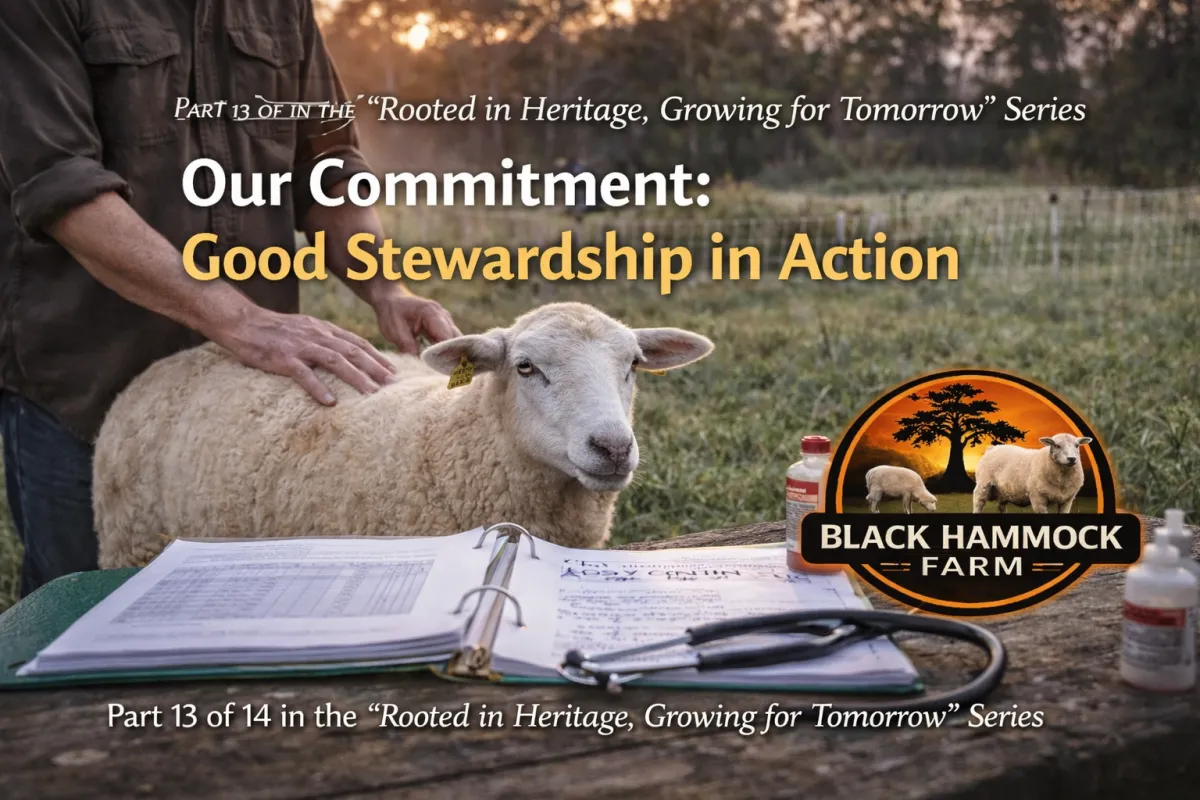
Stewardship You Can See
Our Commitment: Good Stewardship in Action
Part 13 of 14 in the "Rooted in Heritage, Growing for Tomorrow" Series
Throughout this series, I've made claims about Black Hammock Farm. We're a legitimate agricultural operation. We follow professional standards. We care for our animals and our land with intention and expertise.
Claims are easy to make. This week, I want to show you what those claims look like in practice.
Because stewardship isn't a philosophy you talk about. It's a set of actions you take every single day, whether anyone is watching or not.
Animal Welfare: More Than a Buzzword
Every animal at Black Hammock Farm has a name and an identity. We don't manage a faceless herd—we care for individuals.
That starts with body condition scoring.
Body condition scoring is a systematic method for evaluating livestock health, used by professional producers and recommended by university extension programs across the country. On a scale of 1 to 5, we assess each animal's physical condition—feeling along the spine, ribs, and loin to evaluate fat coverage and muscle mass.
A score of 1 means emaciated. A score of 5 means obese. We manage for 3 to 3.5—healthy animals with adequate reserves but not carrying excess weight that could complicate breeding or lambing.
We don't guess. We document. Every ewe gets scored, and those scores inform our management decisions. An animal trending downward gets additional nutrition. An animal trending upward might need adjusted grazing access. The numbers tell a story that casual observation might miss.
Health monitoringgoes beyond condition scores.
We watch for signs of parasites—the primary health challenge for sheep in Florida's humid climate. The FAMACHA system, developed specifically for small ruminant management, uses eyelid color to assess anemia from barber pole worm infestation. Pale eyelids indicate a problem; red eyelids indicate health.
We check hooves regularly. Foot rot and foot scald thrive in wet conditions, and prevention is far easier than treatment. We maintain clean, dry areas and trim hooves on a regular schedule.
We observe behavior. A sheep standing apart from the flock. A ewe not eating with her usual enthusiasm. A lamb that seems lethargic. Animals can't tell you when something's wrong—you have to know them well enough to notice.
Veterinary relationshipsmatter.
We don't wait for emergencies to establish care. We have a veterinarian who knows our operation, understands our management approach, and is available when we need guidance. Professional producers don't wing it—they build support networks before problems arise.
Breeding: Science, Not Chance
Our breeding program isn't "put rams with ewes and hope for the best." It's systematic, documented, and intentional.
We maintain an18-ewe breeding flockmanaged in rotating groups. Group A, Group B, Group C—each on a 12-week breeding interval. This staggered approach ensures year-round lamb production rather than a single seasonal surge.
Every breeding is planned:
Which ram pairs with which ewes (we track genetics to avoid inbreeding)
When breeding groups are assembled (timed for optimal lambing conditions)
Expected lambing dates (so we can provide appropriate monitoring)
Every outcome is recorded:
Conception rates by ram and ewe
Lambing ease (did the ewe need assistance?)
Number of lambs (singles, twins, triplets)
Birth weights and early growth rates
Any health issues during pregnancy or delivery
This data isn't just paperwork. It informs future decisions. A ewe with consistently difficult lambings might be culled from the breeding program. A ram throwing high-performing lambs becomes more valuable. Over time, the flock improves because we're selecting based on documented performance, not guesswork.
Individual animal identificationmakes this possible.
Every sheep at Black Hammock Farm can be identified and tracked. We know who's who, who's related to whom, and what each animal's history includes. This isn't hobby farming—it's the record-keeping that commercial livestock operations require.
Land Stewardship: Working With the Ecosystem
The land is not a backdrop for our operation. It's a partner.
Rotational grazingis the foundation of our pasture management.
We don't turn sheep loose on a field and let them graze it to dirt. We divide our acreage into paddocks and rotate animals through them systematically. Graze a section, move to the next, let the grazed area recover.
This approach:
Prevents overgrazing that damages pasture health
Allows vegetation to regrow and deepen root systems
Breaks parasite cycles (larvae in pasture die before animals return)
Distributes manure across the land rather than concentrating it
Maintains the plant diversity that healthy pastures need
We adjust rotation timing based on conditions. Fast growth in spring means faster rotation. Slower growth in dry periods means longer rest. The land tells us what it needs if we're paying attention.
Stocking ratesmatter as much as rotation.
How many animals per acre? The answer depends on pasture productivity, season, and weather. We follow UF/IFAS Extension guidelines for Florida conditions, which recommend much lighter stocking than producers in lush temperate regions might use.
Overstocking destroys pastures. Understocking wastes potential. Getting it right requires observation, adjustment, and willingness to make hard decisions—like reducing animal numbers if conditions warrant.
Soil healthis the ultimate measure.
Healthy soil grows healthy pasture, which grows healthy animals. We're not extracting from the land—we're building it. Rotational grazing with appropriate rest periods allows soil biology to thrive. Animal manure adds organic matter. Plant roots stabilize structure and add carbon.
We don't use synthetic fertilizers. We don't spray herbicides across our pastures. The sheep are our vegetation management system, and their manure is our fertilizer. It's a closed loop that's worked for thousands of years.
Professional Standards: How We Operate
Running a farm is running a business. We approach it that way.
Formal lease agreementsgovern our relationships with neighboring landowners whose property we graze. These aren't casual arrangements—they're written contracts specifying:
Duration and renewal terms
Responsibilities for fencing, water, and animal care
Stocking rates and grazing schedules
Liability and insurance requirements
Agricultural purpose and intent
These agreements demonstrate commercial operation. You don't execute legal contracts for hobbies.
Insurance and liability coverage protect everyone involved. Our Rent-A-Herd service operates on client properties, which means we carry appropriate liability coverage. Professional operations manage risk; amateur operations ignore it.
Business documentationgoes beyond animal records:
Revenue tracking by product line (livestock sales, Rent-A-Herd services, eggs and poultry)
Expense categorization and monitoring
Profit and loss assessment
Business planning and projections
We operate with what Florida statute calls "reasonable expectation of profit." That expectation isn't wishful thinking—it's based on documented revenue streams, understood costs, and realistic growth projections.
Transparency: Nothing to Hide
I've opened our operation to scrutiny throughout this series because we have nothing to hide.
The breeding records exist. The lease agreements exist. The body condition scores exist. The business documentation exists.
When the Magistrate reviewed our case, she had access to this evidence. She concluded that Black Hammock Farm meets every requirement of a bona fide commercial agricultural operation. That ruling wasn't based on sympathy or storytelling—it was based on documentation.
Our neighbors know what we do.The sheep are visible. The operations are observable. We're not running a hidden enterprise behind closed fences—we're farming in plain sight, in a community that can see our work.
Our clients know what they're getting. Rent-A-Herd customers receive clear explanations of our process, our animals, and our expectations. The Backyard Chicken Program includes ongoing support because we want participants to succeed, not just to make a sale.
County officials are welcome anytime.I've extended this invitation before and I'll extend it again: if anyone from Seminole County wants to see what we do, the gate is open. Walk the pastures. Review the records. Ask any question you want.
Legitimate operations welcome scrutiny. It's only when something's wrong that people hide.
Continuous Improvement: Always Learning
Good stewardship means acknowledging that you don't know everything.
We attend UF/IFAS Extension workshops when they're offered. We read research publications. We connect with other Katahdin producers through breed associations and the Farmer Veteran Coalition network. We learn from our mistakes—and we make them, like every farmer does.
The conservation grazing work we've discussed in this series is an example of continuous learning. We're not experts in wetland ecology. But we're educating ourselves, observing results on our own property, and building toward the expertise that would make us valuable partners for larger conservation efforts.
We follow updated protocols as best practices evolve. Parasite management recommendations have changed significantly over the past decade as resistance to dewormers has grown. We've adapted our approach based on current science rather than outdated habits.
We invest in infrastructure as resources allow. Better fencing. Improved water systems. Handling facilities that make animal care safer and less stressful. Every improvement makes the operation more professional and more sustainable.
We plan for succession.This farm isn't just about today—it's about building something that outlasts us. That means documenting what we do, training others who might continue the work, and making decisions that serve long-term sustainability rather than short-term convenience.
The Standard We Hold Ourselves To
Here's what I believe about farming:
The animals in our care deserve lives worth living. Not just survival—genuine welfare. Space to move, food to eat, health to maintain, and treatment that respects their nature as living creatures.
The land we steward deserves to be left better than we found it. Not depleted, not degraded, not treated as a resource to extract from. Built up, improved, made more productive and more resilient for whoever comes next.
The community we serve deserves honesty. About what we do, how we do it, and what we're capable of. No exaggeration, no false claims, no promises we can't keep.
The profession we practice deserves respect. Farming is skilled work. It requires knowledge, judgment, and continuous learning. We honor that tradition by taking it seriously.
These aren't marketing slogans. They're commitments—tested every day in decisions large and small.
When I choose to rotate pastures even though it's inconvenient, that's stewardship.
When I spend money on veterinary care that cuts into slim margins, that's stewardship.
When I document breeding outcomes even though paperwork is tedious, that's stewardship.
When I tell a potential client that our service isn't right for their situation, that's stewardship.
The word comes from an old concept: a steward is someone who manages property on behalf of another. We don't really own this land—we hold it in trust. For the community. For future generations. For the idea that agriculture can be sustainable, ethical, and valuable.
That's the standard we hold ourselves to. That's what we mean when we say we're committed to good stewardship.
What This Means for March 28th
When we appear before the Value Adjustment Board next week, we won't just be claiming to be a legitimate agricultural operation.
We'll be demonstrating it.
The documentation is ready. The evidence is assembled. The practices I've described in this post are verifiable, observable, and consistent with what professional agriculture looks like.
An independent Magistrate has already reviewed this evidence and concluded that we meet every legal requirement. We're asking the Board to affirm what the record shows.
But regardless of what happens in that hearing room, the stewardship continues.
Tomorrow morning, I'll walk the pastures. I'll check on the ewes. I'll evaluate conditions and make decisions based on what the animals and the land need. The same thing I did yesterday. The same thing I'll do the day after the hearing, whatever the outcome.
Because stewardship isn't something you do for an audience. It's who you are.
Next week in Part 14: "What Happens Next: An Invitation to Stand With Us"—the final chapter of this series, as we approach the March 28th hearing and look toward the future of Black Hammock Farm.
From the Pasture: Group C ewes have entered their breeding window this week. We've paired them with our secondary ram based on genetic complementarity—avoiding lineages that overlap with previous pairings. Expected lambing will fall in late spring, continuing our year-round production cycle.
Our Practices at a Glance:
Body condition scoring for all breeding stock
FAMACHA parasite monitoring
Rotational grazing with documented rest periods
Individual animal identification and tracking
Formal lease agreements for all off-site grazing
Breeding records with full genetic documentation
Business planning with revenue and expense tracking
A Question for Readers: What does "good stewardship" mean to you—whether for land, animals, or any responsibility you hold? We'd love to hear your perspective in the comments.
#RootedInHeritage #BlackHammockFarm #GoodStewardship #AnimalWelfare #SustainableFarming
1579 Walsh Street Oviedo,
Florida 32765
COMPANY
FARM SERVICES
LIVESTOCK PROGRAMS
FOLLOW US


POWERED BY:

© 2025 Black Hammock Family Farm.
All rights reserved.
1579 Walsh Street Oviedo,
Florida 32765
COMPANY
FARM SERVICES
LIVESTOCK PROGRAMS
FOLLOW US
POWERED BY:
© 2025 Black Hammock Family Farm. All rights reserved.