
Small Call to Action Headline
Black hammock farm'S Out Reach Programs
From Destruction to Creation and Healing
Black Hammock Farm extends beyond commercial agriculture into three community outreach programs, each reflecting our core belief that working the land offers pathways to peace, belonging, and resilience.
Fields of Peace Program
A Day with Brothers and Animals
Fields of Peace provides veteran service members a space for recovery, connection, and purpose through hands-on agricultural work. Farming offers what many veterans seek after service: meaningful physical labor, connection to living things, quiet purpose, and brotherhood without the weight of conflict.
“The program operates on a simple premise: there is peace in the pasture.” — Kip Hudakoz.
Who We Serve:
Combat veterans processing transition to civilian life.
Veterans experiencing PTSD, anxiety, or difficulty reintegrating
Service members seeking community outside clinical settings
Any veteran curious about agriculture as a second career or personal practice
No diagnosis required. No paperwork. Just show up.
What at Day Looks Like
Participants arrive in the morning and work alongside Agent K—a Marine veteran of the Gulf War Era—tending the flock and maintaining the farm.
Activities may include:
Morning flock check and feeding
Moving sheep between paddocks
Setting up portable fencing for rotational grazing
Body condition scoring and individual animal assessment
Basic veterinary care and hoof maintenance
Fence repair and pasture improvement
Equipment maintenance
Poultry care and egg collection
The work is real. The sheep don't care about your service record—they need to be fed, moved, and looked after. There's something grounding in that simplicity.
Lunch is shared. Stories are optional. The land does most of the talking.
Program Philosophy
Clinical settings serve essential purposes, but not every veteran thrives in them. Some need to work with their hands. Some need animals that respond to calm, steady presence. Some need to be outdoors, away from fluorescent lights and waiting rooms.
Fields of Peace isn't therapy. It's farming. But farming has its own way of working on a person.
The transition from military service to civilian life often lacks clear purpose. Agriculture provides that purpose in its most elemental form: living things depend on you. The work matters. The results are visible. And at the end of the day, you've built something instead of destroying something.
Open Pasture Program
Sustainable Farming for Everyone
Misssion: Open Pasture Program creates accessible agricultural experiences for individuals of all abilities, with particular emphasis on welcoming those with disabilities and special needs. The farm becomes a classroom without walls—a place where everyone can contribute, learn, and connect with the land.
Sustainable farming isn't just about environmental practices. It's about sustaining people, communities, and futures. Open Pasture ensures that pathway is open to all.
“The program operates on a simple premise: When a community learns together, they grow together.” — Kip Hudakoz.
Who We Serve:
Individuals with developmental disabilities
Those with physical disabilities seeking adaptive agricultural activities
Special needs students and educational programs
Therapeutic programs seeking agricultural partnerships
Families wanting inclusive farm experiences
Anyone interested in sustainable farming education
Potential activities include:
Open Pasture adapts to participants rather than requiring participants to adapt to us. Activities are scaled, modified, and structured based on individual abilities and interests.
Potential activities include:
Sensory experiences with sheep (supervised interaction, wool textures)
Egg collection from heritage poultry
Planting and garden maintenance
Feeding routines with visual schedules
Nature observation and journaling
Basic animal care tasks
Harvest activities (seasonal)
Farm art projects using natural materials
Sessions can be structured for individuals, small groups, or organized programs. We work with caregivers, teachers, and therapeutic professionals to design experiences that meet specific goals.
Program Philosophy
Agricultural settings offer unique benefits for individuals with disabilities:
Sensory regulation — The farm provides rich, natural sensory input: animal textures, outdoor sounds, soil and vegetation, physical movement through space.
Predictable routines — Animals require consistent care. This creates structure that many individuals find calming and manageable.
Meaningful contribution — Every task on a farm matters. Collecting eggs, filling water troughs, spreading feed—these are real jobs with visible results. Participants aren't doing "activities." They're doing farm work.
Non-judgmental environment — Sheep don't care about diagnoses or limitations. They respond to calm presence and consistent handling. Success is measured in completed tasks, not standardized assessments.
Connection to natural systems — Understanding where food comes from, how animals live, how seasons change—these connections ground us in something larger than ourselves.
Connection to CommunOT
Black Hammock Farm proudly supports CommunOT Farm and Programming, which pioneers therapeutic agricultural experiences. Open Pasture draws inspiration from their model and seeks to expand access to farm-based programming in Seminole County. Contact CommunOT for more details
Seminole Small Farm Alliance
Strength in Numbers, Roots in Community
Mission: The Seminole Small Farm Alliance provides mutual support, shared resources, and collective advocacy for small-scale agricultural operations in Seminole County, Florida. In a region where development pressure and bureaucratic obstacles threaten small farms, the Alliance ensures no farmer stands alone.
“The program operates on a simple premise: there is peace in the pasture.” — Kip Hudakoz.
The Problem We Address:
Small farms in Seminole County face challenges that large agricultural operations don't:
Agricultural classification battles — Property Appraisers may deny agricultural classification to legitimate operations, forcing small farmers into expensive appeals. The process is opaque, inconsistent, and financially devastating for operations already running on thin margins.
Regulatory navigation — Zoning codes, development orders, livestock regulations, water management permits—small farmers must navigate systems designed for larger operations or residential properties, often with little guidance.
Isolation — Unlike agricultural regions where farmers have built-in community, Seminole County's small farms are often islands surrounded by suburban development. Farmers lack peers who understand their challenges.
Resource limitations — Equipment, expertise, veterinary services, processing facilities—resources readily available in rural agricultural areas are scarce or expensive in transitional counties like Seminole.
What the Alliance Offers
Advocacy and Classification Support
Black Hammock Farm recently prevailed in a Value Adjustment Board appeal after the Property Appraiser denied agricultural classification despite the operation meeting every statutory requirement. The magistrate ruled decisively in our favor, criticizing the Appraiser's narrow interpretation.
That experience—including over $10,000 in legal costs and months of preparation—produced hard-won knowledge:
How Florida Statute 193.461 actually works
What documentation establishes "bona fide commercial agriculture"
How to present evidence effectively to the VAB
Which legal arguments succeed and which fail
How to navigate the appeals timeline
Alliance members facing classification challenges don't start from zero. They start with our playbook, our documentation templates, and our experience. When possible, we can connect farmers with legal counsel who understand agricultural classification.
Shared Knowledge Base:
Best practices for livestock in Florida's climate
Veterinary and extension service contacts
Equipment sharing and rental opportunities
Processing and direct-sales guidance
Grant and financing resources
Insurance and liability considerations
Collective Voice:
Individual small farmers have little influence on county policy. A coalition of farms speaking together commands attention. The Alliance can:
Engage with county commissioners on agricultural issues
Participate in comprehensive plan updates affecting agricultural land
Advocate for small-farm-friendly interpretations of regulations
Build relationships with Planning, Zoning, and Property Appraiser offices
Represent small agriculture in conversations currently dominated by development interests
Community Connection:
Regular gatherings—whether formal meetings or informal farm visits—break the isolation that small farmers experience. Problems shared are problems halved. Successes celebrated together build momentum.
Memembership:
The Seminole Small Farm Alliance welcomes:
Operating farms of any size in Seminole County
Farms pursuing agricultural classification
Landowners considering agricultural use
Agricultural operations in adjacent counties facing similar challenges
Supporting members (non-farmers who support small agriculture)
Initial membership is informal—join our contact list, attend gatherings, participate in discussions. As the Alliance develops, we may establish more formal structure based on member needs.
Founding Principles
Non-partisan — Agricultural issues cross political lines. The Alliance advocates for small farms, not parties or candidates.
Collaborative with government — We work with county officials, not against them. The goal is partnership and mutual understanding, not adversarial relationships. Many officials simply don't understand small farm operations; education often resolves conflicts.
Respect for diversity — Small farms vary enormously: produce, livestock, nurseries, aquaculture, agritourism. All legitimate agricultural operations are welcome regardless of type or scale.
Rooted in heritage — Seminole County has deep agricultural history, from the celery fields of Black Hammock to the citrus groves that once covered the region. The Alliance honors that heritage while building agricultural futures.
Future Developement
Formal organizational structure (nonprofit status consideration)
Regular meeting schedule and communication channels
Resource library (legal templates, documentation guides, contact lists)
Annual small farm tour showcasing Alliance members
Partnerships with University of Florida IFAS Extension
Engagement with Florida Farm Bureau and other agricultural organizations
Advocacy agenda developed collaboratively by members
Program Integration
These three programs share common roots and reinforce each other:
Fields of Peace veterans may discover agricultural careers, potentially starting their own operations with Seminole Small Farm Alliance support.
Open Pasture Program participants experience working farms, building public appreciation for the small agriculture that the Alliance protects.
Alliance member farms may host Fields of Peace or Open Pasture programming, expanding reach beyond Black Hammock Farm alone.
All three embody Black Hammock Farm's core philosophy: agriculture as creation, healing, and community connection. The commercial breeding operation and Rent-A-Herd services provide the sustainable foundation. These outreach programs extend that foundation into service.
Contact and Next Steps
Fields of Peace inquiries: Veterans interested in farm days, or veteran service organizations seeking partnerships
Open Pasture Program inquiries: Individuals, families, educators, or therapeutic programs interested in accessible farm experiences
Seminole Small Farm Alliance inquiries: Farmers seeking support, landowners considering agriculture, or community members wanting to support small farms
All programs: blackhammockfarm.com
Black Hammock Farm — Live, Fresh, Local
BLACK HAMMOCK FARM NEWS
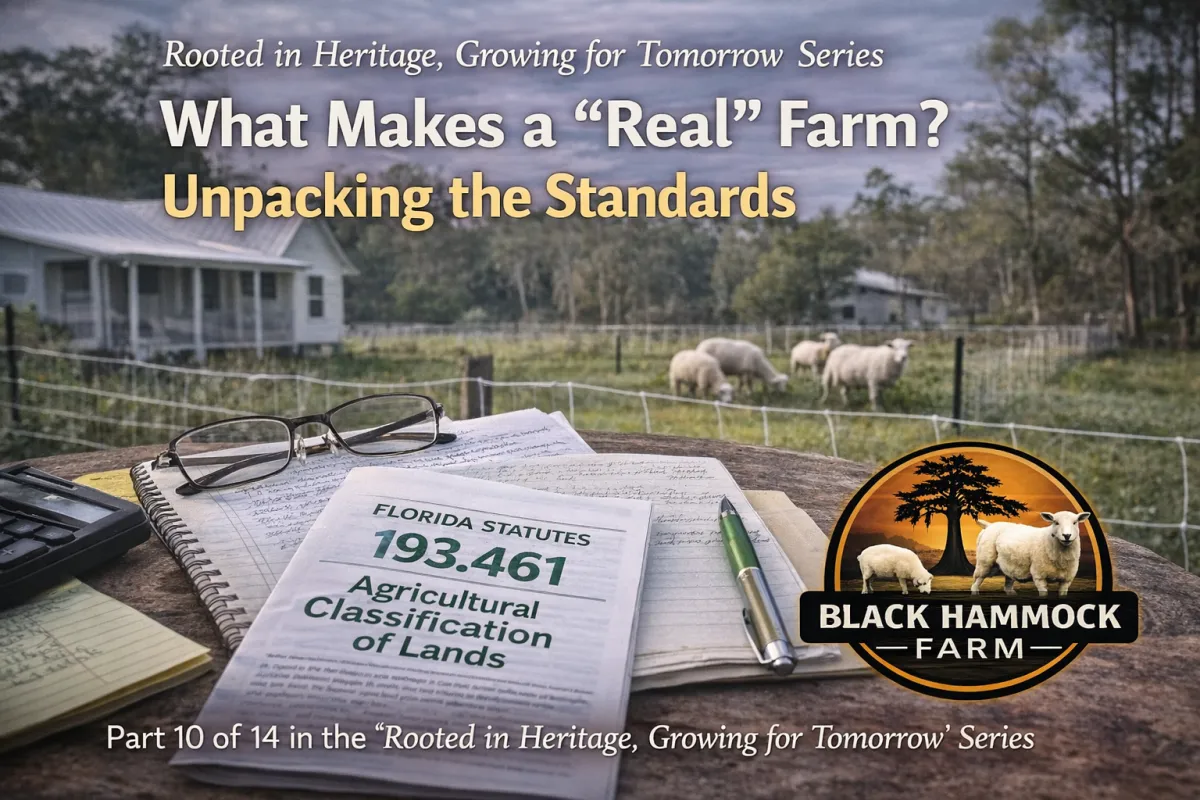
What Defines a Real Farm in Florida?
What Makes a "Real" Farm? Unpacking the Standards
Part 10 of 14 in the "Rooted in Heritage, Growing for Tomorrow" Series
When I tell people I'm a farmer, I can see the image forming in their minds.
Hundreds of acres. Red barns. Tractors rolling across endless fields. Maybe some cattle grazing on distant hillsides, or combines harvesting wheat under a golden sunset.
Then they visit Black Hammock Farm.
They see a few dozen acres. Katahdin sheep grazing in paddocks. Chicken coops. Portable fencing. A scale of operation that fits in the space between subdivisions rather than sprawling to the horizon.
And I can see the recalculation happening: Is this really a farm?
It's a fair question. The images we carry of agriculture come from movies and advertisements, from a century of industrialization that made "big" synonymous with "real." If farming means thousands of acres and millions of dollars, then what do you call what we do?
I call it farming. Florida law agrees. And this week, I want to explain why.
What the Law Actually Requires
Florida Statute 193.461 establishes the criteria for agricultural classification. It's the legal standard that determines whether land qualifies for assessment based on agricultural use rather than development potential.
The statute doesn't mention acreage minimums. It doesn't require specific revenue thresholds. It doesn't demand that operations look like industrial agriculture.
What it requires is "bona fide commercial agricultural purposes."
Let's break that down:
Bona fide means genuine. Good faith. Not a sham or a pretense, but a real commitment to agricultural use. The question isn't whether your farm looks impressive—it's whether your agricultural activity is authentic.
Commercial means oriented toward profit. Not a hobby pursued for personal enjoyment regardless of economics. A commercial operation intends to generate revenue, manages toward that goal, and has a reasonable expectation of achieving it.
Agricultural purposes cover a broad range of activities: raising livestock, producing crops, breeding animals, and cultivating plants. The statute includes explicitly "livestock" and "poultry" among qualifying uses—exactly what Black Hammock Farm produces.
That's the legal standard. Genuine. Commercial. Agricultural.
Notice what's missing: scale.
The Factors That Actually Matter
When a Property Appraiser evaluates an agricultural classification application, Florida law directs them to consider specific factors. These aren't suggestions—they're statutory requirements.
The length of time the land has been used for agricultural purposes. Not "how big is the operation" but "how long has this been happening?" Continuous agrarian use over the years demonstrates a commitment that casual hobby use doesn't.
Whether the use has been continuous, agriculture isn't a one-time thing. Animals need care every day. Pastures need management every season. Continuous use shows that the operation is real, not a convenient claim made at tax time.
The purchase price paid for the land. This factor helps distinguish between land bought for agricultural use and land bought for investment or speculation with agriculture as a cover story.
The size of the tract. Yes, size is a factor—but it's one factor among many, not a disqualifying threshold. The statute explicitly contemplates that agricultural operations come in different sizes.
Has an effort been made to adequately care for the land, and are you actually managing the property? Maintaining fences, rotating pastures, and controlling invasive species? Or is the land neglected while you claim agricultural use?
Whether the land is under lease and the terms of the lease, formal lease arrangements demonstrate commercial intent. They show that the operation extends beyond casual personal use into business relationships with legal obligations.
Whether the land is being valued at its agricultural use by any state or federal agency. Other governmental recognitions of agricultural status support classification.
Read through that list. Now ask: which of those factors requires industrial scale?
None of them.
What Black Hammock Farm Actually Does
Let me be specific about our operation, because specificity matters.
Systematic breeding program. We maintain an 18-ewe breeding flock managed in documented rotation. Group A ewes bred at specific intervals. Group B ewes are on a different schedule. Group C follows after. Each animal is tracked individually with identification systems. Breeding dates recorded. Lambling outcomes documented.
This isn't "we have some sheep." This is livestock production with protocols.
Multiple lease agreements. Black Hammock Farm operates across approximately 17 acres through formal lease agreements with neighboring properties. These aren't handshake deals—they're written contracts with professional management provisions that specify responsibilities, terms, and agricultural purposes.
Lease arrangements at this scale demonstrate commercial intent. You don't execute formal legal agreements for a hobby.
Diversified revenue streams. Our operation generates income through multiple channels:
Livestock sales (lambs, breeding stock)
Rent-A-Herd vegetation management services
Poultry and egg sales
The U-Pick Up program for holiday livestock
The Backyard Chicken Program supports new poultry keepers
This isn't a single-product operation hoping one thing works out. It's a diversified agricultural business pursuing multiple market opportunities.
Professional documentation. We maintain body condition scores for our animals—the systematic evaluation of livestock health that serious producers use to guide management decisions. We follow University of Florida IFAS Extension guidelines for our region and species. We keep records that would satisfy any agricultural auditor.
Reasonable expectation of profit. Our business plan projects profitability as the operation matures. We're in the building phase that any agricultural startup experiences, but the trajectory is toward commercial viability. Every decision we make is oriented toward that goal.
The Small Farm Reality
Here's something that often gets lost in conversations about agricultural classification: most farms in America are small.
According to USDA data, 89% of U.S. farms are classified as "small"—generating less than $350,000 in gross cash farm income annually. The majority generate far less than that.
Family operations. Part-time farmers who also hold other jobs. Specialty producers serving local markets rather than commodity chains. Diversified operations that don't fit neatly into industrial categories.
These farms matter. They provide local food. They maintain agricultural land. They preserve rural character in communities facing development pressure. They offer alternatives to industrial production for consumers who want them.
If agricultural classification only protected large operations, we'd be writing policy that excludes the vast majority of American farms. That can't be what Florida's legislature intended when it created these protections.
The "Hobby Farm" Accusation
I know what skeptics think: small farms are just hobbies for wealthy landowners who want tax breaks.
I think that accusation should be a direct response.
A hobby is something you do for personal enjoyment, regardless of whether it makes economic sense. You don't care if it loses money because the pleasure justifies the cost.
A commercial operation is something you do with the intention of earning a profit. You make decisions based on economics. You track income and expenses. You adjust practices based on what's working and what isn't.
The distinction isn't size. Its orientation.
A wealthy person with 500 acres who keeps a few horses for personal riding and claims agricultural classification? That's a hobby. The horses don't generate revenue. There's no business plan. The "agricultural use" is really personal recreation.
A family with 17 acres who maintains formal breeding programs, executes commercial lease agreements, provides fee-based services to the community, sells livestock and eggs, and documents everything with professional protocols? That's a commercial operation. The intention, structure, and management all point toward the business purpose.
Black Hammock Farm isn't a lifestyle amenity. It's a business—built with profitability in mind, managed according to commercial principles, and documented like any serious agricultural enterprise.
We've invested over $10,000 in legal fees alone defending this classification. Nobody spends that kind of money on a hobby.
What We're Really Asking
When we stand before the Value Adjustment Board on March 28th, we're not asking for special treatment. We're not asking them to bend the rules for a sympathetic story.
We're asking them to apply the law as written.
Florida Statute 193.461 establishes criteria for agricultural classification. An independent Magistrate reviewed our operation against those criteria and found that we meet every requirement. The evidence supports our case.
The question isn't whether Black Hammock Farm is as big as an industrial operation. It isn't. Neither are 89% of American farms.
The question is whether we're engaged in bona fide commercial agricultural activity. The breeding programs say yes. The lease agreements say yes. The revenue streams say yes. The documentation says yes. The Magistrate said yes.
We're asking the Value Adjustment Board to say yes to.
Why This Matters Beyond Us
If the standard for agricultural classification becomes "look like industrial agriculture," small farms across Florida face an impossible bar.
The family raising pastured poultry on ten acres? Not a real farm.
The specialty vegetable grower serving farmers' markets? Not a real farm.
Is the heritage livestock breeder preserving rare genetics? Not a real farm.
The beginning farmer building an operation from scratch? Not a real farm—at least not until they somehow achieve scale without the classification that makes building possible.
That's not what Florida's agricultural classification law was designed to do. It was designed to keep working farms working—all sizes, all types, all the families trying to produce something valuable from the land.
Black Hammock Farm is one of those families. We've built something real. We've documented it thoroughly. An independent reviewer confirmed that we meet the legal standard.
A farm isn't measured by its acreage alone. It's measured by the intention, the care, and the commitment to producing something of value for the community.
By that measure—the measure that actually matters—Black Hammock Farm is as real as it gets.
Next week in Part 11: "Neighbors, Not Adversaries: A Call for Collaboration"—we'll explore how agricultural operations and county governments can work together rather than at cross-purposes, and share our vision for a more productive relationship.
From the Pasture: Breeding season continues on schedule. We're monitoring Group B ewes closely as they approach lambing—body condition scores are strong, and we're seeing healthy weight gain, which predicts good outcomes. The systematic approach works, season after season.
By the Numbers: Black Hammock Farm currently manages 22 animals (3 rams, 8 ewes, 11 lambs) with individual identification across approximately 17 acres of owned and leased property. Every animal is tracked. Every breeding is documented. This is commercial agriculture.
A Question for Readers: What do you think makes a "real" farm? Is it size? Revenue? Intention? We'd love to hear your perspective in the comments.
#RootedInHeritage #BlackHammockFarm #SmallFarmsMatter #BonafideAgriculture #FamilyFarm
1579 Walsh Street Oviedo,
Florida 32765
COMPANY
FARM SERVICES
LIVESTOCK PROGRAMS
FOLLOW US


POWERED BY:

© 2025 Black Hammock Family Farm.
All rights reserved.
1579 Walsh Street Oviedo,
Florida 32765
COMPANY
FARM SERVICES
LIVESTOCK PROGRAMS
FOLLOW US
POWERED BY:
© 2025 Black Hammock Family Farm. All rights reserved.