
Small Call to Action Headline
Black hammock farm'S Out Reach Programs
From Destruction to Creation and Healing
Black Hammock Farm extends beyond commercial agriculture into three community outreach programs, each reflecting our core belief that working the land offers pathways to peace, belonging, and resilience.
Fields of Peace Program
A Day with Brothers and Animals
Fields of Peace provides veteran service members a space for recovery, connection, and purpose through hands-on agricultural work. Farming offers what many veterans seek after service: meaningful physical labor, connection to living things, quiet purpose, and brotherhood without the weight of conflict.
“The program operates on a simple premise: there is peace in the pasture.” — Kip Hudakoz.
Who We Serve:
Combat veterans processing transition to civilian life.
Veterans experiencing PTSD, anxiety, or difficulty reintegrating
Service members seeking community outside clinical settings
Any veteran curious about agriculture as a second career or personal practice
No diagnosis required. No paperwork. Just show up.
What at Day Looks Like
Participants arrive in the morning and work alongside Agent K—a Marine veteran of the Gulf War Era—tending the flock and maintaining the farm.
Activities may include:
Morning flock check and feeding
Moving sheep between paddocks
Setting up portable fencing for rotational grazing
Body condition scoring and individual animal assessment
Basic veterinary care and hoof maintenance
Fence repair and pasture improvement
Equipment maintenance
Poultry care and egg collection
The work is real. The sheep don't care about your service record—they need to be fed, moved, and looked after. There's something grounding in that simplicity.
Lunch is shared. Stories are optional. The land does most of the talking.
Program Philosophy
Clinical settings serve essential purposes, but not every veteran thrives in them. Some need to work with their hands. Some need animals that respond to calm, steady presence. Some need to be outdoors, away from fluorescent lights and waiting rooms.
Fields of Peace isn't therapy. It's farming. But farming has its own way of working on a person.
The transition from military service to civilian life often lacks clear purpose. Agriculture provides that purpose in its most elemental form: living things depend on you. The work matters. The results are visible. And at the end of the day, you've built something instead of destroying something.
Open Pasture Program
Sustainable Farming for Everyone
Misssion: Open Pasture Program creates accessible agricultural experiences for individuals of all abilities, with particular emphasis on welcoming those with disabilities and special needs. The farm becomes a classroom without walls—a place where everyone can contribute, learn, and connect with the land.
Sustainable farming isn't just about environmental practices. It's about sustaining people, communities, and futures. Open Pasture ensures that pathway is open to all.
“The program operates on a simple premise: When a community learns together, they grow together.” — Kip Hudakoz.
Who We Serve:
Individuals with developmental disabilities
Those with physical disabilities seeking adaptive agricultural activities
Special needs students and educational programs
Therapeutic programs seeking agricultural partnerships
Families wanting inclusive farm experiences
Anyone interested in sustainable farming education
Potential activities include:
Open Pasture adapts to participants rather than requiring participants to adapt to us. Activities are scaled, modified, and structured based on individual abilities and interests.
Potential activities include:
Sensory experiences with sheep (supervised interaction, wool textures)
Egg collection from heritage poultry
Planting and garden maintenance
Feeding routines with visual schedules
Nature observation and journaling
Basic animal care tasks
Harvest activities (seasonal)
Farm art projects using natural materials
Sessions can be structured for individuals, small groups, or organized programs. We work with caregivers, teachers, and therapeutic professionals to design experiences that meet specific goals.
Program Philosophy
Agricultural settings offer unique benefits for individuals with disabilities:
Sensory regulation — The farm provides rich, natural sensory input: animal textures, outdoor sounds, soil and vegetation, physical movement through space.
Predictable routines — Animals require consistent care. This creates structure that many individuals find calming and manageable.
Meaningful contribution — Every task on a farm matters. Collecting eggs, filling water troughs, spreading feed—these are real jobs with visible results. Participants aren't doing "activities." They're doing farm work.
Non-judgmental environment — Sheep don't care about diagnoses or limitations. They respond to calm presence and consistent handling. Success is measured in completed tasks, not standardized assessments.
Connection to natural systems — Understanding where food comes from, how animals live, how seasons change—these connections ground us in something larger than ourselves.
Connection to CommunOT
Black Hammock Farm proudly supports CommunOT Farm and Programming, which pioneers therapeutic agricultural experiences. Open Pasture draws inspiration from their model and seeks to expand access to farm-based programming in Seminole County. Contact CommunOT for more details
Seminole Small Farm Alliance
Strength in Numbers, Roots in Community
Mission: The Seminole Small Farm Alliance provides mutual support, shared resources, and collective advocacy for small-scale agricultural operations in Seminole County, Florida. In a region where development pressure and bureaucratic obstacles threaten small farms, the Alliance ensures no farmer stands alone.
“The program operates on a simple premise: there is peace in the pasture.” — Kip Hudakoz.
The Problem We Address:
Small farms in Seminole County face challenges that large agricultural operations don't:
Agricultural classification battles — Property Appraisers may deny agricultural classification to legitimate operations, forcing small farmers into expensive appeals. The process is opaque, inconsistent, and financially devastating for operations already running on thin margins.
Regulatory navigation — Zoning codes, development orders, livestock regulations, water management permits—small farmers must navigate systems designed for larger operations or residential properties, often with little guidance.
Isolation — Unlike agricultural regions where farmers have built-in community, Seminole County's small farms are often islands surrounded by suburban development. Farmers lack peers who understand their challenges.
Resource limitations — Equipment, expertise, veterinary services, processing facilities—resources readily available in rural agricultural areas are scarce or expensive in transitional counties like Seminole.
What the Alliance Offers
Advocacy and Classification Support
Black Hammock Farm recently prevailed in a Value Adjustment Board appeal after the Property Appraiser denied agricultural classification despite the operation meeting every statutory requirement. The magistrate ruled decisively in our favor, criticizing the Appraiser's narrow interpretation.
That experience—including over $10,000 in legal costs and months of preparation—produced hard-won knowledge:
How Florida Statute 193.461 actually works
What documentation establishes "bona fide commercial agriculture"
How to present evidence effectively to the VAB
Which legal arguments succeed and which fail
How to navigate the appeals timeline
Alliance members facing classification challenges don't start from zero. They start with our playbook, our documentation templates, and our experience. When possible, we can connect farmers with legal counsel who understand agricultural classification.
Shared Knowledge Base:
Best practices for livestock in Florida's climate
Veterinary and extension service contacts
Equipment sharing and rental opportunities
Processing and direct-sales guidance
Grant and financing resources
Insurance and liability considerations
Collective Voice:
Individual small farmers have little influence on county policy. A coalition of farms speaking together commands attention. The Alliance can:
Engage with county commissioners on agricultural issues
Participate in comprehensive plan updates affecting agricultural land
Advocate for small-farm-friendly interpretations of regulations
Build relationships with Planning, Zoning, and Property Appraiser offices
Represent small agriculture in conversations currently dominated by development interests
Community Connection:
Regular gatherings—whether formal meetings or informal farm visits—break the isolation that small farmers experience. Problems shared are problems halved. Successes celebrated together build momentum.
Memembership:
The Seminole Small Farm Alliance welcomes:
Operating farms of any size in Seminole County
Farms pursuing agricultural classification
Landowners considering agricultural use
Agricultural operations in adjacent counties facing similar challenges
Supporting members (non-farmers who support small agriculture)
Initial membership is informal—join our contact list, attend gatherings, participate in discussions. As the Alliance develops, we may establish more formal structure based on member needs.
Founding Principles
Non-partisan — Agricultural issues cross political lines. The Alliance advocates for small farms, not parties or candidates.
Collaborative with government — We work with county officials, not against them. The goal is partnership and mutual understanding, not adversarial relationships. Many officials simply don't understand small farm operations; education often resolves conflicts.
Respect for diversity — Small farms vary enormously: produce, livestock, nurseries, aquaculture, agritourism. All legitimate agricultural operations are welcome regardless of type or scale.
Rooted in heritage — Seminole County has deep agricultural history, from the celery fields of Black Hammock to the citrus groves that once covered the region. The Alliance honors that heritage while building agricultural futures.
Future Developement
Formal organizational structure (nonprofit status consideration)
Regular meeting schedule and communication channels
Resource library (legal templates, documentation guides, contact lists)
Annual small farm tour showcasing Alliance members
Partnerships with University of Florida IFAS Extension
Engagement with Florida Farm Bureau and other agricultural organizations
Advocacy agenda developed collaboratively by members
Program Integration
These three programs share common roots and reinforce each other:
Fields of Peace veterans may discover agricultural careers, potentially starting their own operations with Seminole Small Farm Alliance support.
Open Pasture Program participants experience working farms, building public appreciation for the small agriculture that the Alliance protects.
Alliance member farms may host Fields of Peace or Open Pasture programming, expanding reach beyond Black Hammock Farm alone.
All three embody Black Hammock Farm's core philosophy: agriculture as creation, healing, and community connection. The commercial breeding operation and Rent-A-Herd services provide the sustainable foundation. These outreach programs extend that foundation into service.
Contact and Next Steps
Fields of Peace inquiries: Veterans interested in farm days, or veteran service organizations seeking partnerships
Open Pasture Program inquiries: Individuals, families, educators, or therapeutic programs interested in accessible farm experiences
Seminole Small Farm Alliance inquiries: Farmers seeking support, landowners considering agriculture, or community members wanting to support small farms
All programs: blackhammockfarm.com
Black Hammock Farm — Live, Fresh, Local
BLACK HAMMOCK FARM NEWS
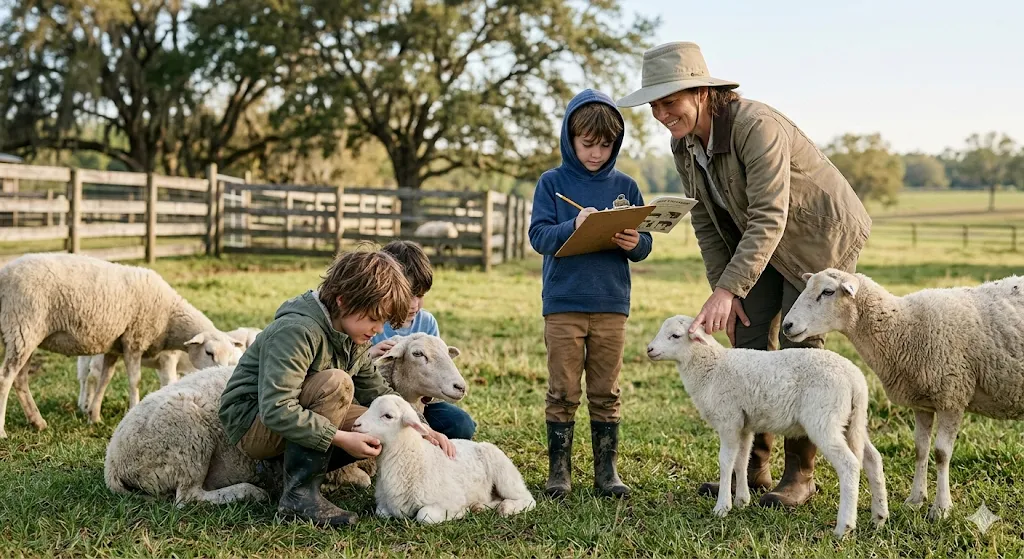
Where Lambs Teach Lessons: How Black Hammock Farm Is Redefining Science Education This Spring
Where Lambs Teach Lessons: How Black Hammock Farm Is Redefining Science Education This Spring
There's a moment — and if you've ever watched a child meet a lamb for the very first time, you know exactly what I'm talking about — where learning stops being something that happens to a kid and starts being something that happens in them.
That moment doesn't usually happen in a classroom. It happens outside, in the open air, with muddy boots and wide eyes and a question they didn't even know they had until the animal was right in front of them.
This March 14th, Black Hammock Farm is hosting exactly that kind of moment — and every family in Central Florida should know about it.
A Farm Lab Unlike Any Field Trip You've Seen Before
Functional Farm Science: The Lifecycle of the Lamb isn't a passive field trip. It's a structured, hands-on farm lab experience co-created by Tyler Lacertosa, OTD, and Dr. Melissa Mesman (EdD candidate) through CommunOT Farm & Programming — a pediatric occupational therapy organization rooted in Seminole County, FL.
The premise is simple but powerful: real science education happens best in real environments. And right now, during lambing season on a working heritage livestock farm, there is no better classroom on earth than Black Hammock Farm in Oviedo, Florida.
This is hands-on farm science education in Florida at its finest — built for children ages 2–18, including learners with sensory processing needs.
What Your Child Will Actually Do on March 14
When students arrive at Black Hammock Farm, they won't be handed a worksheet and told to observe. They'll be participants — guided through the same assessment practices that professional shepherds and veterinary staff use every day.
Here's what the farm lab includes:
Body Condition Scoring (BCS)
Students use their hands to evaluate the health and nutritional status of sheep through a standardized palpation technique — no scales, no equipment, just trained observation. This is nature-based occupational therapy farm experience in action: sensory engagement that builds both scientific understanding and real-world skill.
Lamb Vaccination Protocols
Participants explore the CDT vaccination schedule — what it protects against, why timing matters, and why a lamb's first hours of life are critical for immunity. Age-differentiated materials ensure every learner, from toddler to teen, connects with the content meaningfully.
Live Animal Interaction & Field Guide Documentation
Students interact directly with Katahdin sheep and their lambs in an open pasture setting, then use printed field guides to record and document their observations — building the habits of scientific inquiry through structured discovery.
This is the kind of outdoor science lab for kids in Seminole County, FL that turns a Saturday morning into a memory that shapes how a child thinks about the natural world for years to come.
Why Black Hammock Farm Is the Perfect Partner
Not every farm can host an experience like this. Black Hammock Farm isn't just a venue — it's a working heritage livestock operation raising Katahdin sheep and free-range poultry with a deep commitment to ethical, educational animal husbandry.
Katahdin sheep are a hair breed known for their gentle temperament and ease of management — which makes them especially well-suited to educational interaction with children. And March, right in the heart of lambing season, is the most powerful time of year to explore the livestock lifecycle firsthand.
The open-air farm environment also does something a classroom simply can't: it provides the sensory regulation inputs — natural textures, gentle animal sounds, fresh air, unstructured outdoor movement — that help children with sensory processing needs regulate and focus. Visit communotfarm.com to learn more about how CommunOT designs every experience with OT skill targets in mind.
Designed for Every Kind of Learner
One of the things that makes this hands-on livestock science field trip in Central Florida so special is that it was designed with every learner in mind — not just neurotypical students, not just older kids, not just homeschoolers.
CommunOT has developed age-differentiated take-home materials for this event:
Younger participants receive warmly illustrated content with accessible vocabulary
Teen participants receive rigorous packets with scientific terminology, scenario analysis, and OT-connected reflection prompts
Parents receive their own guidance on how to support their child's engagement and extend the learning at home
Whether your child is two or eighteen, there's a meaningful entry point waiting for them at Black Hammock Farm.
This Is Only the Beginning — Spring Roots 2026
The March 14th event is the first of two planned CommunOT farm programming sessions for 2026. The fall event, Harvest & Thrive, will build on the themes introduced this spring. Families who participate in both gain a longitudinal view of the farm calendar — and a richer understanding of the seasonal rhythms that shape agricultural life.
Farm science education in Florida doesn't have to end when the field trip bus pulls away. At Black Hammock Farm, it's a living, growing curriculum — one that follows the seasons, the animals, and the curiosity of the children who show up ready to learn.
Reserve Your Spot Before It's Gone
Space is limited. This is a small-group, hands-on experience — not a large open event — which means once it fills up, it fills up.
Event Details:
Date: Saturday, March 14, 2026
Time: 10:00 – 11:30 AM
Location: Black Hammock Farm, Oviedo, FL
Cost: $30 per student
Ages: 2–18 · All learners welcome
Register now at communotfarm.com before spots are gone.
Your child doesn't need a perfect classroom to learn great science. Sometimes, they just need a lamb, a field guide, and a farm that believes in them.
CommunOT Farm & Programming is a pediatric occupational therapy organization based in Seminole County, FL, dedicated to integrating sensory-rich, nature-based experiences into developmental programming for children ages 2–18. Learn more and register at communotfarm.com.
1579 Walsh Street Oviedo,
Florida 32765
COMPANY
FARM SERVICES
LIVESTOCK PROGRAMS
FOLLOW US


POWERED BY:
© 2025 Black Hammock Family Farm.
All rights reserved.
1579 Walsh Street Oviedo,
Florida 32765
COMPANY
FARM SERVICES
LIVESTOCK PROGRAMS
FOLLOW US
POWERED BY:
© 2025 Black Hammock Family Farm. All rights reserved.