
Small Call to Action Headline
Black hammock farm'S Out Reach Programs
From Destruction to Creation and Healing
Black Hammock Farm extends beyond commercial agriculture into three community outreach programs, each reflecting our core belief that working the land offers pathways to peace, belonging, and resilience.
Fields of Peace Program
A Day with Brothers and Animals
Fields of Peace provides veteran service members a space for recovery, connection, and purpose through hands-on agricultural work. Farming offers what many veterans seek after service: meaningful physical labor, connection to living things, quiet purpose, and brotherhood without the weight of conflict.
“The program operates on a simple premise: there is peace in the pasture.” — Kip Hudakoz.
Who We Serve:
Combat veterans processing transition to civilian life.
Veterans experiencing PTSD, anxiety, or difficulty reintegrating
Service members seeking community outside clinical settings
Any veteran curious about agriculture as a second career or personal practice
No diagnosis required. No paperwork. Just show up.
What at Day Looks Like
Participants arrive in the morning and work alongside Agent K—a Marine veteran of the Gulf War Era—tending the flock and maintaining the farm.
Activities may include:
Morning flock check and feeding
Moving sheep between paddocks
Setting up portable fencing for rotational grazing
Body condition scoring and individual animal assessment
Basic veterinary care and hoof maintenance
Fence repair and pasture improvement
Equipment maintenance
Poultry care and egg collection
The work is real. The sheep don't care about your service record—they need to be fed, moved, and looked after. There's something grounding in that simplicity.
Lunch is shared. Stories are optional. The land does most of the talking.
Program Philosophy
Clinical settings serve essential purposes, but not every veteran thrives in them. Some need to work with their hands. Some need animals that respond to calm, steady presence. Some need to be outdoors, away from fluorescent lights and waiting rooms.
Fields of Peace isn't therapy. It's farming. But farming has its own way of working on a person.
The transition from military service to civilian life often lacks clear purpose. Agriculture provides that purpose in its most elemental form: living things depend on you. The work matters. The results are visible. And at the end of the day, you've built something instead of destroying something.
Open Pasture Program
Sustainable Farming for Everyone
Misssion: Open Pasture Program creates accessible agricultural experiences for individuals of all abilities, with particular emphasis on welcoming those with disabilities and special needs. The farm becomes a classroom without walls—a place where everyone can contribute, learn, and connect with the land.
Sustainable farming isn't just about environmental practices. It's about sustaining people, communities, and futures. Open Pasture ensures that pathway is open to all.
“The program operates on a simple premise: When a community learns together, they grow together.” — Kip Hudakoz.
Who We Serve:
Individuals with developmental disabilities
Those with physical disabilities seeking adaptive agricultural activities
Special needs students and educational programs
Therapeutic programs seeking agricultural partnerships
Families wanting inclusive farm experiences
Anyone interested in sustainable farming education
Potential activities include:
Open Pasture adapts to participants rather than requiring participants to adapt to us. Activities are scaled, modified, and structured based on individual abilities and interests.
Potential activities include:
Sensory experiences with sheep (supervised interaction, wool textures)
Egg collection from heritage poultry
Planting and garden maintenance
Feeding routines with visual schedules
Nature observation and journaling
Basic animal care tasks
Harvest activities (seasonal)
Farm art projects using natural materials
Sessions can be structured for individuals, small groups, or organized programs. We work with caregivers, teachers, and therapeutic professionals to design experiences that meet specific goals.
Program Philosophy
Agricultural settings offer unique benefits for individuals with disabilities:
Sensory regulation — The farm provides rich, natural sensory input: animal textures, outdoor sounds, soil and vegetation, physical movement through space.
Predictable routines — Animals require consistent care. This creates structure that many individuals find calming and manageable.
Meaningful contribution — Every task on a farm matters. Collecting eggs, filling water troughs, spreading feed—these are real jobs with visible results. Participants aren't doing "activities." They're doing farm work.
Non-judgmental environment — Sheep don't care about diagnoses or limitations. They respond to calm presence and consistent handling. Success is measured in completed tasks, not standardized assessments.
Connection to natural systems — Understanding where food comes from, how animals live, how seasons change—these connections ground us in something larger than ourselves.
Connection to CommunOT
Black Hammock Farm proudly supports CommunOT Farm and Programming, which pioneers therapeutic agricultural experiences. Open Pasture draws inspiration from their model and seeks to expand access to farm-based programming in Seminole County. Contact CommunOT for more details
Seminole Small Farm Alliance
Strength in Numbers, Roots in Community
Mission: The Seminole Small Farm Alliance provides mutual support, shared resources, and collective advocacy for small-scale agricultural operations in Seminole County, Florida. In a region where development pressure and bureaucratic obstacles threaten small farms, the Alliance ensures no farmer stands alone.
“The program operates on a simple premise: there is peace in the pasture.” — Kip Hudakoz.
The Problem We Address:
Small farms in Seminole County face challenges that large agricultural operations don't:
Agricultural classification battles — Property Appraisers may deny agricultural classification to legitimate operations, forcing small farmers into expensive appeals. The process is opaque, inconsistent, and financially devastating for operations already running on thin margins.
Regulatory navigation — Zoning codes, development orders, livestock regulations, water management permits—small farmers must navigate systems designed for larger operations or residential properties, often with little guidance.
Isolation — Unlike agricultural regions where farmers have built-in community, Seminole County's small farms are often islands surrounded by suburban development. Farmers lack peers who understand their challenges.
Resource limitations — Equipment, expertise, veterinary services, processing facilities—resources readily available in rural agricultural areas are scarce or expensive in transitional counties like Seminole.
What the Alliance Offers
Advocacy and Classification Support
Black Hammock Farm recently prevailed in a Value Adjustment Board appeal after the Property Appraiser denied agricultural classification despite the operation meeting every statutory requirement. The magistrate ruled decisively in our favor, criticizing the Appraiser's narrow interpretation.
That experience—including over $10,000 in legal costs and months of preparation—produced hard-won knowledge:
How Florida Statute 193.461 actually works
What documentation establishes "bona fide commercial agriculture"
How to present evidence effectively to the VAB
Which legal arguments succeed and which fail
How to navigate the appeals timeline
Alliance members facing classification challenges don't start from zero. They start with our playbook, our documentation templates, and our experience. When possible, we can connect farmers with legal counsel who understand agricultural classification.
Shared Knowledge Base:
Best practices for livestock in Florida's climate
Veterinary and extension service contacts
Equipment sharing and rental opportunities
Processing and direct-sales guidance
Grant and financing resources
Insurance and liability considerations
Collective Voice:
Individual small farmers have little influence on county policy. A coalition of farms speaking together commands attention. The Alliance can:
Engage with county commissioners on agricultural issues
Participate in comprehensive plan updates affecting agricultural land
Advocate for small-farm-friendly interpretations of regulations
Build relationships with Planning, Zoning, and Property Appraiser offices
Represent small agriculture in conversations currently dominated by development interests
Community Connection:
Regular gatherings—whether formal meetings or informal farm visits—break the isolation that small farmers experience. Problems shared are problems halved. Successes celebrated together build momentum.
Memembership:
The Seminole Small Farm Alliance welcomes:
Operating farms of any size in Seminole County
Farms pursuing agricultural classification
Landowners considering agricultural use
Agricultural operations in adjacent counties facing similar challenges
Supporting members (non-farmers who support small agriculture)
Initial membership is informal—join our contact list, attend gatherings, participate in discussions. As the Alliance develops, we may establish more formal structure based on member needs.
Founding Principles
Non-partisan — Agricultural issues cross political lines. The Alliance advocates for small farms, not parties or candidates.
Collaborative with government — We work with county officials, not against them. The goal is partnership and mutual understanding, not adversarial relationships. Many officials simply don't understand small farm operations; education often resolves conflicts.
Respect for diversity — Small farms vary enormously: produce, livestock, nurseries, aquaculture, agritourism. All legitimate agricultural operations are welcome regardless of type or scale.
Rooted in heritage — Seminole County has deep agricultural history, from the celery fields of Black Hammock to the citrus groves that once covered the region. The Alliance honors that heritage while building agricultural futures.
Future Developement
Formal organizational structure (nonprofit status consideration)
Regular meeting schedule and communication channels
Resource library (legal templates, documentation guides, contact lists)
Annual small farm tour showcasing Alliance members
Partnerships with University of Florida IFAS Extension
Engagement with Florida Farm Bureau and other agricultural organizations
Advocacy agenda developed collaboratively by members
Program Integration
These three programs share common roots and reinforce each other:
Fields of Peace veterans may discover agricultural careers, potentially starting their own operations with Seminole Small Farm Alliance support.
Open Pasture Program participants experience working farms, building public appreciation for the small agriculture that the Alliance protects.
Alliance member farms may host Fields of Peace or Open Pasture programming, expanding reach beyond Black Hammock Farm alone.
All three embody Black Hammock Farm's core philosophy: agriculture as creation, healing, and community connection. The commercial breeding operation and Rent-A-Herd services provide the sustainable foundation. These outreach programs extend that foundation into service.
Contact and Next Steps
Fields of Peace inquiries: Veterans interested in farm days, or veteran service organizations seeking partnerships
Open Pasture Program inquiries: Individuals, families, educators, or therapeutic programs interested in accessible farm experiences
Seminole Small Farm Alliance inquiries: Farmers seeking support, landowners considering agriculture, or community members wanting to support small farms
All programs: blackhammockfarm.com
Black Hammock Farm — Live, Fresh, Local
BLACK HAMMOCK FARM NEWS
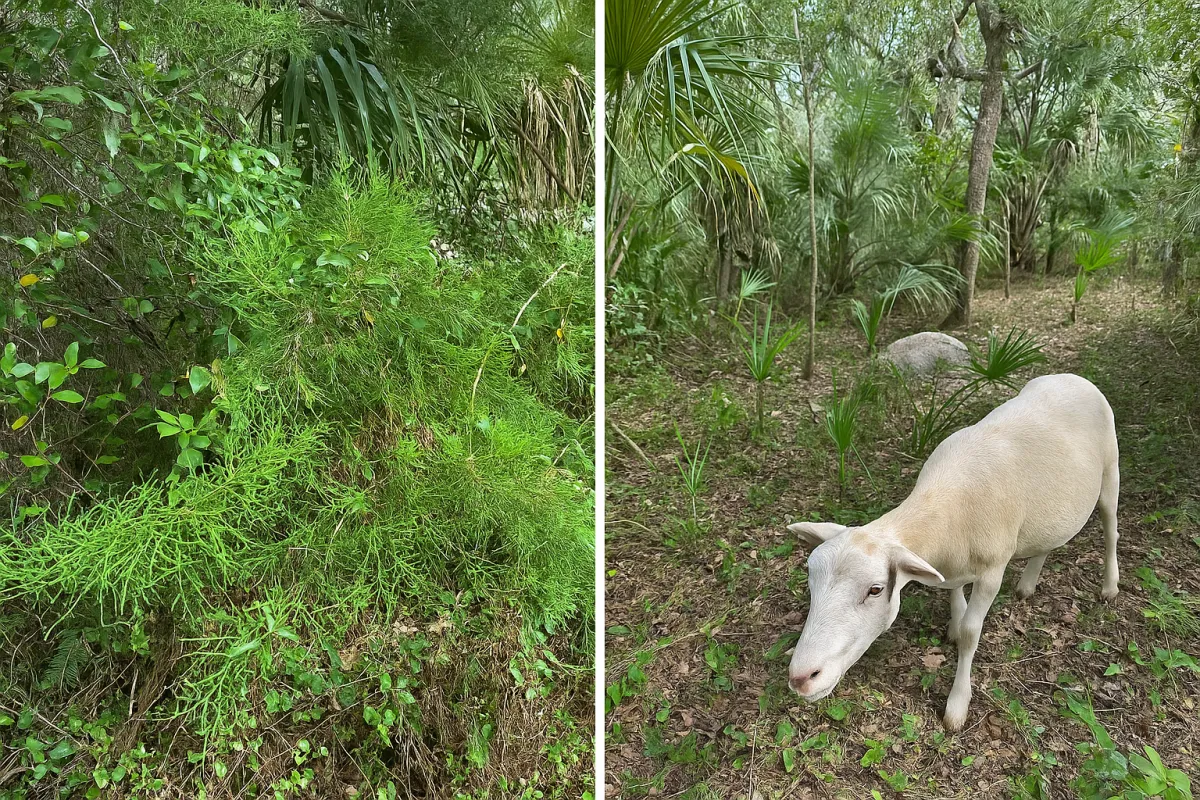
The Silent Invasion: Wetlands and Invasive Species
How Invasive Species Are Destroying Florida's Wetland Ecosystems
Part 1 of 4: Katahdin Sheep & Florida Wetland Management Series
The morning sun filters through a canopy that shouldn't exist. Where sawgrass marshes once stretched unbroken toward the horizon, dense stands of Australian punk trees now cast deep shadows across what remains of Florida's Everglades. This scene repeats itself across the state—in water conservation areas, along riverbanks, and through the intricate network of seasonal wetlands that once defined Florida's ecological identity.
Florida's wetlands are disappearing, not through drainage projects or development alone, but through a more insidious threat: biological invasion. The numbers tell a stark story. More than 1.7 million acres of the state's remaining natural areas have fallen to non-native plant species, according to the Florida Fish and Wildlife Conservation Commission.[1] These invaders don't simply displace native vegetation. They fundamentally restructure entire ecosystems, altering everything from soil chemistry to fire behavior, from water flow patterns to wildlife populations.
Understanding Florida's Wetland Architecture
To grasp the magnitude of this crisis, one must first understand what makes Florida wetlands so complex and so vulnerable. These are not simple, uniform landscapes. Florida wetlands exist along a sophisticated hydrology gradient, with each zone supporting distinct communities of plants and animals adapted to specific flooding regimes.
The upland buffer zones form the outer edge—transitional habitats where seasonal saturation creates a meeting ground between terrestrial and aquatic ecosystems. Here, mixed hardwoods, pines, and shrubs establish themselves on ground that floods occasionally but remains dry for much of the year.[2] Move lower into the upper wetland, or emergent zone, and the character shifts. Standing water persists for 30 to 50 percent of the year. Herbaceous plants dominate—grasses, sedges, forbs—all species capable of tolerating both flood and drought. The lower wetland zone remains permanently flooded or saturated. Specialized hydrophytes—plants with remarkable adaptations for life in water—form dense communities in these deep zones.
Each zone serves critical ecological functions. The transitional areas act as filters, capturing sediments and nutrients before they reach permanent water bodies. They provide essential habitat for species that move between aquatic and terrestrial environments. The upper wetlands store floodwaters, recharge aquifers, and support extraordinary biodiversity. The lower zones maintain water quality, regulate temperature, and shelter fish populations.
But this intricate architecture makes wetlands particularly susceptible to invasion. Invasive species often establish first in the disturbed transitional zones, then march systematically toward the wetland core, transforming each layer as they advance.
The Scale of Biological Pollution
The term "biological pollution" might sound dramatic. It's not. When the International Biodiversity Panel released its comprehensive assessment, the findings were unequivocal: invasive species have played a role in 60 percent of known plant and animal extinctions worldwide.[3] In Florida, where subtropical climate and international ports create perfect conditions for establishment, the situation grows more dire each year.
Consider the scope. South Florida hosts roughly 200 introduced plant and animal species that have established breeding populations—more than any other region in the United States and among the highest concentrations globally.[4] The South Florida Water Management District, the state's largest single landowner with nearly 1.5 million acres under management, now prioritizes 66 different non-native plant species for active control.[4] The annual cost of managing invasive plants alone exceeds $45 million across state and federal agencies.[3]
These aren't merely budget concerns. Behind each dollar spent lies an ecosystem in retreat.
The Ecological Destroyers
Three invasive species exemplify the catastrophic transformation that invasives inflict on Florida wetlands. Each demonstrates a different mechanism of destruction, but all share the capacity to fundamentally alter the ecosystems they invade.
Melaleuca: The Wetland Drainer
The Australian punk tree, Melaleuca quinquenervia, arrived in Florida in the early 1900s as an ornamental. Settlers imagined it might help drain swampland for development. It succeeded beyond anyone's darkest expectations.
Melaleuca drains wetlands through aggressive water consumption and transpiration, displacing native species while reducing biodiversity and fundamentally altering fire patterns.[5] In the Everglades, it transformed treeless sawgrass marshes into dense forests.

The trees don't simply grow in wetlands—they change them. Their presence increases soil elevation as organic matter accumulates. They modify fire regimes that native species depend upon for regeneration. The ecological processes that permitted the unique Everglades ecosystem to persist for millennia cannot function in the shadow of melaleuca forests.[1]
The scale of melaleuca infestation required unprecedented response. After decades of effort, the species is now described as under "maintenance control" in Water Conservation Areas 2 and 3, and in Lake Okeechobee.[4] But maintenance control isn't eradication. It means permanent vigilance, constant management, and millions of dollars spent annually to prevent the return of melaleuca dominance.
Brazilian Pepper: The Light Thief
If melaleuca is Florida's wetland drainer, Brazilian pepper (Schinus terebinthifolia) serves as its light thief. This species has earned the dubious distinction of being called the "poster child for invasive plants in Florida" by University of Florida researchers.[6]
Brazilian pepper forms dense thickets that block sunlight and water, preventing the growth of other plants.[5] The trees create impenetrable canopies. Their allelopathic properties—chemicals released into the soil—suppress the germination and growth of native species. Parts of the plant prove toxic to birds and cause severe contact dermatitis in humans, but these hazards pale compared to its ecological impact.

Mitigation banks—wetland restoration projects required to offset development impacts—regularly report "sudden invasions" and "dense infestations" of Brazilian pepper that derail restoration efforts and delay the release of mitigation credits.[6] Land managers battle the species continuously. Cut it down, and it resprouts vigorously. The dense seed production ensures new invasions from any area where mature plants persist. Its aggressive growth makes it nearly impossible for native wildlife to find food or shelter in invaded areas.[7]
Old World Climbing Fern: The Fire Ladder
Some invasive species destroy through competition or chemical warfare. Lygodium microphyllum, the Old World climbing fern, employs a more dramatic strategy: it weaponizes fire.
This vine, native to Africa, Asia, and Australia, appeared in south Florida in the late 1950s.[8] It climbs up and over trees, forming dense horizontal canopies that can cover entire plant communities. The mats of vegetation shade out and kill everything beneath, severely impacting native plants including the tree islands that dot the Everglades landscape.[8]

But the fern's most devastating characteristic is its flammability. Florida's native wetland plants evolved with ground fires—low-intensity burns that clear understory without damaging mature trees. Old World climbing fern changes this dynamic completely. The dense, dry fern material acts as a fire ladder, carrying flames into tree canopies that would normally remain untouched.[5,8] What were once low-severity ground fires become catastrophic events that kill mature trees and fundamentally alter forest structure.
The fern can transform fire-resistant wetland areas into fire-prone tinderboxes, creating conditions that favor further invasion while destroying the native plant communities that provide habitat for threatened wildlife.
The Cascading Collapse
These three species represent only the most visible edge of a much larger crisis. Florida's wetlands face assault from dozens of aggressive invaders, each contributing to a cascading ecological collapse.
In aquatic systems, hydrilla (Hydrilla verticillata) demonstrates the speed at which invasives can overwhelm native ecosystems. First introduced from Sri Lanka in the early 1950s, hydrilla can infest and cover an entire water body in as little as three years. By 1991, this single species had infested more than 40 percent of Florida's public lakes and rivers.[1] The dense canopies of vegetation at the water surface prevent sunlight from reaching native submersed plant species, while simultaneously altering historic water flow patterns.[8] Recreation becomes impossible. Fish populations crash. Water quality deteriorates.
Water hyacinth (Eichhornia crassipes) appeared even earlier, introduced as an ornamental plant in the late 1800s. By the early 1960s, it covered more than 120,000 acres of public lakes and rivers.[8] The plant can double its population size in approximately two weeks through rapid reproduction and vegetative growth. The resulting mats clog waterways, limit flood control, reduce wildlife use, and restrict boat traffic.[8]
On upland edges and in transitional zones, cogongrass (Imperata cylindrica) ranks among the world's worst invasive plants. Its aggressive growth outcompetes native vegetation, posing significant threats to biodiversity and ecosystem health.[5] Torpedograss (Panicum repens) creates similar problems in wetter areas, forming dense colonies that exclude native species and alter nutrient cycling.
The cumulative impact extends far beyond simple plant community changes. Wildlife populations collapse when invasive plants replace native species that provide food and shelter. The Florida Bonneted Bat, numerous wading bird species, the Everglade Snail Kite, and countless other species face habitat loss as invasives transform the landscapes they depend upon.[9]
Soil chemistry shifts as invasive plants deposit different organic matter and alter nutrient cycling patterns. Mycorrhizal fungi networks that native plants depend upon decline or disappear. Aquifer recharge patterns change when invasive vegetation alters water infiltration and transpiration rates.
The Traditional Response: Expensive and Inadequate
Florida's resource managers haven't ignored this crisis. The response has been massive, coordinated, and extremely expensive. Yet despite decades of effort and tens of millions of dollars spent annually, invasive species continue to spread.
The South Florida Water Management District operates the largest aquatic plant management program in the United States. In 2015 alone, the agency treated 185,714 acres of priority exotic plants across South Florida ecosystems.[4] Mechanical removal requires heavy equipment, extensive labor, and creates significant site disturbance. Chemical control using herbicides raises concerns about impacts to water quality, non-target species, and human health—particularly in wetland environments where everything eventually flows into drinking water sources or sensitive ecosystems.
The costs are staggering. Mechanical clearing typically runs $600 to $1,300 per acre for initial treatment.[10] Herbicide applications range from $400 to $800 per acre. But these figures represent only first-time treatments. Invasive species don't surrender easily. Brazilian pepper resprouts vigorously from cut stumps. Cogongrass regenerates from extensive rhizome networks. Old World climbing fern disperses millions of microscopic spores that can travel for miles on the wind.
Most invasive plant infestations require repeated treatments over multiple years to achieve even temporary control. The true cost of managing an invasive infestation often reaches several thousand dollars per acre spread across a decade or more of continuous effort.
Biological control offers some promise. The melaleuca management program introduced specialized insects that feed on the tree, limiting seed production and slowing its spread. This approach helped achieve maintenance control status for melaleuca in some major wetland systems.[4] An Australian moth that feeds on Old World climbing fern has also established in Florida, causing significant damage to the fern without harming native plants.[4]
But biological control takes decades to develop and implement. Each potential control organism must undergo exhaustive testing to ensure it won't harm native species. Many invasive plants lack suitable biological control agents. And even successful biological control rarely achieves complete eradication—it simply reduces population densities to more manageable levels.
The Future Without Action
The trajectory is clear. Without effective, sustainable management strategies, Florida's remaining wetlands will continue their transformation into novel ecosystems dominated by invasive species. The term "novel ecosystem" might sound benign. It's not. These are communities that bear little resemblance to the native wetlands they replaced.
Novel ecosystems support fewer species. They provide degraded habitat for wildlife. They alter hydrology in ways that affect surrounding areas. They change fire regimes, increasing the risk of catastrophic wildfires. They reduce property values, limit recreational opportunities, and threaten the water supply for millions of Floridians who depend on wetlands for aquifer recharge and water filtration.
Climate change amplifies every challenge. Rising temperatures favor many tropical invasive species. More intense storms provide opportunities for invasives to establish in disturbed areas. Altered rainfall patterns stress native species while creating new niches for invaders to exploit.
Florida has already lost 44 percent of its wetlands since statehood.[6] The remaining wetlands face development pressure, pollution, altered hydrology from upstream water use, and now the biological onslaught of invasive species. Each threat compounds the others. Wetlands already stressed by pollution prove more susceptible to invasion. Altered hydrology creates disturbed areas where invasives establish easily.
The question isn't whether Florida's wetlands will change. They're changing now, rapidly and catastrophically. The question is whether we can develop management strategies that are both effective enough to slow the invasion and sustainable enough to maintain over the decades required to restore these ecosystems.
Traditional approaches—mechanical removal, chemical control, biological control—each offer partial solutions. Each requires enormous ongoing investment. Each comes with environmental costs of its own. Florida needs additional tools in the fight against invasive species, particularly for managing the transitional zones where invasions begin.
Here, an unexpected ally may offer hope. For decades, livestock grazing has been employed worldwide to manage vegetation in ways that mechanical and chemical methods cannot match. Sheep, in particular, possess dietary preferences that align remarkably well with the plants causing the most problems in Florida's wetland margins. Research from the University of Florida and other institutions has documented the role of managed grazing in maintaining wetland plant diversity and controlling invasive vegetation.[11,12]
The Katahdin breed—a hair sheep developed specifically for challenging climates—demonstrates characteristics that make it uniquely suited to Florida's subtropical conditions. These animals require no shearing, show strong tolerance to both heat and internal parasites, and maintain year-round fertility in warm climates.[13,14] Unlike wool breeds that struggle in Florida's humid environment, Katahdin sheep thrive in conditions that would devastate traditional sheep operations.
The concept isn't theoretical. A 14-year experimental study on 40 seasonal wetlands in Florida found that cattle grazing maintained higher native plant diversity compared to areas where grazing was removed.[12] The research documented that removing grazing actually led to increases in some invasive species, including West Indian marsh grass. While the study focused on cattle, the principles of managed grazing apply across livestock species, with sheep offering advantages in areas where their selective feeding behavior targets problematic forbs and browse species.
This represents more than simple vegetation control. Properly managed sheep grazing creates continuous pressure on invasive regrowth, reduces fire fuel loads, operates without chemicals, and—critically for long-term sustainability—generates economic returns through lamb production. The approach aligns with research from multiple universities demonstrating that targeted grazing can achieve vegetation management goals while supporting both agricultural and conservation objectives.[15,16]
Pioneering Work at Black Hammock Farms
At Black Hammock Farms in central Florida, this theoretical framework is becoming practical reality. The operation has begun training specialized flocks of Katahdin sheep to work in heavily vegetated wetland transitional zones—the exact areas where invasive species gain their first foothold before spreading into pristine wetland cores.
The training process requires patience and systematic documentation. Young sheep are introduced gradually to dense vegetation areas, allowing them to develop the confidence and skills needed to navigate through tangled understory that would intimidate animals raised exclusively on open pasture. The flocks learn to move through thickets of greenbrier, wild grape, and mixed forbs—vegetation so dense that human passage becomes nearly impossible without machetes.
What makes this work particularly valuable is the comprehensive documentation accompanying it. Black Hammock Farms maintains detailed photographic records and vegetation assessments of treatment areas, tracking changes in plant community composition over time.

The before-and-after comparisons reveal dramatic transformations: impenetrable walls of vegetation reduced to manageable understory within months of sustained grazing pressure. Areas where sight lines extended mere feet through dense brush become open enough to observe wildlife and monitor ecosystem recovery.
Early results suggest the approach addresses problems that conventional methods struggle to solve. The thorny, herbicide-resistant greenbrier that creates such difficulties for land managers proves highly palatable to trained sheep, particularly the tender new growth that emerges after the animals clear initial infestations. Wild grape vines that smother native vegetation get systematically browsed back, reducing canopy coverage while the sheep obtain nutritionally adequate forage. The mixed forbs and broadleaf weeds that conventional livestock often ignore become dietary staples for sheep trained to work in these challenging environments.
Perhaps most significantly, the documentation reveals signs of native species recovery in heavily grazed areas. As invasive and problematic vegetation gets reduced, light reaches the forest floor again. Native groundcovers begin to reestablish. The understory structure starts to resemble the layered complexity that characterizes healthy Florida wetland margins rather than the monoculture thickets that invasive species create.
The work remains in early stages, but it demonstrates a principle that large-scale research has suggested: managed grazing can be more than a maintenance tool. Applied strategically in transitional zones, it may serve as an active restoration technique—one that operates continuously, requires no chemical inputs, creates minimal site disturbance, and pays for itself through livestock production.
Black Hammock Farms' commitment extends beyond their own acreage. The operation views this work as a long-term research project with applications across Florida's threatened wetlands. By training flocks specifically for vegetation management work and documenting the ecological responses, the farm is building a knowledge base that other producers and land managers can draw upon. The breeding program prioritizes genetics that support this work—selecting for parasite resistance, heat tolerance, and the temperament needed for animals that must work in challenging terrain.
At Black Hammock Farms, animal welfare and ecological stewardship go hand in hand. The farm is actively documenting effective protocols to ensure Katahdin sheep are never exposed to vegetation known to be toxic or harmful. Through careful mapping of native and invasive plant species, grazing rotation schedules, and ongoing collaboration with agricultural extension specialists, Black Hammock Farms is developing a science-based system that protects animal health while advancing sustainable wetland management practices across Florida.
This isn't a silver bullet. No single approach will solve Florida's invasive species crisis. But it represents an additional tool, one particularly well-suited to the transitional zones where prevention matters most. If specialized sheep flocks can maintain pressure on invasive regrowth in these critical buffer areas, they may help prevent the spread of invasions from edge habitats into wetland cores. That prevention could prove far more effective than attempting restoration after invasives have already transformed entire ecosystems.
The solution, perhaps surprisingly, may have been grazing in our pastures all along. What's needed now is to document how these principles translate to real-world application in Florida's challenging wetland environments—and to understand exactly which plants these animals can help control.
In Part 2 of this series, we'll move from the broad scale of ecological collapse to the specific battleground where this crisis plays out daily: the transitional zones where upland meets wetland. We'll examine the exact species threatening these critical areas, identifying the plants that must be controlled to preserve Florida's wetland ecology. Through field documentation and research analysis, we'll build the foundation for understanding why a low-tech, natural management approach might succeed where high-tech solutions have fallen short.
References
Florida Fish and Wildlife Conservation Commission. (n.d.). "Frequently Asked Questions: Invasive Plant Management." https://myfwc.com/wildlifehabitats/habitat/invasive-plants/faqs/
Ecology of Florida. (2025). Wikipedia. https://en.wikipedia.org/wiki/Ecology_of_Florida
Pringle, J. (2024). "Invasive species are transforming the Everglades." Knowable Magazine. https://knowablemagazine.org/content/article/food-environment/2024/how-to-save-the-everglades
South Florida Water Management District. (n.d.). "Vegetation and Exotic Control." https://www.sfwmd.gov/our-work/vegetation
Southwest Florida Water Management District. (n.d.). "Invasive Species in Florida: Identifying and Managing Harmful Plants and Animals." https://www.swfwmd.state.fl.us/resources/invasive-species-florida
Schnabel, R. (2025). "Replace-me-not: Native Florida plants struggle to take hold amid invasive species in man-made ecosystems." WUFT News. https://www.wuft.org/environment/2025-07-16/replace-me-not-native-florida-plants-struggle-to-take-hold-amid-invasive-species-in-man-made-ecosystems
Wild Florida. (2024). "11 Invasive Species in Florida Threatening the Everglades." https://blog.wildfloridairboats.com/invasive-species-of-the-everglades
Conservancy of Southwest Florida. (2021). "The Mass Spread: Invasive Plant Species in Southwest Florida." https://conservancy.org/the-mass-spread-invasive-plant-species-in-southwest-florida/
Florida Fish and Wildlife Conservation Commission. (n.d.). "Habitats." https://myfwc.com/conservation/value/fwcg/habitats/
Purdue University. (2021). "Goat Grazing Could Be Option for Invasive Species Removal." https://ag.purdue.edu/news/department/forestry-and-natural-resources/2021/09/goat-grazing-could-be-option-for-invasive-species-removal.html
USDA Natural Resources Conservation Service. (n.d.). "Managing Wetland Vegetation." https://www.wcc.nrcs.usda.gov/ftpref/wntsc/strmRest/SEwetlands/ch5.pdf
Sonnier, G., Boughton, E.H., Reifsneider, S., & Bohlen, P.J. (2023). "Long-term response of wetland plant communities to management intensity, grazing abandonment, and prescribed fire." Ecological Applications, 33(3). https://pmc.ncbi.nlm.nih.gov/articles/PMC10078234/
University of Florida IFAS Extension, Duval County. (n.d.). "Sheep Breeds." https://sfyl.ifas.ufl.edu/duval/agriculture-and-agribusiness-management/livestock-and-poultry/sheep/sheep-breeds/
Wildeus, S., & Turner, K.E. (2024). "Selection of Sheep Meat Breeds in Florida." University of Florida IFAS Extension Publication VM264. https://edis.ifas.ufl.edu/publication/VM264
California Lamb Board. (2025). "Grazing Sheep: A Sustainable Approach to Land Stewardship." https://californialamb.com/grazing-sheep/
Noble Research Institute. (2025). "Pairing Grape Vines with Grazing." https://www.noble.org/legacy/2025-spring/pairing-grape-vines-with-grazing/
About Black Hammock Farms: Black Hammock Farms operates a Florida-based Katahdin sheep breeding program focused on parasite resistance, climate adaptation, and sustainable vegetation management. Through research-based approaches and educational outreach, we demonstrate practical solutions for managing Florida's challenging subtropical landscapes.
Next in Series: Part 2 - "Know Your Enemy: Identifying the Invasive Plants Threatening Florida's Wetland Borders"
Retry
1579 Walsh Street Oviedo,
Florida 32765
COMPANY
FARM SERVICES
LIVESTOCK PROGRAMS
FOLLOW US


POWERED BY:

© 2025 Black Hammock Family Farm.
All rights reserved.
1579 Walsh Street Oviedo,
Florida 32765
COMPANY
FARM SERVICES
LIVESTOCK PROGRAMS
FOLLOW US
POWERED BY:
© 2025 Black Hammock Family Farm. All rights reserved.