
Small Call to Action Headline
Black hammock farm'S Out Reach Programs
From Destruction to Creation and Healing
Black Hammock Farm extends beyond commercial agriculture into three community outreach programs, each reflecting our core belief that working the land offers pathways to peace, belonging, and resilience.
Fields of Peace Program
A Day with Brothers and Animals
Fields of Peace provides veteran service members a space for recovery, connection, and purpose through hands-on agricultural work. Farming offers what many veterans seek after service: meaningful physical labor, connection to living things, quiet purpose, and brotherhood without the weight of conflict.
“The program operates on a simple premise: there is peace in the pasture.” — Kip Hudakoz.
Who We Serve:
Combat veterans processing transition to civilian life.
Veterans experiencing PTSD, anxiety, or difficulty reintegrating
Service members seeking community outside clinical settings
Any veteran curious about agriculture as a second career or personal practice
No diagnosis required. No paperwork. Just show up.
What at Day Looks Like
Participants arrive in the morning and work alongside Agent K—a Marine veteran of the Gulf War Era—tending the flock and maintaining the farm.
Activities may include:
Morning flock check and feeding
Moving sheep between paddocks
Setting up portable fencing for rotational grazing
Body condition scoring and individual animal assessment
Basic veterinary care and hoof maintenance
Fence repair and pasture improvement
Equipment maintenance
Poultry care and egg collection
The work is real. The sheep don't care about your service record—they need to be fed, moved, and looked after. There's something grounding in that simplicity.
Lunch is shared. Stories are optional. The land does most of the talking.
Program Philosophy
Clinical settings serve essential purposes, but not every veteran thrives in them. Some need to work with their hands. Some need animals that respond to calm, steady presence. Some need to be outdoors, away from fluorescent lights and waiting rooms.
Fields of Peace isn't therapy. It's farming. But farming has its own way of working on a person.
The transition from military service to civilian life often lacks clear purpose. Agriculture provides that purpose in its most elemental form: living things depend on you. The work matters. The results are visible. And at the end of the day, you've built something instead of destroying something.
Open Pasture Program
Sustainable Farming for Everyone
Misssion: Open Pasture Program creates accessible agricultural experiences for individuals of all abilities, with particular emphasis on welcoming those with disabilities and special needs. The farm becomes a classroom without walls—a place where everyone can contribute, learn, and connect with the land.
Sustainable farming isn't just about environmental practices. It's about sustaining people, communities, and futures. Open Pasture ensures that pathway is open to all.
“The program operates on a simple premise: When a community learns together, they grow together.” — Kip Hudakoz.
Who We Serve:
Individuals with developmental disabilities
Those with physical disabilities seeking adaptive agricultural activities
Special needs students and educational programs
Therapeutic programs seeking agricultural partnerships
Families wanting inclusive farm experiences
Anyone interested in sustainable farming education
Potential activities include:
Open Pasture adapts to participants rather than requiring participants to adapt to us. Activities are scaled, modified, and structured based on individual abilities and interests.
Potential activities include:
Sensory experiences with sheep (supervised interaction, wool textures)
Egg collection from heritage poultry
Planting and garden maintenance
Feeding routines with visual schedules
Nature observation and journaling
Basic animal care tasks
Harvest activities (seasonal)
Farm art projects using natural materials
Sessions can be structured for individuals, small groups, or organized programs. We work with caregivers, teachers, and therapeutic professionals to design experiences that meet specific goals.
Program Philosophy
Agricultural settings offer unique benefits for individuals with disabilities:
Sensory regulation — The farm provides rich, natural sensory input: animal textures, outdoor sounds, soil and vegetation, physical movement through space.
Predictable routines — Animals require consistent care. This creates structure that many individuals find calming and manageable.
Meaningful contribution — Every task on a farm matters. Collecting eggs, filling water troughs, spreading feed—these are real jobs with visible results. Participants aren't doing "activities." They're doing farm work.
Non-judgmental environment — Sheep don't care about diagnoses or limitations. They respond to calm presence and consistent handling. Success is measured in completed tasks, not standardized assessments.
Connection to natural systems — Understanding where food comes from, how animals live, how seasons change—these connections ground us in something larger than ourselves.
Connection to CommunOT
Black Hammock Farm proudly supports CommunOT Farm and Programming, which pioneers therapeutic agricultural experiences. Open Pasture draws inspiration from their model and seeks to expand access to farm-based programming in Seminole County. Contact CommunOT for more details
Seminole Small Farm Alliance
Strength in Numbers, Roots in Community
Mission: The Seminole Small Farm Alliance provides mutual support, shared resources, and collective advocacy for small-scale agricultural operations in Seminole County, Florida. In a region where development pressure and bureaucratic obstacles threaten small farms, the Alliance ensures no farmer stands alone.
“The program operates on a simple premise: there is peace in the pasture.” — Kip Hudakoz.
The Problem We Address:
Small farms in Seminole County face challenges that large agricultural operations don't:
Agricultural classification battles — Property Appraisers may deny agricultural classification to legitimate operations, forcing small farmers into expensive appeals. The process is opaque, inconsistent, and financially devastating for operations already running on thin margins.
Regulatory navigation — Zoning codes, development orders, livestock regulations, water management permits—small farmers must navigate systems designed for larger operations or residential properties, often with little guidance.
Isolation — Unlike agricultural regions where farmers have built-in community, Seminole County's small farms are often islands surrounded by suburban development. Farmers lack peers who understand their challenges.
Resource limitations — Equipment, expertise, veterinary services, processing facilities—resources readily available in rural agricultural areas are scarce or expensive in transitional counties like Seminole.
What the Alliance Offers
Advocacy and Classification Support
Black Hammock Farm recently prevailed in a Value Adjustment Board appeal after the Property Appraiser denied agricultural classification despite the operation meeting every statutory requirement. The magistrate ruled decisively in our favor, criticizing the Appraiser's narrow interpretation.
That experience—including over $10,000 in legal costs and months of preparation—produced hard-won knowledge:
How Florida Statute 193.461 actually works
What documentation establishes "bona fide commercial agriculture"
How to present evidence effectively to the VAB
Which legal arguments succeed and which fail
How to navigate the appeals timeline
Alliance members facing classification challenges don't start from zero. They start with our playbook, our documentation templates, and our experience. When possible, we can connect farmers with legal counsel who understand agricultural classification.
Shared Knowledge Base:
Best practices for livestock in Florida's climate
Veterinary and extension service contacts
Equipment sharing and rental opportunities
Processing and direct-sales guidance
Grant and financing resources
Insurance and liability considerations
Collective Voice:
Individual small farmers have little influence on county policy. A coalition of farms speaking together commands attention. The Alliance can:
Engage with county commissioners on agricultural issues
Participate in comprehensive plan updates affecting agricultural land
Advocate for small-farm-friendly interpretations of regulations
Build relationships with Planning, Zoning, and Property Appraiser offices
Represent small agriculture in conversations currently dominated by development interests
Community Connection:
Regular gatherings—whether formal meetings or informal farm visits—break the isolation that small farmers experience. Problems shared are problems halved. Successes celebrated together build momentum.
Memembership:
The Seminole Small Farm Alliance welcomes:
Operating farms of any size in Seminole County
Farms pursuing agricultural classification
Landowners considering agricultural use
Agricultural operations in adjacent counties facing similar challenges
Supporting members (non-farmers who support small agriculture)
Initial membership is informal—join our contact list, attend gatherings, participate in discussions. As the Alliance develops, we may establish more formal structure based on member needs.
Founding Principles
Non-partisan — Agricultural issues cross political lines. The Alliance advocates for small farms, not parties or candidates.
Collaborative with government — We work with county officials, not against them. The goal is partnership and mutual understanding, not adversarial relationships. Many officials simply don't understand small farm operations; education often resolves conflicts.
Respect for diversity — Small farms vary enormously: produce, livestock, nurseries, aquaculture, agritourism. All legitimate agricultural operations are welcome regardless of type or scale.
Rooted in heritage — Seminole County has deep agricultural history, from the celery fields of Black Hammock to the citrus groves that once covered the region. The Alliance honors that heritage while building agricultural futures.
Future Developement
Formal organizational structure (nonprofit status consideration)
Regular meeting schedule and communication channels
Resource library (legal templates, documentation guides, contact lists)
Annual small farm tour showcasing Alliance members
Partnerships with University of Florida IFAS Extension
Engagement with Florida Farm Bureau and other agricultural organizations
Advocacy agenda developed collaboratively by members
Program Integration
These three programs share common roots and reinforce each other:
Fields of Peace veterans may discover agricultural careers, potentially starting their own operations with Seminole Small Farm Alliance support.
Open Pasture Program participants experience working farms, building public appreciation for the small agriculture that the Alliance protects.
Alliance member farms may host Fields of Peace or Open Pasture programming, expanding reach beyond Black Hammock Farm alone.
All three embody Black Hammock Farm's core philosophy: agriculture as creation, healing, and community connection. The commercial breeding operation and Rent-A-Herd services provide the sustainable foundation. These outreach programs extend that foundation into service.
Contact and Next Steps
Fields of Peace inquiries: Veterans interested in farm days, or veteran service organizations seeking partnerships
Open Pasture Program inquiries: Individuals, families, educators, or therapeutic programs interested in accessible farm experiences
Seminole Small Farm Alliance inquiries: Farmers seeking support, landowners considering agriculture, or community members wanting to support small farms
All programs: blackhammockfarm.com
Black Hammock Farm — Live, Fresh, Local
BLACK HAMMOCK FARM NEWS
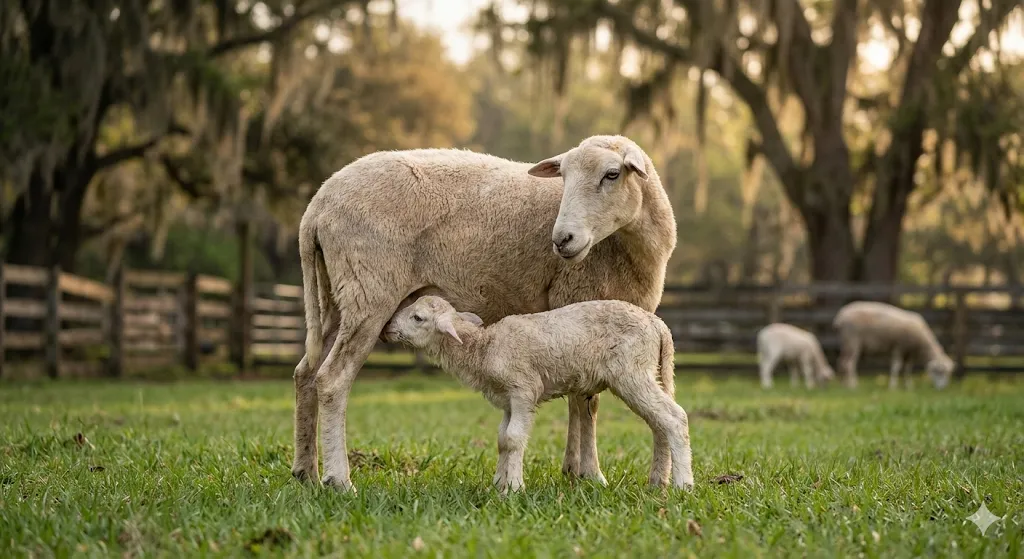
Protecting the Youngest: How a Mother's First Milk Saves a Lamb's Life
Protecting the Youngest: How a Mother's First Milk Saves a Lamb's Life
A lamb born on a well-managed farm may never receive its first protection from a needle.
Its immunity arrives in a different form entirely — thick, golden, and warm — produced by its mother in the first hours after birth. If the lamb nurses in time, it absorbs something remarkable: a concentrated package of maternal antibodies, built through months of careful preparation, ready to defend a body that has never encountered the world before.
That's the science of colostrum. And this Saturday at Black Hammock Farm, students will learn exactly how it works — and why what happens in those first few hours after birth determines whether a lamb thrives or doesn't survive its first week.
The Only Vaccine Every Flock Needs — CDT
Of all the vaccines available for sheep, only one is universally recommended for every flock, everywhere: CDT.
CDT is a three-way vaccine that protects against two clostridial diseases and tetanus — all caused by bacteria that are already present in the environment. In soil. In feces. In the gut of healthy animals right now. Under normal conditions, these bacteria cause no harm. But under the right circumstances — a dietary shift, a wound, a sudden energy influx — they multiply explosively and produce fatal toxins with almost no warning.
Here's what CDT protects against:
C — Clostridium perfringens Type C: Causes hemorrhagic enteritis (bloody scours) in nursing lambs during their first weeks of life. Triggered by sudden feed changes or excess milk intake.
D — Clostridium perfringens Type D: Known as "overeating disease" or pulpy kidney. Affects lambs over one month old, often triggered by high-concentrate feeding.
T — Clostridium tetani: Tetanus, or lockjaw. Risk peaks at docking, castration, and disbudding — any procedure that creates an open wound. Can strike before any visible symptoms appear.
This is why lamb vaccination science is taught at CommunOT Farm & Programming farm labs — because understanding disease prevention in living systems is exactly the kind of real-world biology that makes learning stick.
The Colostrum Connection — The Most Powerful Protection Happens Before Birth
Here's the insight that changes how you think about lamb health management entirely: the most effective way to protect a newborn lamb is to vaccinate its mother before birth.
When a vaccinated ewe's immune system produces antibodies to CDT, those antibodies become concentrated in her colostrum — the thick first milk produced in the hours immediately following birth. When a newborn lamb nurses within that critical first-hour window, it absorbs those maternal antibodies directly through its gut wall. This passive immunity protects the lamb for its first six to eight weeks of life, covering the period when it is most vulnerable to Type C enteritis.
This is why ewe vaccination timing is one of the most important management decisions on a sheep farm. A lamb born to an unvaccinated or poorly vaccinated ewe enters the world without that protection already in place.
Visit communotfarm.com to learn more about how CommunOT uses real agricultural science like this to build meaningful learning experiences for children.
Timing Is Everything — The CDT Vaccination Schedule
Knowing what to vaccinate against is only half the picture. Knowing when is what determines whether it works.
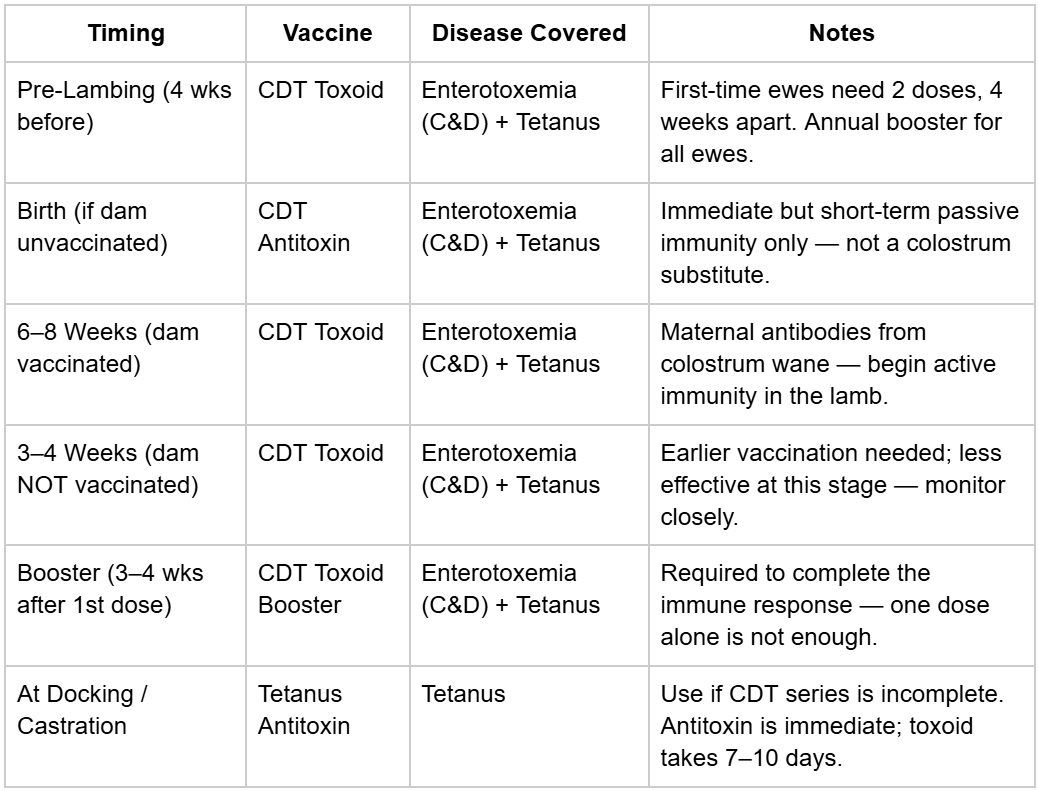
First-time mothers (primiparous ewes) require a two-dose primary series in late pregnancy, given four weeks apart. Their immune systems have not previously been primed, and a single dose won't generate sufficient antibody concentration in colostrum to reliably protect their lambs.
This is colostrum immunity and lamb vaccination science made tangible — and it's exactly what students explore during the Black Hammock Farm farm lab.
How Vaccines Are Delivered — SQ vs. IM Injection
How a vaccine is given matters just as much as what it contains. CDT and most clostridial vaccines are administered subcutaneously (SQ) — under the skin, not into the muscle. Using the wrong route reduces effectiveness and can cause unnecessary tissue damage.
Subcutaneous (SQ) — The Correct Route for CDT
The needle is inserted under the skin at the base of a "tent" of skin pinched up from the body. Slower absorption, but less tissue damage. Always confirm the route on the vaccine label.
Intramuscular (IM) — Used for Some Vaccines & Medications
The needle is inserted into muscle tissue, typically the neck or hindquarter. Faster absorption but higher risk of injection-site reactions and carcass blemishes. Never use IM for CDT unless the label specifically permits it.
A few other essentials for safe vaccine administration:
Needle selection: Use 18- or 20-gauge needles. Change needles frequently — ideally one fresh needle per animal.
Injection site: For market or show animals, the axilla (armpit area) avoids visible blemishes on commercially relevant tissue.
Storage: Refrigerated, protected from light and temperature extremes. Never use expired, frozen, or heat-damaged vaccines.
Record keeping: Document every administration — what was given, dosage, lot number, expiration date, and date administered.
When CDT Isn't Enough — Situational Vaccines
CDT is universal — but some flocks need more depending on regional disease pressure and flock history. These are never standard recommendations; they require veterinary guidance and knowledge of your specific situation.
Soremouth (Orf): A live vaccine for a viral skin disease affecting mouth and feet. Important: orf is a zoonotic disease that can spread from sheep to humans. Wear gloves.
E. coli Scours: A pre-breeding ewe vaccine that transfers immunity through colostrum, or an oral antibody product given directly to high-risk newborns at birth.
Abortion Vaccines (Vibrio / Chlamydia): Administered before breeding. Ewe lambs require a three-dose series for full protection in their first breeding season.
Foot Rot (FootVax): Best administered before the wet season — late winter to early spring in Florida.
8-Way Clostridial (Covexin-8): Expands coverage to include blackleg. For most Florida flocks, CDT alone is sufficient.
Learn more about how CommunOT Farm & Programming connects this kind of agricultural science to real learning outcomes for children in Central Florida.
The OT Connection — Systems Thinking in the Pasture
There's something else happening when a student traces the path from a ewe's vaccination to a lamb's immunity at birth. They're not just learning biology. They're practicing systems thinking — tracing a decision to an outcome across time, through a living system they can see and touch.
For children with developmental differences, this kind of sequential reasoning — if this happens now, then that happens later — supports executive function development, cause-and-effect comprehension, and scientific literacy. It also builds on themes of care, protection, and interdependence that are central to OT-informed social-emotional learning.
That's the quiet power behind every activity CommunOT Farm & Programming designs: the science and the therapy are the same experience.
See It for Yourself This Saturday
This Saturday, March 14th, students will explore lamb vaccination science and colostrum immunity firsthand — at Black Hammock Farm in Oviedo, guided by occupational therapists and a working farm family during the height of lambing season.
Event Details:
Date: Saturday, March 14, 2026
Time: 10:00 – 11:30 AM
Location: Black Hammock Farm, Oviedo, FL
Cost: $30 per student
Ages: 2–18 · All learners welcome
👉 Reserve your spot at communotfarm.com
A lamb's protection begins before it's even born — with a decision its mother's shepherd made weeks earlier. That's not just good farming. That's a science lesson worth showing up for.
CommunOT Farm & Programming is a pediatric occupational therapy organization based in Seminole County, FL, dedicated to integrating sensory-rich, nature-based experiences into developmental programming for children ages 2–18. Register and learn more at communotfarm.com.
1579 Walsh Street Oviedo,
Florida 32765
COMPANY
FARM SERVICES
LIVESTOCK PROGRAMS
FOLLOW US


POWERED BY:

© 2025 Black Hammock Family Farm.
All rights reserved.
1579 Walsh Street Oviedo,
Florida 32765
COMPANY
FARM SERVICES
LIVESTOCK PROGRAMS
FOLLOW US
POWERED BY:
© 2025 Black Hammock Family Farm. All rights reserved.