
Small Call to Action Headline
Black hammock farm'S
Katahdin Sheep Wetlands Management Study
Why This Study Matters
Florida faces a critical challenge in wetland management as invasive species threaten ecosystem integrity across the state. The South Florida Water Management District identifies approximately 200 introduced plant and animal species established in the region, with 66 non-native plant species designated as priorities for control. Current management strategies rely heavily on mechanical removal, prescribed burns, and herbicide applications—methods that are expensive, labor-intensive, and may have unintended ecological consequences.
Simultaneously, livestock grazing in wetland environments remains controversial and understudied, particularly in subtropical climates. While extensive research documents livestock impacts on wetlands, the vast majority focuses on cattle in temperate regions. Research on sheep grazing in subtropical wetlands, specifically using parasite-resistant hair sheep breeds, remains critically limited.
1579 Walsh Street Oviedo,
Florida 32765
COMPANY
FARM SERVICES
LIVESTOCK PROGRAMS
FOLLOW US


POWERED BY:

© 2025 Black Hammock Family Farm.
All rights reserved.
The Participants: The Innovation of Using Katahdin Sheep In WetLAND MANAGEMENT
Katahdin sheep represent a unique opportunity for Florida wetland management due to their specific biological adaptations:
Parasite Resistance: Research demonstrates that Katahdin sheep possess significantly higher parasite resistance than conventional wool breeds. Studies conducted at Virginia Tech and Arkansas showed Katahdin sheep had fecal egg counts 45% lower than Dorper crosses and required substantially less anthelmintic treatment than wool breeds. Their Caribbean hair sheep ancestry provides genetic resistance evolved in hot, humid, high-parasite environments—precisely the conditions present in Florida wetlands.
Climate Adaptation: Katahdin sheep demonstrate well-developed heat tolerance in tropical and subtropical regions. Their hair coat (rather than wool) allows superior thermoregulation in humid conditions where wool breeds experience heat stress. University of Florida research identifies Katahdin as one of six meat breeds demonstrating ability to naturally minimize parasite burdens in Florida conditions.
Selective Grazing Behavior: Sheep exhibit different grazing patterns than cattle. Research indicates sheep nibble grass close to the ground and selectively consume flowers and certain vegetation types. This selective grazing could target specific invasive plant species while minimizing impact on desired native vegetation.
Reduced Wetland Impact: Sheep are lighter and more agile than cattle, causing less soil compaction and trampling damage. Studies in New Zealand and British Columbia specifically noted that sheep grazing can be preferable to cattle in fragile wetland environments vulnerable to poaching (soil damage from hoofprints in wet conditions).
Conservation and Economic Benefits
Vegetation Management Without Chemicals: Multiple studies demonstrate that moderate grazing intensity can increase plant species diversity and control dominant invasive species that exclude less competitive native plants. Research in California vernal pools showed that reintroduced grazing at moderate stocking rates significantly increased both diversity and native cover after just two years. European wetland studies found that patchy, occasionally intense grazing increased protected plant species and habitat heterogeneity while benefiting both conservation and agricultural goals.
Cost-Effective Management: The solar grazing industry demonstrates that sheep can provide effective, economical vegetation management. While mechanical mowing requires expensive equipment, fuel, and risks panel/infrastructure damage, sheep provide continuous low-cost maintenance while generating potential revenue through meat production.
Ecosystem Services: Properly managed grazing can create habitat heterogeneity that benefits wildlife. Research in Hungarian marshes showed increases in wetland bird populations, protected plant species, and patches of open vegetation with grazing intensity gradients. The key is avoiding continuous heavy grazing while allowing patchy, varied grazing pressure.
Carbon Footprint Reduction: Replacing mechanical vegetation management eliminates fossil fuel consumption for mowers while integrating livestock production into ecosystem restoration.
PRELIMINARY HYPOTHESES .
Vegetation Control
Hypothesis: Katahdin sheep grazing at moderate stocking densities (2-4 sheep/acre for 2-4 week periods) will significantly reduce biomass of target invasive species compared to ungrazed control areas, while maintaining or increasing native plant species diversity.
Water Quality
Hypothesis: Moderate-intensity sheep grazing will maintain water quality parameters (turbidity, nitrogen, phosphorus, fecal coliform bacteria) within acceptable ranges for wetland ecosystem health, with impacts significantly lower than documented cattle grazing effects.
SHEEP HEALTH
Hypothesis: Katahdin sheep grazing on Florida wetland vegetation will maintain adequate body condition scores and parasite resistance within acceptable management thresholds, requiring no more than 15% of animals to need anthelmintic treatment during the grazing period.
ECoNOMICAL VIABILITY
Hypothesis: Sheep grazing vegetation management costs will be ≤50% of equivalent mechanical mowing and herbicide application costs over a 12-month period, while producing marketable lamb weight gain.
Biodiversity Impact
Hypothesis: Sheep grazing vegetation management costs will be ≤50% of equivalent mechanical mowing and herbicide application costs over a 12-month period, while producing marketable lamb weight gain.
ETHICAL CONSIDERATIONS & LIMITATIONS .
ANIMAL WELFARE
All sheep management will follow American Veterinary Medical Association guidelines
Monitoring protocols ensure early detection of heat stress or health issues
Access to shade, clean water, and supplemental minerals as needed
Immediate veterinary intervention protocols established
Environmental Protections
Grazing exclusion during critical wildlife breeding/nesting periods
Monitoring for any decline in threatened or endangered species
Adaptive management to respond to unintended impacts
Coordination with Florida Fish and Wildlife Conservation Commission
Study Limitations
Results may be specific to Black Hammock Farm's wetland types and may not generalize to all Florida wetlands
Seasonal variation requires multi-year data collection for robust conclusions
Initial infrastructure investment may limit adoption by other landowners
Weather variability in Florida may affect consistency of grazing schedules
BLACK HAMMOCK FARM NEWS
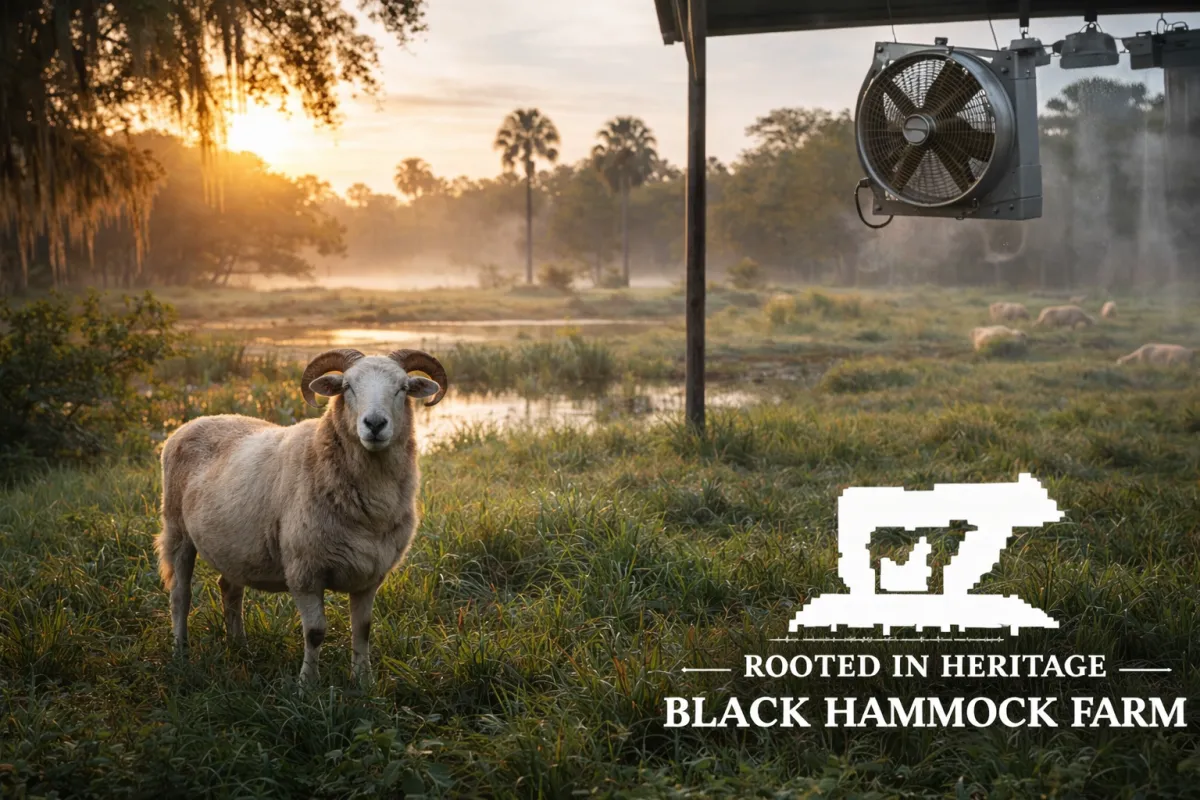
Built to Belong Here
Built to Belong Here
Part 3 of 14 in the “Rooted in Heritage, Growing for Tomorrow” Series
Some animals are forced to fit a place.
Others belong there.
Modern agriculture often treats livestock like interchangeable tools—moved from climate to climate, managed with inputs designed to compensate for mismatch. Fans, shade structures, medications, constant intervention. If the animal struggles, the solution is rarely to question whether it should be there at all.
At Black Hammock Farm, we started from a different premise:
What if the animal already knew how to live here?
When Breeds Lose Their Purpose
Not all livestock breeds are created equal—and many were never meant to survive everywhere.
Over the past century, agriculture has favored uniformity. Animals bred for rapid growth, predictable output, and compatibility with industrial systems. The result is efficiency on paper—but fragility in practice.
As environments change, many of these breeds struggle without heavy management:
Heat stress in hot climates
Parasite pressure requiring routine medication
Dependence on housing, machinery, and feed inputs
When animals lose their ability to function naturally in a landscape, farming becomes a battle instead of a partnership.
That’s not progress. That’s dependency.
The Quiet Disappearance of Heritage Livestock
While production breeds multiplied, something else quietly disappeared.
Heritage livestock—breeds developed for specific regions, soils, and climates—began to fade. Not because they failed, but because they didn’t fit industrial metrics.
They were:
Slower growing
Less uniform
Harder to standardize
But they were also resilient. Adaptable. Efficient without constant intervention.
These breeds carried genetic memory—the accumulated knowledge of generations surviving in real landscapes, not controlled environments.
When we lose those genetics, we don’t just lose animals.
We lose options.
Why Katahdin Sheep Belong in Florida
Katahdin sheep weren’t chosen for sentiment.
They were chosen for suitability.
Developed in Maine, Katahdins were bred to thrive under challenging conditions—poor forage, parasite pressure, variable weather. Unlike wool breeds, they carry a hair coat that sheds naturally, eliminating the need for shearing and reducing heat stress.
In Florida’s climate, that matters.
They tolerate heat and humidity
They show natural resistance to internal parasites
They maintain body condition on pasture
They require fewer inputs to stay healthy
This isn’t luck. It’s design.
Katahdins don’t fight the environment.
They work within it.
Farming That Works With the Land
When livestock belongs in a place, the land responds differently.
Grazing becomes lighter and more intentional. Pastures recover faster. Wetland edges stabilize instead of erode. The need for chemical controls diminishes because the system itself regains balance.
This is where stewardship becomes visible.
We don’t force production.
We observe patterns.
We adjust pressure.
We let the animals do what they’re designed to do.
That approach doesn’t scale quickly—but it scales correctly.
Genetic Diversity Is Insurance
In agriculture, diversity isn’t nostalgia.
It’s risk management.
Climate shifts. Parasites adapt. Markets fluctuate. When systems rely on narrow genetic pools, a single disruption can cause collapse.
Heritage breeds provide redundancy. They carry traits modern systems may need again—traits that can’t be recreated once they’re gone.
Preserving those genetics isn’t about the past.
It’s about resilience.
Built for This Place, This Time
Black Hammock Farm doesn’t exist to recreate history. It exists to apply its lessons.
The land remembers what works.
The animals remember how to survive.
Our responsibility is to listen—to match livestock to landscape, not the other way around.
Because farming succeeds most often when it stops trying to dominate nature and starts cooperating with it.
What Comes Next
In Part 4, we’ll take a closer look athow livestock can actively restore land, not just occupy it—exploring conservation grazing, wetland management, and why sheep may be one of Florida’s most underutilized environmental tools.
Built to belong here.
Not forced.
Not artificial.
Just right.
Next in Part 4: “More Than Grazing” — How sheep can restore wetlands, manage invasive species, and reduce the need for chemicals and machinery.
1579 Walsh Street Oviedo,
Florida 32765
COMPANY
FARM SERVICES
LIVESTOCK PROGRAMS
FOLLOW US
POWERED BY:
© 2025 Black Hammock Family Farm. All rights reserved.