
Small Call to Action Headline
Black hammock farm'S
Katahdin Sheep Wetlands Management Study
Why This Study Matters
Florida faces a critical challenge in wetland management as invasive species threaten ecosystem integrity across the state. The South Florida Water Management District identifies approximately 200 introduced plant and animal species established in the region, with 66 non-native plant species designated as priorities for control. Current management strategies rely heavily on mechanical removal, prescribed burns, and herbicide applications—methods that are expensive, labor-intensive, and may have unintended ecological consequences.
Simultaneously, livestock grazing in wetland environments remains controversial and understudied, particularly in subtropical climates. While extensive research documents livestock impacts on wetlands, the vast majority focuses on cattle in temperate regions. Research on sheep grazing in subtropical wetlands, specifically using parasite-resistant hair sheep breeds, remains critically limited.
1579 Walsh Street Oviedo,
Florida 32765
COMPANY
FARM SERVICES
LIVESTOCK PROGRAMS
FOLLOW US


POWERED BY:

© 2025 Black Hammock Family Farm.
All rights reserved.
The Participants: The Innovation of Using Katahdin Sheep In WetLAND MANAGEMENT
Katahdin sheep represent a unique opportunity for Florida wetland management due to their specific biological adaptations:
Parasite Resistance: Research demonstrates that Katahdin sheep possess significantly higher parasite resistance than conventional wool breeds. Studies conducted at Virginia Tech and Arkansas showed Katahdin sheep had fecal egg counts 45% lower than Dorper crosses and required substantially less anthelmintic treatment than wool breeds. Their Caribbean hair sheep ancestry provides genetic resistance evolved in hot, humid, high-parasite environments—precisely the conditions present in Florida wetlands.
Climate Adaptation: Katahdin sheep demonstrate well-developed heat tolerance in tropical and subtropical regions. Their hair coat (rather than wool) allows superior thermoregulation in humid conditions where wool breeds experience heat stress. University of Florida research identifies Katahdin as one of six meat breeds demonstrating ability to naturally minimize parasite burdens in Florida conditions.
Selective Grazing Behavior: Sheep exhibit different grazing patterns than cattle. Research indicates sheep nibble grass close to the ground and selectively consume flowers and certain vegetation types. This selective grazing could target specific invasive plant species while minimizing impact on desired native vegetation.
Reduced Wetland Impact: Sheep are lighter and more agile than cattle, causing less soil compaction and trampling damage. Studies in New Zealand and British Columbia specifically noted that sheep grazing can be preferable to cattle in fragile wetland environments vulnerable to poaching (soil damage from hoofprints in wet conditions).
Conservation and Economic Benefits
Vegetation Management Without Chemicals: Multiple studies demonstrate that moderate grazing intensity can increase plant species diversity and control dominant invasive species that exclude less competitive native plants. Research in California vernal pools showed that reintroduced grazing at moderate stocking rates significantly increased both diversity and native cover after just two years. European wetland studies found that patchy, occasionally intense grazing increased protected plant species and habitat heterogeneity while benefiting both conservation and agricultural goals.
Cost-Effective Management: The solar grazing industry demonstrates that sheep can provide effective, economical vegetation management. While mechanical mowing requires expensive equipment, fuel, and risks panel/infrastructure damage, sheep provide continuous low-cost maintenance while generating potential revenue through meat production.
Ecosystem Services: Properly managed grazing can create habitat heterogeneity that benefits wildlife. Research in Hungarian marshes showed increases in wetland bird populations, protected plant species, and patches of open vegetation with grazing intensity gradients. The key is avoiding continuous heavy grazing while allowing patchy, varied grazing pressure.
Carbon Footprint Reduction: Replacing mechanical vegetation management eliminates fossil fuel consumption for mowers while integrating livestock production into ecosystem restoration.
PRELIMINARY HYPOTHESES .
Vegetation Control
Hypothesis: Katahdin sheep grazing at moderate stocking densities (2-4 sheep/acre for 2-4 week periods) will significantly reduce biomass of target invasive species compared to ungrazed control areas, while maintaining or increasing native plant species diversity.
Water Quality
Hypothesis: Moderate-intensity sheep grazing will maintain water quality parameters (turbidity, nitrogen, phosphorus, fecal coliform bacteria) within acceptable ranges for wetland ecosystem health, with impacts significantly lower than documented cattle grazing effects.
SHEEP HEALTH
Hypothesis: Katahdin sheep grazing on Florida wetland vegetation will maintain adequate body condition scores and parasite resistance within acceptable management thresholds, requiring no more than 15% of animals to need anthelmintic treatment during the grazing period.
ECoNOMICAL VIABILITY
Hypothesis: Sheep grazing vegetation management costs will be ≤50% of equivalent mechanical mowing and herbicide application costs over a 12-month period, while producing marketable lamb weight gain.
Biodiversity Impact
Hypothesis: Sheep grazing vegetation management costs will be ≤50% of equivalent mechanical mowing and herbicide application costs over a 12-month period, while producing marketable lamb weight gain.
ETHICAL CONSIDERATIONS & LIMITATIONS .
ANIMAL WELFARE
All sheep management will follow American Veterinary Medical Association guidelines
Monitoring protocols ensure early detection of heat stress or health issues
Access to shade, clean water, and supplemental minerals as needed
Immediate veterinary intervention protocols established
Environmental Protections
Grazing exclusion during critical wildlife breeding/nesting periods
Monitoring for any decline in threatened or endangered species
Adaptive management to respond to unintended impacts
Coordination with Florida Fish and Wildlife Conservation Commission
Study Limitations
Results may be specific to Black Hammock Farm's wetland types and may not generalize to all Florida wetlands
Seasonal variation requires multi-year data collection for robust conclusions
Initial infrastructure investment may limit adoption by other landowners
Weather variability in Florida may affect consistency of grazing schedules
BLACK HAMMOCK FARM NEWS
Stewardship You Can See
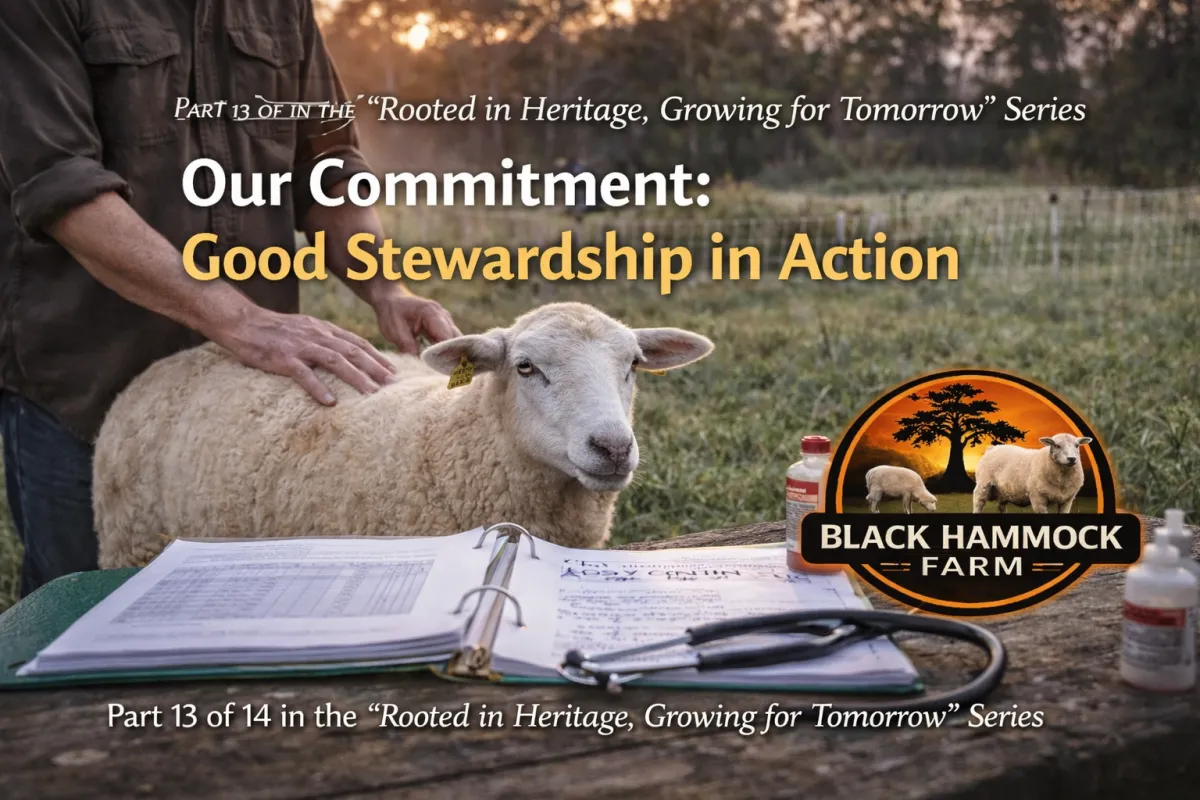
Our Commitment: Good Stewardship in Action
Part 13 of 14 in the "Rooted in Heritage, Growing for Tomorrow" Series
Throughout this series, I've made claims about Black Hammock Farm. We're a legitimate agricultural operation. We follow professional standards. We care for our animals and our land with intention and expertise.
Claims are easy to make. This week, I want to show you what those claims look like in practice.
Because stewardship isn't a philosophy you talk about. It's a set of actions you take every single day, whether anyone is watching or not.
Animal Welfare: More Than a Buzzword
Every animal at Black Hammock Farm has a name and an identity. We don't manage a faceless herd—we care for individuals.
That starts with body condition scoring.
Body condition scoring is a systematic method for evaluating livestock health, used by professional producers and recommended by university extension programs across the country. On a scale of 1 to 5, we assess each animal's physical condition—feeling along the spine, ribs, and loin to evaluate fat coverage and muscle mass.
A score of 1 means emaciated. A score of 5 means obese. We manage for 3 to 3.5—healthy animals with adequate reserves but not carrying excess weight that could complicate breeding or lambing.
We don't guess. We document. Every ewe gets scored, and those scores inform our management decisions. An animal trending downward gets additional nutrition. An animal trending upward might need adjusted grazing access. The numbers tell a story that casual observation might miss.
Health monitoringgoes beyond condition scores.
We watch for signs of parasites—the primary health challenge for sheep in Florida's humid climate. The FAMACHA system, developed specifically for small ruminant management, uses eyelid color to assess anemia from barber pole worm infestation. Pale eyelids indicate a problem; red eyelids indicate health.
We check hooves regularly. Foot rot and foot scald thrive in wet conditions, and prevention is far easier than treatment. We maintain clean, dry areas and trim hooves on a regular schedule.
We observe behavior. A sheep standing apart from the flock. A ewe not eating with her usual enthusiasm. A lamb that seems lethargic. Animals can't tell you when something's wrong—you have to know them well enough to notice.
Veterinary relationshipsmatter.
We don't wait for emergencies to establish care. We have a veterinarian who knows our operation, understands our management approach, and is available when we need guidance. Professional producers don't wing it—they build support networks before problems arise.
Breeding: Science, Not Chance
Our breeding program isn't "put rams with ewes and hope for the best." It's systematic, documented, and intentional.
We maintain an18-ewe breeding flockmanaged in rotating groups. Group A, Group B, Group C—each on a 12-week breeding interval. This staggered approach ensures year-round lamb production rather than a single seasonal surge.
Every breeding is planned:
Which ram pairs with which ewes (we track genetics to avoid inbreeding)
When breeding groups are assembled (timed for optimal lambing conditions)
Expected lambing dates (so we can provide appropriate monitoring)
Every outcome is recorded:
Conception rates by ram and ewe
Lambing ease (did the ewe need assistance?)
Number of lambs (singles, twins, triplets)
Birth weights and early growth rates
Any health issues during pregnancy or delivery
This data isn't just paperwork. It informs future decisions. A ewe with consistently difficult lambings might be culled from the breeding program. A ram throwing high-performing lambs becomes more valuable. Over time, the flock improves because we're selecting based on documented performance, not guesswork.
Individual animal identificationmakes this possible.
Every sheep at Black Hammock Farm can be identified and tracked. We know who's who, who's related to whom, and what each animal's history includes. This isn't hobby farming—it's the record-keeping that commercial livestock operations require.
Land Stewardship: Working With the Ecosystem
The land is not a backdrop for our operation. It's a partner.
Rotational grazingis the foundation of our pasture management.
We don't turn sheep loose on a field and let them graze it to dirt. We divide our acreage into paddocks and rotate animals through them systematically. Graze a section, move to the next, let the grazed area recover.
This approach:
Prevents overgrazing that damages pasture health
Allows vegetation to regrow and deepen root systems
Breaks parasite cycles (larvae in pasture die before animals return)
Distributes manure across the land rather than concentrating it
Maintains the plant diversity that healthy pastures need
We adjust rotation timing based on conditions. Fast growth in spring means faster rotation. Slower growth in dry periods means longer rest. The land tells us what it needs if we're paying attention.
Stocking ratesmatter as much as rotation.
How many animals per acre? The answer depends on pasture productivity, season, and weather. We follow UF/IFAS Extension guidelines for Florida conditions, which recommend much lighter stocking than producers in lush temperate regions might use.
Overstocking destroys pastures. Understocking wastes potential. Getting it right requires observation, adjustment, and willingness to make hard decisions—like reducing animal numbers if conditions warrant.
Soil healthis the ultimate measure.
Healthy soil grows healthy pasture, which grows healthy animals. We're not extracting from the land—we're building it. Rotational grazing with appropriate rest periods allows soil biology to thrive. Animal manure adds organic matter. Plant roots stabilize structure and add carbon.
We don't use synthetic fertilizers. We don't spray herbicides across our pastures. The sheep are our vegetation management system, and their manure is our fertilizer. It's a closed loop that's worked for thousands of years.
Professional Standards: How We Operate
Running a farm is running a business. We approach it that way.
Formal lease agreementsgovern our relationships with neighboring landowners whose property we graze. These aren't casual arrangements—they're written contracts specifying:
Duration and renewal terms
Responsibilities for fencing, water, and animal care
Stocking rates and grazing schedules
Liability and insurance requirements
Agricultural purpose and intent
These agreements demonstrate commercial operation. You don't execute legal contracts for hobbies.
Insurance and liability coverage protect everyone involved. Our Rent-A-Herd service operates on client properties, which means we carry appropriate liability coverage. Professional operations manage risk; amateur operations ignore it.
Business documentationgoes beyond animal records:
Revenue tracking by product line (livestock sales, Rent-A-Herd services, eggs and poultry)
Expense categorization and monitoring
Profit and loss assessment
Business planning and projections
We operate with what Florida statute calls "reasonable expectation of profit." That expectation isn't wishful thinking—it's based on documented revenue streams, understood costs, and realistic growth projections.
Transparency: Nothing to Hide
I've opened our operation to scrutiny throughout this series because we have nothing to hide.
The breeding records exist. The lease agreements exist. The body condition scores exist. The business documentation exists.
When the Magistrate reviewed our case, she had access to this evidence. She concluded that Black Hammock Farm meets every requirement of a bona fide commercial agricultural operation. That ruling wasn't based on sympathy or storytelling—it was based on documentation.
Our neighbors know what we do.The sheep are visible. The operations are observable. We're not running a hidden enterprise behind closed fences—we're farming in plain sight, in a community that can see our work.
Our clients know what they're getting. Rent-A-Herd customers receive clear explanations of our process, our animals, and our expectations. The Backyard Chicken Program includes ongoing support because we want participants to succeed, not just to make a sale.
County officials are welcome anytime.I've extended this invitation before and I'll extend it again: if anyone from Seminole County wants to see what we do, the gate is open. Walk the pastures. Review the records. Ask any question you want.
Legitimate operations welcome scrutiny. It's only when something's wrong that people hide.
Continuous Improvement: Always Learning
Good stewardship means acknowledging that you don't know everything.
We attend UF/IFAS Extension workshops when they're offered. We read research publications. We connect with other Katahdin producers through breed associations and the Farmer Veteran Coalition network. We learn from our mistakes—and we make them, like every farmer does.
The conservation grazing work we've discussed in this series is an example of continuous learning. We're not experts in wetland ecology. But we're educating ourselves, observing results on our own property, and building toward the expertise that would make us valuable partners for larger conservation efforts.
We follow updated protocols as best practices evolve. Parasite management recommendations have changed significantly over the past decade as resistance to dewormers has grown. We've adapted our approach based on current science rather than outdated habits.
We invest in infrastructure as resources allow. Better fencing. Improved water systems. Handling facilities that make animal care safer and less stressful. Every improvement makes the operation more professional and more sustainable.
We plan for succession.This farm isn't just about today—it's about building something that outlasts us. That means documenting what we do, training others who might continue the work, and making decisions that serve long-term sustainability rather than short-term convenience.
The Standard We Hold Ourselves To
Here's what I believe about farming:
The animals in our care deserve lives worth living. Not just survival—genuine welfare. Space to move, food to eat, health to maintain, and treatment that respects their nature as living creatures.
The land we steward deserves to be left better than we found it. Not depleted, not degraded, not treated as a resource to extract from. Built up, improved, made more productive and more resilient for whoever comes next.
The community we serve deserves honesty. About what we do, how we do it, and what we're capable of. No exaggeration, no false claims, no promises we can't keep.
The profession we practice deserves respect. Farming is skilled work. It requires knowledge, judgment, and continuous learning. We honor that tradition by taking it seriously.
These aren't marketing slogans. They're commitments—tested every day in decisions large and small.
When I choose to rotate pastures even though it's inconvenient, that's stewardship.
When I spend money on veterinary care that cuts into slim margins, that's stewardship.
When I document breeding outcomes even though paperwork is tedious, that's stewardship.
When I tell a potential client that our service isn't right for their situation, that's stewardship.
The word comes from an old concept: a steward is someone who manages property on behalf of another. We don't really own this land—we hold it in trust. For the community. For future generations. For the idea that agriculture can be sustainable, ethical, and valuable.
That's the standard we hold ourselves to. That's what we mean when we say we're committed to good stewardship.
What This Means for March 28th
When we appear before the Value Adjustment Board next week, we won't just be claiming to be a legitimate agricultural operation.
We'll be demonstrating it.
The documentation is ready. The evidence is assembled. The practices I've described in this post are verifiable, observable, and consistent with what professional agriculture looks like.
An independent Magistrate has already reviewed this evidence and concluded that we meet every legal requirement. We're asking the Board to affirm what the record shows.
But regardless of what happens in that hearing room, the stewardship continues.
Tomorrow morning, I'll walk the pastures. I'll check on the ewes. I'll evaluate conditions and make decisions based on what the animals and the land need. The same thing I did yesterday. The same thing I'll do the day after the hearing, whatever the outcome.
Because stewardship isn't something you do for an audience. It's who you are.
Next week in Part 14: "What Happens Next: An Invitation to Stand With Us"—the final chapter of this series, as we approach the March 28th hearing and look toward the future of Black Hammock Farm.
From the Pasture: Group C ewes have entered their breeding window this week. We've paired them with our secondary ram based on genetic complementarity—avoiding lineages that overlap with previous pairings. Expected lambing will fall in late spring, continuing our year-round production cycle.
Our Practices at a Glance:
Body condition scoring for all breeding stock
FAMACHA parasite monitoring
Rotational grazing with documented rest periods
Individual animal identification and tracking
Formal lease agreements for all off-site grazing
Breeding records with full genetic documentation
Business planning with revenue and expense tracking
A Question for Readers: What does "good stewardship" mean to you—whether for land, animals, or any responsibility you hold? We'd love to hear your perspective in the comments.
#RootedInHeritage #BlackHammockFarm #GoodStewardship #AnimalWelfare #SustainableFarming
1579 Walsh Street Oviedo,
Florida 32765
COMPANY
FARM SERVICES
LIVESTOCK PROGRAMS
FOLLOW US
POWERED BY:
© 2025 Black Hammock Family Farm. All rights reserved.