
Small Call to Action Headline
Black hammock farm'S
Katahdin Sheep Wetlands Management Study
Why This Study Matters
Florida faces a critical challenge in wetland management as invasive species threaten ecosystem integrity across the state. The South Florida Water Management District identifies approximately 200 introduced plant and animal species established in the region, with 66 non-native plant species designated as priorities for control. Current management strategies rely heavily on mechanical removal, prescribed burns, and herbicide applications—methods that are expensive, labor-intensive, and may have unintended ecological consequences.
Simultaneously, livestock grazing in wetland environments remains controversial and understudied, particularly in subtropical climates. While extensive research documents livestock impacts on wetlands, the vast majority focuses on cattle in temperate regions. Research on sheep grazing in subtropical wetlands, specifically using parasite-resistant hair sheep breeds, remains critically limited.
1579 Walsh Street Oviedo,
Florida 32765
COMPANY
FARM SERVICES
LIVESTOCK PROGRAMS
FOLLOW US


POWERED BY:

© 2025 Black Hammock Family Farm.
All rights reserved.
The Participants: The Innovation of Using Katahdin Sheep In WetLAND MANAGEMENT
Katahdin sheep represent a unique opportunity for Florida wetland management due to their specific biological adaptations:
Parasite Resistance: Research demonstrates that Katahdin sheep possess significantly higher parasite resistance than conventional wool breeds. Studies conducted at Virginia Tech and Arkansas showed Katahdin sheep had fecal egg counts 45% lower than Dorper crosses and required substantially less anthelmintic treatment than wool breeds. Their Caribbean hair sheep ancestry provides genetic resistance evolved in hot, humid, high-parasite environments—precisely the conditions present in Florida wetlands.
Climate Adaptation: Katahdin sheep demonstrate well-developed heat tolerance in tropical and subtropical regions. Their hair coat (rather than wool) allows superior thermoregulation in humid conditions where wool breeds experience heat stress. University of Florida research identifies Katahdin as one of six meat breeds demonstrating ability to naturally minimize parasite burdens in Florida conditions.
Selective Grazing Behavior: Sheep exhibit different grazing patterns than cattle. Research indicates sheep nibble grass close to the ground and selectively consume flowers and certain vegetation types. This selective grazing could target specific invasive plant species while minimizing impact on desired native vegetation.
Reduced Wetland Impact: Sheep are lighter and more agile than cattle, causing less soil compaction and trampling damage. Studies in New Zealand and British Columbia specifically noted that sheep grazing can be preferable to cattle in fragile wetland environments vulnerable to poaching (soil damage from hoofprints in wet conditions).
Conservation and Economic Benefits
Vegetation Management Without Chemicals: Multiple studies demonstrate that moderate grazing intensity can increase plant species diversity and control dominant invasive species that exclude less competitive native plants. Research in California vernal pools showed that reintroduced grazing at moderate stocking rates significantly increased both diversity and native cover after just two years. European wetland studies found that patchy, occasionally intense grazing increased protected plant species and habitat heterogeneity while benefiting both conservation and agricultural goals.
Cost-Effective Management: The solar grazing industry demonstrates that sheep can provide effective, economical vegetation management. While mechanical mowing requires expensive equipment, fuel, and risks panel/infrastructure damage, sheep provide continuous low-cost maintenance while generating potential revenue through meat production.
Ecosystem Services: Properly managed grazing can create habitat heterogeneity that benefits wildlife. Research in Hungarian marshes showed increases in wetland bird populations, protected plant species, and patches of open vegetation with grazing intensity gradients. The key is avoiding continuous heavy grazing while allowing patchy, varied grazing pressure.
Carbon Footprint Reduction: Replacing mechanical vegetation management eliminates fossil fuel consumption for mowers while integrating livestock production into ecosystem restoration.
PRELIMINARY HYPOTHESES .
Vegetation Control
Hypothesis: Katahdin sheep grazing at moderate stocking densities (2-4 sheep/acre for 2-4 week periods) will significantly reduce biomass of target invasive species compared to ungrazed control areas, while maintaining or increasing native plant species diversity.
Water Quality
Hypothesis: Moderate-intensity sheep grazing will maintain water quality parameters (turbidity, nitrogen, phosphorus, fecal coliform bacteria) within acceptable ranges for wetland ecosystem health, with impacts significantly lower than documented cattle grazing effects.
SHEEP HEALTH
Hypothesis: Katahdin sheep grazing on Florida wetland vegetation will maintain adequate body condition scores and parasite resistance within acceptable management thresholds, requiring no more than 15% of animals to need anthelmintic treatment during the grazing period.
ECoNOMICAL VIABILITY
Hypothesis: Sheep grazing vegetation management costs will be ≤50% of equivalent mechanical mowing and herbicide application costs over a 12-month period, while producing marketable lamb weight gain.
Biodiversity Impact
Hypothesis: Sheep grazing vegetation management costs will be ≤50% of equivalent mechanical mowing and herbicide application costs over a 12-month period, while producing marketable lamb weight gain.
ETHICAL CONSIDERATIONS & LIMITATIONS .
ANIMAL WELFARE
All sheep management will follow American Veterinary Medical Association guidelines
Monitoring protocols ensure early detection of heat stress or health issues
Access to shade, clean water, and supplemental minerals as needed
Immediate veterinary intervention protocols established
Environmental Protections
Grazing exclusion during critical wildlife breeding/nesting periods
Monitoring for any decline in threatened or endangered species
Adaptive management to respond to unintended impacts
Coordination with Florida Fish and Wildlife Conservation Commission
Study Limitations
Results may be specific to Black Hammock Farm's wetland types and may not generalize to all Florida wetlands
Seasonal variation requires multi-year data collection for robust conclusions
Initial infrastructure investment may limit adoption by other landowners
Weather variability in Florida may affect consistency of grazing schedules
BLACK HAMMOCK FARM NEWS
The Land Remembers
The Land Remembers
Part 2 of 14 in the “Rooted in Heritage, Growing for Tomorrow” Series
There are places where history is preserved in museums.
And there are places where history is preserved in the soil.
The Black Hammock is the latter.
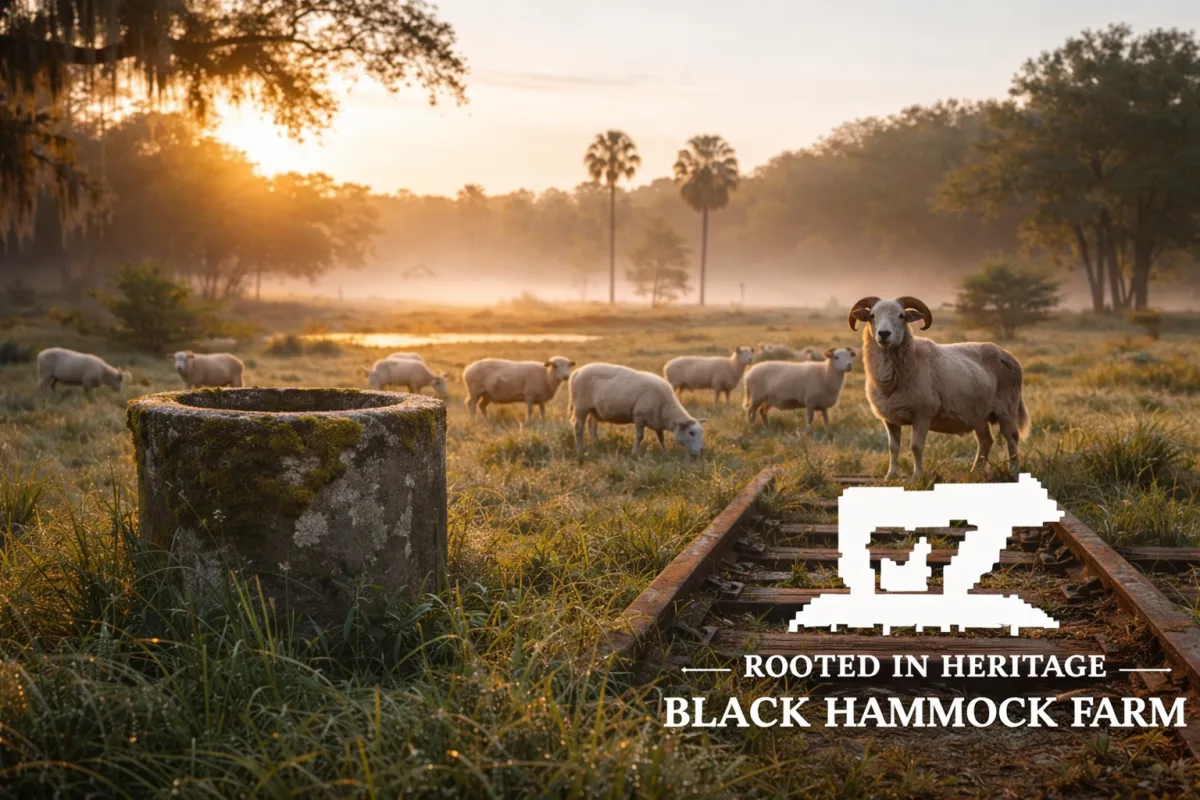
When you walk this land slowly—when you pay attention—you start to notice things that don’t belong to the present. Concrete collars half-buried and moss-covered, marking where artesian wells once flowed. Old railroad ties emerging from the ground at odd angles, their purpose long forgotten by most, but not by the land itself.
This ground remembers what it was asked to do.
And it remembers that it delivered.
When the Black Hammock Fed a Nation
In the early 1900s, this region wasn’t an afterthought on a map. It was an agricultural engine.
The Black Hammock—named for its dark, fertile muck soil—became the celery capital of Florida. By the 1920s, Oviedo and the surrounding area were producing nearly a quarter of the celery consumed in the United States. That didn’t happen by accident.
Farmers drained wetlands strategically. Artesian wells provided consistent irrigation. Rail lines were laid directly into the fields so produce could be harvested, packed, and shipped north within hours. This land was valuable because it was productive.
Families built their lives around that productivity.
Communities grew because the land gave them a reason to stay.
That era eventually faded. Markets changed. Development pressures increased. Farming moved elsewhere. But the soil never forgot what it was capable of.
Soil Has a Memory
Modern agriculture often treats land like a blank slate—something to be reshaped, paved, or repurposed. But anyone who works the ground knows better.
Soil remembers patterns.
It remembers where water wants to flow.
It remembers what grows easily and what struggles.
It remembers how it was managed—and mismanaged.
The rich muck soil of the Black Hammock still responds when treated with respect. Native grasses rebound quickly. Pastures recover faster than expected. Wetland edges stabilize when grazed correctly instead of mowed or sprayed.
This isn’t coincidence. It’s continuity.
We didn’t create this land’s productivity. We inherited it.
Stewardship Isn’t About Going Backward
Honoring history doesn’t mean pretending it’s still 1925.
We aren’t growing celery.
We aren’t laying new rail lines.
We aren’t draining wetlands for row crops.
What wearedoing is asking a more modern question:
How can this land continue to produce—without being destroyed in the process?
For us, the answer came through livestock suited to the environment. Katahdin sheep don’t fight Florida’s heat and humidity—they thrive in it. They graze selectively. They disturb the soil lightly. They manage vegetation without chemicals, machinery, or constant human intervention.
In many ways, they’re doing what celery once did: workingwiththe land instead of against it.
The Cost of Forgetting
When people say, “There’s no farming left here,” what they often mean is that they no longer recognize it.
Farming today doesn’t always look like it did a century ago. It’s quieter. Smaller. More adaptive. And often, more fragile.
Once land loses its agricultural identity, it becomes easier to justify paving it. Once a farm disappears, it rarely comes back. And when the last working fields are gone, so is the local knowledge of how to feed a community from its own soil.
Forgetting history has consequences.
Remembering it creates responsibility.
Carrying the Thread Forward
We don’t claim ownership of this legacy.
We claim guardianship.
Our role is temporary. The land will outlast us. The question is whether it will remain productive—or simply preserved as a memory behind fences and plaques.
Every decision we make at Black Hammock Farm is shaped by that awareness. We aren’t just farming for today’s needs. We’re farming in a way that leaves options open for those who come next.
Because this land has already proven what it can do—when it’s allowed to work.
What Comes Next
In the next part of this series, we’ll talk about the animals themselves—why heritage livestock matter, how genetic diversity is quietly disappearing, and why preserving functional breeds like Katahdin sheep isn’t nostalgia, but necessity.
The land remembers.
The question is whether we’re willing to listen.
Next in Part 3: “Built to Belong Here” — Why heritage livestock breeds are disappearing, and why Florida farms can’t afford to lose them.
1579 Walsh Street Oviedo,
Florida 32765
COMPANY
FARM SERVICES
LIVESTOCK PROGRAMS
FOLLOW US
POWERED BY:
© 2025 Black Hammock Family Farm. All rights reserved.