
Small Call to Action Headline
Black hammock farm'S
Katahdin Sheep Wetlands Management Study
Why This Study Matters
Florida faces a critical challenge in wetland management as invasive species threaten ecosystem integrity across the state. The South Florida Water Management District identifies approximately 200 introduced plant and animal species established in the region, with 66 non-native plant species designated as priorities for control. Current management strategies rely heavily on mechanical removal, prescribed burns, and herbicide applications—methods that are expensive, labor-intensive, and may have unintended ecological consequences.
Simultaneously, livestock grazing in wetland environments remains controversial and understudied, particularly in subtropical climates. While extensive research documents livestock impacts on wetlands, the vast majority focuses on cattle in temperate regions. Research on sheep grazing in subtropical wetlands, specifically using parasite-resistant hair sheep breeds, remains critically limited.
1579 Walsh Street Oviedo,
Florida 32765
COMPANY
FARM SERVICES
LIVESTOCK PROGRAMS
FOLLOW US


POWERED BY:

© 2025 Black Hammock Family Farm.
All rights reserved.
The Participants: The Innovation of Using Katahdin Sheep In WetLAND MANAGEMENT
Katahdin sheep represent a unique opportunity for Florida wetland management due to their specific biological adaptations:
Parasite Resistance: Research demonstrates that Katahdin sheep possess significantly higher parasite resistance than conventional wool breeds. Studies conducted at Virginia Tech and Arkansas showed Katahdin sheep had fecal egg counts 45% lower than Dorper crosses and required substantially less anthelmintic treatment than wool breeds. Their Caribbean hair sheep ancestry provides genetic resistance evolved in hot, humid, high-parasite environments—precisely the conditions present in Florida wetlands.
Climate Adaptation: Katahdin sheep demonstrate well-developed heat tolerance in tropical and subtropical regions. Their hair coat (rather than wool) allows superior thermoregulation in humid conditions where wool breeds experience heat stress. University of Florida research identifies Katahdin as one of six meat breeds demonstrating ability to naturally minimize parasite burdens in Florida conditions.
Selective Grazing Behavior: Sheep exhibit different grazing patterns than cattle. Research indicates sheep nibble grass close to the ground and selectively consume flowers and certain vegetation types. This selective grazing could target specific invasive plant species while minimizing impact on desired native vegetation.
Reduced Wetland Impact: Sheep are lighter and more agile than cattle, causing less soil compaction and trampling damage. Studies in New Zealand and British Columbia specifically noted that sheep grazing can be preferable to cattle in fragile wetland environments vulnerable to poaching (soil damage from hoofprints in wet conditions).
Conservation and Economic Benefits
Vegetation Management Without Chemicals: Multiple studies demonstrate that moderate grazing intensity can increase plant species diversity and control dominant invasive species that exclude less competitive native plants. Research in California vernal pools showed that reintroduced grazing at moderate stocking rates significantly increased both diversity and native cover after just two years. European wetland studies found that patchy, occasionally intense grazing increased protected plant species and habitat heterogeneity while benefiting both conservation and agricultural goals.
Cost-Effective Management: The solar grazing industry demonstrates that sheep can provide effective, economical vegetation management. While mechanical mowing requires expensive equipment, fuel, and risks panel/infrastructure damage, sheep provide continuous low-cost maintenance while generating potential revenue through meat production.
Ecosystem Services: Properly managed grazing can create habitat heterogeneity that benefits wildlife. Research in Hungarian marshes showed increases in wetland bird populations, protected plant species, and patches of open vegetation with grazing intensity gradients. The key is avoiding continuous heavy grazing while allowing patchy, varied grazing pressure.
Carbon Footprint Reduction: Replacing mechanical vegetation management eliminates fossil fuel consumption for mowers while integrating livestock production into ecosystem restoration.
PRELIMINARY HYPOTHESES .
Vegetation Control
Hypothesis: Katahdin sheep grazing at moderate stocking densities (2-4 sheep/acre for 2-4 week periods) will significantly reduce biomass of target invasive species compared to ungrazed control areas, while maintaining or increasing native plant species diversity.
Water Quality
Hypothesis: Moderate-intensity sheep grazing will maintain water quality parameters (turbidity, nitrogen, phosphorus, fecal coliform bacteria) within acceptable ranges for wetland ecosystem health, with impacts significantly lower than documented cattle grazing effects.
SHEEP HEALTH
Hypothesis: Katahdin sheep grazing on Florida wetland vegetation will maintain adequate body condition scores and parasite resistance within acceptable management thresholds, requiring no more than 15% of animals to need anthelmintic treatment during the grazing period.
ECoNOMICAL VIABILITY
Hypothesis: Sheep grazing vegetation management costs will be ≤50% of equivalent mechanical mowing and herbicide application costs over a 12-month period, while producing marketable lamb weight gain.
Biodiversity Impact
Hypothesis: Sheep grazing vegetation management costs will be ≤50% of equivalent mechanical mowing and herbicide application costs over a 12-month period, while producing marketable lamb weight gain.
ETHICAL CONSIDERATIONS & LIMITATIONS .
ANIMAL WELFARE
All sheep management will follow American Veterinary Medical Association guidelines
Monitoring protocols ensure early detection of heat stress or health issues
Access to shade, clean water, and supplemental minerals as needed
Immediate veterinary intervention protocols established
Environmental Protections
Grazing exclusion during critical wildlife breeding/nesting periods
Monitoring for any decline in threatened or endangered species
Adaptive management to respond to unintended impacts
Coordination with Florida Fish and Wildlife Conservation Commission
Study Limitations
Results may be specific to Black Hammock Farm's wetland types and may not generalize to all Florida wetlands
Seasonal variation requires multi-year data collection for robust conclusions
Initial infrastructure investment may limit adoption by other landowners
Weather variability in Florida may affect consistency of grazing schedules
BLACK HAMMOCK FARM NEWS
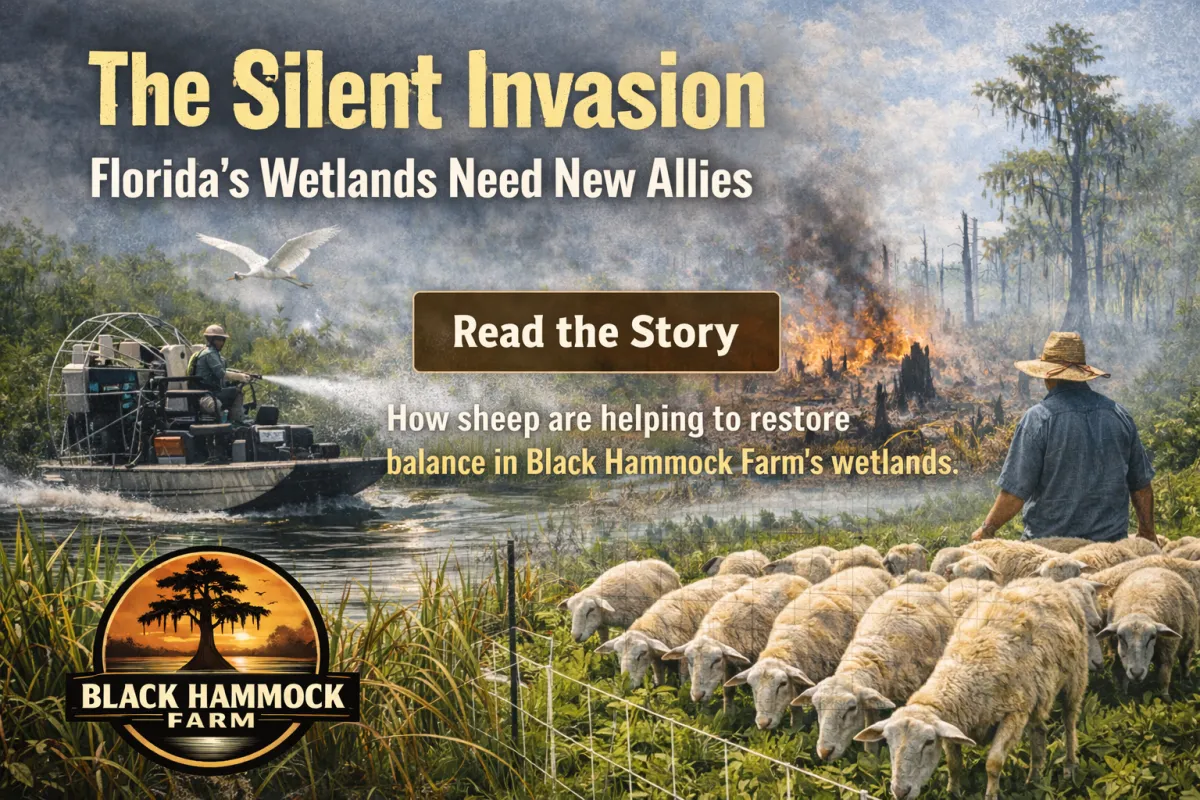
Florida Wetlands & the Silent Invasion
Sheep on the Front Lines: Targeted Grazing for Conservation
Part 7 of 14 in the "Rooted in Heritage, Growing for Tomorrow" Series
Last week, I wrote about the crisis facing Florida's wetlands—the silent invasion of aggressive plant species that's costing the state over $100 million annually and reshaping ecosystems faster than conventional management can respond.
This week, I want to get practical.
What does targeted grazing actually look like? How do sheep interact with wetland edges? What are we learning from our own land—the successes, the limitations, the surprises?
Because at Black Hammock Farm, this isn't theory. It's something we observe every day.
The Transitional Zone: Where Battles Are Won or Lost
If you want to understand why sheep matter for wetland conservation, you need to understand transitional zones.
These are the edges—the places where upland meets wetland, where dry ground gradually gives way to saturated soil, where terrestrial and aquatic ecosystems blur together. They're not as dramatic as open water or as familiar as pasture. Most people walk right past them without noticing.
But ecologically, transitional zones are everything.
These edges act as filters, capturing sediments and nutrients before they reach permanent water bodies. They provide critical habitat for species that move between environments—amphibians, wading birds, countless invertebrates. They buffer wetlands from upland disturbances. They're where much of the biological action happens.
They're also where invasive species establish their beachheads.
Think about it: transitional zones are, by definition, disturbed areas. Water levels fluctuate. Soil conditions vary. Native plant communities are adapted to this variability, but they're also vulnerable to competition. When an aggressive invader arrives—carried by wind, water, or wildlife—the transitional zone is often where it gains its first foothold.
Once established at the edge, invasive plants march systematically toward the wetland core, transforming each layer as they advance. Stop them at the transition, and you protect the whole system. Lose the transition, and the interior falls next.
This is where our sheep work.
What We're Seeing on Our Land
Black Hammock Farm includes transitional wetland areas—places where our pastures grade into seasonally saturated zones connected to the broader Lake Jesup watershed. For years, we've watched our Katahdin sheep interact with these edges. What we've observed has shaped everything we believe about conservation grazing.
The sheep naturally gravitate toward transitional vegetation.
This surprised us at first. We expected them to prefer the lush upland grasses, avoiding the wetter areas with their coarser plants. Instead, we found our Katahdins actively seeking out the transitional zones, grazing vegetation that conventional livestock often ignore.
Part of this is breed-specific. Katahdins were developed for challenging conditions and have more adventurous palates than many sheep breeds. Part of it is simply what sheep do—they're browsers as much as grazers, naturally inclined to sample diverse vegetation rather than fixating on a single forage type.
Whatever the reason, the behavior is consistent. Our sheep work the edges.
Invasive grasses get suppressed; native diversity rebounds.
We don't have formal research plots with controlled variables—we're a working farm, not a university. But we have eyes, and we have years of observation.
In areas where our sheep graze regularly, the aggressive grasses that tend to form monocultures get knocked back. The constant pressure prevents them from building the dense, light-blocking stands that crowd out everything else. And in the spaces that open up, we're seeing plants we hadn't noticed before: native groundcovers, forbs, the diverse low-growing species that characterize healthy transitional zones.
This matches what the scientific literature predicts. Grazing creates heterogeneity—patches of different heights, different densities, different stages of regrowth. That patchwork structure supports more species than either ungrazed monocultures or completely denuded ground.
The soil stays intact.
One of our biggest concerns when we started grazing transitional areas was soil damage. Wetland soils are sensitive. Compaction from heavy traffic—whether machinery or livestock—can destroy the structure that makes them function.
What we've found is that our sheep, at appropriate stocking densities, don't cause the damage we feared. They're light animals, typically 120-180 pounds, with relatively small hooves that distribute weight effectively. They don't churn the ground the way cattle can. They don't create the deep ruts that machinery leaves.
In fact, the minor soil disturbance from sheep hooves may actually benefit some native plants by creating germination opportunities—small bare patches where seeds can contact soil without competing against established vegetation.
The Katahdin Difference
I keep emphasizing that we raise Katahdin sheep specifically, and for conservation grazing, the breed matters enormously.
Heat tolerance. Florida's summers would devastate most wool breeds. Katahdins, with their hair coats that shed seasonally, handle our climate comfortably. They can work through conditions that would send other sheep into heat stress.
Parasite resistance. Wetland edges mean moisture, and moisture means parasites. Katahdins have documented resistance to many of the internal para
1579 Walsh Street Oviedo,
Florida 32765
COMPANY
FARM SERVICES
LIVESTOCK PROGRAMS
FOLLOW US
POWERED BY:
© 2025 Black Hammock Family Farm. All rights reserved.