
Small Call to Action Headline
Black hammock farm'S
Katahdin Sheep Wetlands Management Study
Why This Study Matters
Florida faces a critical challenge in wetland management as invasive species threaten ecosystem integrity across the state. The South Florida Water Management District identifies approximately 200 introduced plant and animal species established in the region, with 66 non-native plant species designated as priorities for control. Current management strategies rely heavily on mechanical removal, prescribed burns, and herbicide applications—methods that are expensive, labor-intensive, and may have unintended ecological consequences.
Simultaneously, livestock grazing in wetland environments remains controversial and understudied, particularly in subtropical climates. While extensive research documents livestock impacts on wetlands, the vast majority focuses on cattle in temperate regions. Research on sheep grazing in subtropical wetlands, specifically using parasite-resistant hair sheep breeds, remains critically limited.
1579 Walsh Street Oviedo,
Florida 32765
COMPANY
FARM SERVICES
LIVESTOCK PROGRAMS
FOLLOW US


POWERED BY:

© 2025 Black Hammock Family Farm.
All rights reserved.
The Participants: The Innovation of Using Katahdin Sheep In WetLAND MANAGEMENT
Katahdin sheep represent a unique opportunity for Florida wetland management due to their specific biological adaptations:
Parasite Resistance: Research demonstrates that Katahdin sheep possess significantly higher parasite resistance than conventional wool breeds. Studies conducted at Virginia Tech and Arkansas showed Katahdin sheep had fecal egg counts 45% lower than Dorper crosses and required substantially less anthelmintic treatment than wool breeds. Their Caribbean hair sheep ancestry provides genetic resistance evolved in hot, humid, high-parasite environments—precisely the conditions present in Florida wetlands.
Climate Adaptation: Katahdin sheep demonstrate well-developed heat tolerance in tropical and subtropical regions. Their hair coat (rather than wool) allows superior thermoregulation in humid conditions where wool breeds experience heat stress. University of Florida research identifies Katahdin as one of six meat breeds demonstrating ability to naturally minimize parasite burdens in Florida conditions.
Selective Grazing Behavior: Sheep exhibit different grazing patterns than cattle. Research indicates sheep nibble grass close to the ground and selectively consume flowers and certain vegetation types. This selective grazing could target specific invasive plant species while minimizing impact on desired native vegetation.
Reduced Wetland Impact: Sheep are lighter and more agile than cattle, causing less soil compaction and trampling damage. Studies in New Zealand and British Columbia specifically noted that sheep grazing can be preferable to cattle in fragile wetland environments vulnerable to poaching (soil damage from hoofprints in wet conditions).
Conservation and Economic Benefits
Vegetation Management Without Chemicals: Multiple studies demonstrate that moderate grazing intensity can increase plant species diversity and control dominant invasive species that exclude less competitive native plants. Research in California vernal pools showed that reintroduced grazing at moderate stocking rates significantly increased both diversity and native cover after just two years. European wetland studies found that patchy, occasionally intense grazing increased protected plant species and habitat heterogeneity while benefiting both conservation and agricultural goals.
Cost-Effective Management: The solar grazing industry demonstrates that sheep can provide effective, economical vegetation management. While mechanical mowing requires expensive equipment, fuel, and risks panel/infrastructure damage, sheep provide continuous low-cost maintenance while generating potential revenue through meat production.
Ecosystem Services: Properly managed grazing can create habitat heterogeneity that benefits wildlife. Research in Hungarian marshes showed increases in wetland bird populations, protected plant species, and patches of open vegetation with grazing intensity gradients. The key is avoiding continuous heavy grazing while allowing patchy, varied grazing pressure.
Carbon Footprint Reduction: Replacing mechanical vegetation management eliminates fossil fuel consumption for mowers while integrating livestock production into ecosystem restoration.
PRELIMINARY HYPOTHESES .
Vegetation Control
Hypothesis: Katahdin sheep grazing at moderate stocking densities (2-4 sheep/acre for 2-4 week periods) will significantly reduce biomass of target invasive species compared to ungrazed control areas, while maintaining or increasing native plant species diversity.
Water Quality
Hypothesis: Moderate-intensity sheep grazing will maintain water quality parameters (turbidity, nitrogen, phosphorus, fecal coliform bacteria) within acceptable ranges for wetland ecosystem health, with impacts significantly lower than documented cattle grazing effects.
SHEEP HEALTH
Hypothesis: Katahdin sheep grazing on Florida wetland vegetation will maintain adequate body condition scores and parasite resistance within acceptable management thresholds, requiring no more than 15% of animals to need anthelmintic treatment during the grazing period.
ECoNOMICAL VIABILITY
Hypothesis: Sheep grazing vegetation management costs will be ≤50% of equivalent mechanical mowing and herbicide application costs over a 12-month period, while producing marketable lamb weight gain.
Biodiversity Impact
Hypothesis: Sheep grazing vegetation management costs will be ≤50% of equivalent mechanical mowing and herbicide application costs over a 12-month period, while producing marketable lamb weight gain.
ETHICAL CONSIDERATIONS & LIMITATIONS .
ANIMAL WELFARE
All sheep management will follow American Veterinary Medical Association guidelines
Monitoring protocols ensure early detection of heat stress or health issues
Access to shade, clean water, and supplemental minerals as needed
Immediate veterinary intervention protocols established
Environmental Protections
Grazing exclusion during critical wildlife breeding/nesting periods
Monitoring for any decline in threatened or endangered species
Adaptive management to respond to unintended impacts
Coordination with Florida Fish and Wildlife Conservation Commission
Study Limitations
Results may be specific to Black Hammock Farm's wetland types and may not generalize to all Florida wetlands
Seasonal variation requires multi-year data collection for robust conclusions
Initial infrastructure investment may limit adoption by other landowners
Weather variability in Florida may affect consistency of grazing schedules
BLACK HAMMOCK FARM NEWS
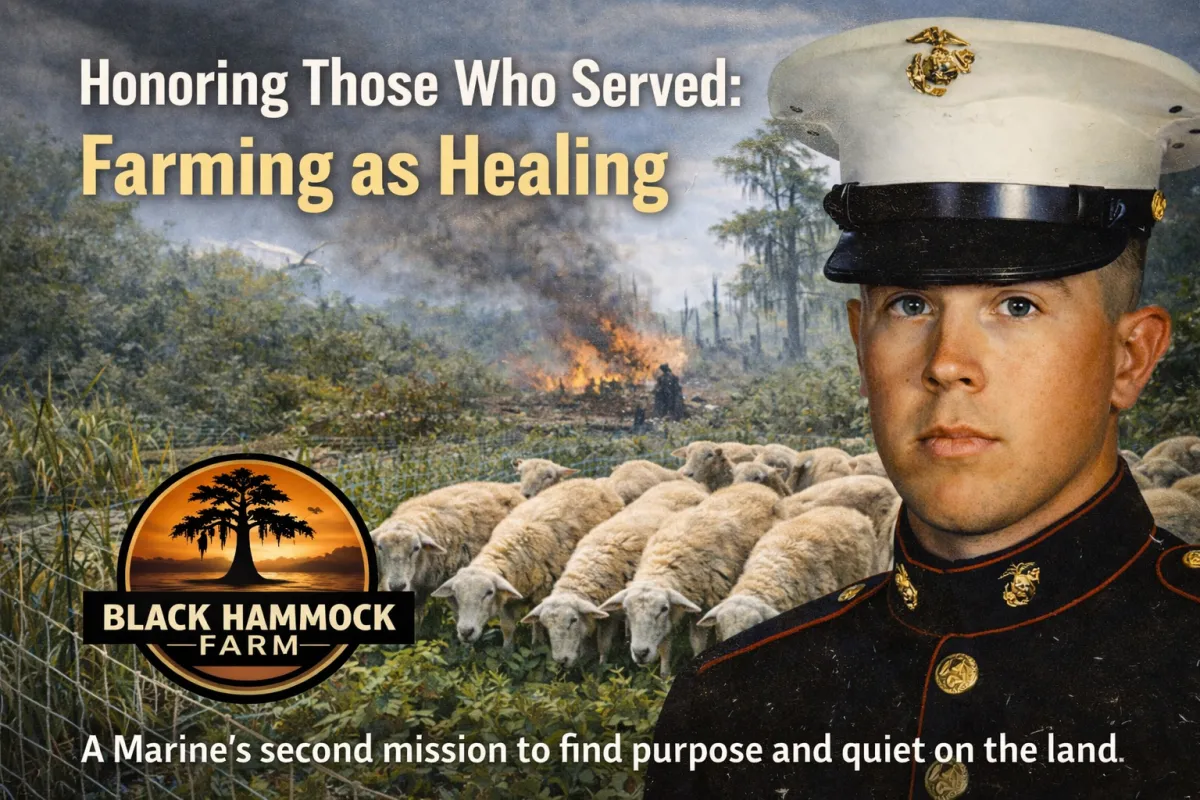
Farming as Healing for Veterans
Honoring Those Who Served: Farming as Healing
Part 8 of 14 in the "Rooted in Heritage, Growing for Tomorrow" Series
There's a moment that happens sometimes when veterans visit the farm.
They'll be standing in the pasture, maybe watching the sheep graze, maybe just breathing the air. And something shifts. The tension in their shoulders eases. Their eyes soften. They get quiet in a way that feels different from awkwardness—more like recognition.
One veteran told me, after a long pause: "This is the first time my head has been quiet in months."
I understood exactly what he meant.
A Marine's Second Mission
My name is Kip Hudakoz, and I'm a United States Marine who served proudly during the Gulf War Era.
I know what it's like to carry the weight of service. I know the strange silence that follows when the structure of military life falls away. I know the search for purpose that doesn't end just because the uniform comes off.
I was trained to destroy. But I've committed to spending the rest of my life creating and healing.
That's not just a philosophy—it's the reason Black Hammock Farm exists.
When I started this operation, I wasn't thinking about agricultural classifications or conservation grazing or community education programs. I was thinking about what I needed: land to steward, animals to care for, work that would rebuild something instead of tearing it down.
What I found was that the healing I needed was available to others too. Veterans who visit this farm often recognize something familiar—not in the sheep or the pastures, but in me. They see someone who walked a similar path and found solid ground on the other side.
That's why Black Hammock Farm is a proud member of the Farmer Veteran Coalition. And that's why this week's post is dedicated to those who served.
The Transition Nobody Talks About
When service members leave the military, we celebrate their homecoming. We thank them for their service. We assume, somehow, that the hard part is over.
It's not.
The transition from military to civilian life is one of the most difficult passages a person can make. Everything changes: the structure, the purpose, the community, the identity. Skills that were essential in uniform don't always translate to civilian jobs. The sense of mission that defined every day suddenly disappears.
Some veterans find their footing quickly. Many struggle, sometimes for years. The statistics on veteran unemployment, homelessness, and mental health challenges tell a story that our "thank you for your service" culture often ignores.
What veterans need isn't just gratitude. They need purpose. They need work that matters. They need communities that value what they bring.
Agriculture offers all of this.
Why Farming Fits
The Farmer Veteran Coalition was founded on a simple insight: the skills and character that make someone effective in military service translate remarkably well to farming.
Think about what both require:
Discipline.Farming doesn't care if you're tired, if the weather is miserable, if you'd rather stay in bed. Animals need feeding. Fences need mending. Crops need tending. The work demands showing up, every day, regardless of how you feel. Veterans understand this.
Adaptability. No battle plan survives contact with the enemy. No farm plan survives contact with reality. Equipment breaks. Weather shifts. Animals get sick. Markets change. Success requires adjusting on the fly, solving problems with whatever resources are available. Veterans have trained for exactly this.
Teamwork and leadership.Farms are operations, and operations need people working together toward common goals. Whether leading a crew or contributing as part of one, the collaborative skills honed in military service apply directly.
Physical capability.Farming is hard work. It demands strength, endurance, and the willingness to push through discomfort. Veterans have spent years building exactly these capacities.
Comfort with risk.Starting a farm—or any business—involves uncertainty. Not everyone can handle the anxiety of outcomes they can't fully control. Military service builds tolerance for risk and the ability to make decisions without perfect information.
Beyond the practical skills, there's something deeper. Many veterans describe a sense of mission in farming that echoes what they felt in service. Feeding people matters. Stewarding land matters. Building something that will outlast you matters.
From one kind of service to another.
The Farmer Veteran Coalition
The Farmer Veteran Coalition began in 2007 as a small gathering of people who recognized what agriculture could offer veterans. Today, it's grown into the largest organization in America dedicated to helping veterans build careers in farming.
Their mission is straightforward: cultivate a new generation of farmers and food leaders by connecting veterans with the resources, training, and community they need to succeed.
The programs they've developed include:
Homegrown By Heroes.This is the official farmer veteran branding program of America. When you see the Homegrown By Heroes label on agricultural products, you know they were produced by a U.S. military veteran. It's a way for consumers to support veteran farmers directly, and for veteran farmers to distinguish themselves in the marketplace.
The Fellowship Fund.This grant program provides direct financial assistance to veterans who are launching or expanding agricultural operations. It's not a loan—it's support, recognizing that access to capital is one of the biggest barriers new farmers face.
Training partnerships.Through partnerships with agricultural training programs across the country, FVC helps veterans gain the hands-on experience and technical knowledge that farming requires. These aren't classroom abstractions—they're working farm apprenticeships that build real skills.
Community.Perhaps most importantly, FVC creates connection. Veteran farmers supporting each other, sharing knowledge, celebrating successes, helping through failures. The isolation that many veterans experience in civilian life gives way to belonging.
Over 52,000 members. Every branch of service. Every state in the nation. A movement that's proving, farm by farm, that agriculture and veteran wellness belong together.
Black Hammock Farm is proud to stand among them.
What We've Seen at Black Hammock Farm
We're not a therapy program. We're not trained counselors. We're a working farm with sheep to tend and eggs to collect and fences that always need repair.
But as a veteran myself, I've noticed something over the years: veterans who spend time here often leave different than they arrived. I recognize the change because I've lived it.
Part of it is the animals. There's something about interacting with livestock that bypasses the defenses we build against human interaction. Sheep don't judge. They don't ask questions. They don't expect you to perform normalcy. They just... are. And somehow, being around creatures who simply exist, moment to moment, helps people who are carrying heavy loads.
Part of it is the work. Physical labor that produces visible results. The satisfaction of a fence line cleared, a water trough filled, a lamb safely delivered. Tasks that engage the body and quiet the mind. Many veterans tell us they sleep better after a day of farm work than they have in months.
Part of it is the land itself. Open sky. Growing things. The smell of earth and grass. Rhythms that don't care about news cycles or social media or the chaos of modern life. Something ancient and grounding that our built environments have largely eliminated.
We can't quantify this. We don't have studies or data. We just have observations: veterans arrive carrying weight, and some of that weight seems lighter when they leave.
That's enough reason for us to keep the door open.
Our Commitment as FVC Members
Black Hammock Farm isn't just a supporter of the Farmer Veteran Coalition—we're members. We believe in what they're doing. We believe that agriculture offers healing. We believe that veterans have skills our farming communities desperately need. We believe that connecting the two benefits everyone.
As members of FVC, our commitment takes several forms:
Awareness.We talk about FVC—in conversations, on our website, in this blog series. Many people have never heard of the organization. Simply spreading the word helps connect veterans with resources they might not know exist.
Welcome.Veterans are always welcome at Black Hammock Farm. Whether they're curious about agriculture, considering a farming career, or just need a place to breathe, our gate is open.
Learning together.We're building expertise in Katahdin sheep, in heritage poultry, in conservation grazing, in the specific challenges of farming in Florida. That knowledge is available to anyone who wants it, including veterans exploring agricultural paths.
Future Possibilities as our operation grows, we think about what roles might exist for veterans interested in hands-on farm work. Nothing formal yet—but the vision includes creating opportunities, not just for ourselves, but for others who might find purpose in this work.
An Invitation from One Veteran to Another
If you're a veteran reading this, I want you to know: you're welcome here. Not as a visitor. As family.
I've been where you are. I know the restlessness that doesn't have a name. I know how hard it is to explain what you're carrying to people who haven't carried it. I know the search for something—anything—that makes the transition feel less like falling.
This farm didn't fix me. Nothing fixes us. But it gave me purpose. It gave me a mission I could believe in. It gave me a reason to get up every morning that had nothing to do with what I'd been trained to destroy and everything to do with what I could create.
Come walk the pastures. Meet the sheep. Collect some eggs. Stay for an hour or a day. You don't have to explain yourself. You don't have to perform. Just be here, with the animals and the land and a fellow Marine who understands.
And if you're interested in farming—whether as a career, a side pursuit, or just a possibility you're exploring—we're happy to share what we know. The learning curve is real, but so is the community of people willing to help.
The Farmer Veteran Coalition can connect you with resources far beyond what we offer: training programs, funding opportunities, mentor farmers across the country. Visit farmvetco.org to learn more. Membership is free for veterans.
A Different Kind of Service
I started this series talking about why we farm. The reasons are many: heritage, community, sustainability, the satisfaction of producing something real.
But for me, personally, there's a reason that runs deeper than all of those: redemption.
I was trained to destroy. Every Marine is. We're good at it. But there comes a point when you have to decide what you're going to do with the rest of your life—whether you're going to keep carrying destruction, or whether you're going to build something different.
Black Hammock Farm is my answer. Every lamb born here, every family that reconnects with the land, every acre of invasive species our sheep help control, every veteran who finds a moment of quiet—that's creation. That's healing. That's the second mission.
Veterans understand service. Many of us are looking for ways to continue serving after uniform. Agriculture offers that path—not as charity, but as contribution. Not as therapy, but as purpose.
At Black Hammock Farm, we're honored to support veterans finding their way to farming. It's a small contribution to a large mission. But every veteran who discovers purpose in agriculture—who finds their head quiet for the first time in months, who builds something that matters, who transitions from one kind of service to another—makes the effort worthwhile.
To all who have served: thank you. And if the land is calling you, I hope you'll answer.
Semper Fi.
Next week in Part 9: "Understanding the Challenge: Property Taxes and Small Farms"—we'll address the economic realities facing agricultural operations like ours, and explain the classification issue that will determine Black Hammock Farm's future.
From the Pasture:The rhythm of the farm continues regardless of season or circumstance. This week we've been focusing on the breeding rotation—evaluating ewes, monitoring condition scores, preparing for the next lambing cycle. The work doesn't stop, and there's comfort in that constancy.
For Veterans:TheFarmer Veteran Coalitionoffers free membership to all who have served. Visitfarmvetco.orgto join, access resources, and connect with a community of veteran farmers across America. As fellow FVC members, we'd be honored to connect with you—reach out throughblackhammockfarm.comand mention your service. The Homegrown By Heroes label helps consumers identify and support veteran-produced agricultural products.
A Question for Readers:Do you know a veteran who might find purpose in agriculture? Someone looking for meaningful work, connection to land, or simply a different path? Please share this post with them. Sometimes the right opportunity just needs the right introduction.
#RootedInHeritage #BlackHammockFarm #FarmerVeteranCoalition #HomegrownByHeroes #VeteranFarmers
1579 Walsh Street Oviedo,
Florida 32765
COMPANY
FARM SERVICES
LIVESTOCK PROGRAMS
FOLLOW US
POWERED BY:
© 2025 Black Hammock Family Farm. All rights reserved.