
Small Call to Action Headline
Black hammock farm'S
Katahdin Sheep Wetlands Management Study
Why This Study Matters
Florida faces a critical challenge in wetland management as invasive species threaten ecosystem integrity across the state. The South Florida Water Management District identifies approximately 200 introduced plant and animal species established in the region, with 66 non-native plant species designated as priorities for control. Current management strategies rely heavily on mechanical removal, prescribed burns, and herbicide applications—methods that are expensive, labor-intensive, and may have unintended ecological consequences.
Simultaneously, livestock grazing in wetland environments remains controversial and understudied, particularly in subtropical climates. While extensive research documents livestock impacts on wetlands, the vast majority focuses on cattle in temperate regions. Research on sheep grazing in subtropical wetlands, specifically using parasite-resistant hair sheep breeds, remains critically limited.
1579 Walsh Street Oviedo,
Florida 32765
COMPANY
FARM SERVICES
LIVESTOCK PROGRAMS
FOLLOW US


POWERED BY:

© 2025 Black Hammock Family Farm.
All rights reserved.
The Participants: The Innovation of Using Katahdin Sheep In WetLAND MANAGEMENT
Katahdin sheep represent a unique opportunity for Florida wetland management due to their specific biological adaptations:
Parasite Resistance: Research demonstrates that Katahdin sheep possess significantly higher parasite resistance than conventional wool breeds. Studies conducted at Virginia Tech and Arkansas showed Katahdin sheep had fecal egg counts 45% lower than Dorper crosses and required substantially less anthelmintic treatment than wool breeds. Their Caribbean hair sheep ancestry provides genetic resistance evolved in hot, humid, high-parasite environments—precisely the conditions present in Florida wetlands.
Climate Adaptation: Katahdin sheep demonstrate well-developed heat tolerance in tropical and subtropical regions. Their hair coat (rather than wool) allows superior thermoregulation in humid conditions where wool breeds experience heat stress. University of Florida research identifies Katahdin as one of six meat breeds demonstrating ability to naturally minimize parasite burdens in Florida conditions.
Selective Grazing Behavior: Sheep exhibit different grazing patterns than cattle. Research indicates sheep nibble grass close to the ground and selectively consume flowers and certain vegetation types. This selective grazing could target specific invasive plant species while minimizing impact on desired native vegetation.
Reduced Wetland Impact: Sheep are lighter and more agile than cattle, causing less soil compaction and trampling damage. Studies in New Zealand and British Columbia specifically noted that sheep grazing can be preferable to cattle in fragile wetland environments vulnerable to poaching (soil damage from hoofprints in wet conditions).
Conservation and Economic Benefits
Vegetation Management Without Chemicals: Multiple studies demonstrate that moderate grazing intensity can increase plant species diversity and control dominant invasive species that exclude less competitive native plants. Research in California vernal pools showed that reintroduced grazing at moderate stocking rates significantly increased both diversity and native cover after just two years. European wetland studies found that patchy, occasionally intense grazing increased protected plant species and habitat heterogeneity while benefiting both conservation and agricultural goals.
Cost-Effective Management: The solar grazing industry demonstrates that sheep can provide effective, economical vegetation management. While mechanical mowing requires expensive equipment, fuel, and risks panel/infrastructure damage, sheep provide continuous low-cost maintenance while generating potential revenue through meat production.
Ecosystem Services: Properly managed grazing can create habitat heterogeneity that benefits wildlife. Research in Hungarian marshes showed increases in wetland bird populations, protected plant species, and patches of open vegetation with grazing intensity gradients. The key is avoiding continuous heavy grazing while allowing patchy, varied grazing pressure.
Carbon Footprint Reduction: Replacing mechanical vegetation management eliminates fossil fuel consumption for mowers while integrating livestock production into ecosystem restoration.
PRELIMINARY HYPOTHESES .
Vegetation Control
Hypothesis: Katahdin sheep grazing at moderate stocking densities (2-4 sheep/acre for 2-4 week periods) will significantly reduce biomass of target invasive species compared to ungrazed control areas, while maintaining or increasing native plant species diversity.
Water Quality
Hypothesis: Moderate-intensity sheep grazing will maintain water quality parameters (turbidity, nitrogen, phosphorus, fecal coliform bacteria) within acceptable ranges for wetland ecosystem health, with impacts significantly lower than documented cattle grazing effects.
SHEEP HEALTH
Hypothesis: Katahdin sheep grazing on Florida wetland vegetation will maintain adequate body condition scores and parasite resistance within acceptable management thresholds, requiring no more than 15% of animals to need anthelmintic treatment during the grazing period.
ECoNOMICAL VIABILITY
Hypothesis: Sheep grazing vegetation management costs will be ≤50% of equivalent mechanical mowing and herbicide application costs over a 12-month period, while producing marketable lamb weight gain.
Biodiversity Impact
Hypothesis: Sheep grazing vegetation management costs will be ≤50% of equivalent mechanical mowing and herbicide application costs over a 12-month period, while producing marketable lamb weight gain.
ETHICAL CONSIDERATIONS & LIMITATIONS .
ANIMAL WELFARE
All sheep management will follow American Veterinary Medical Association guidelines
Monitoring protocols ensure early detection of heat stress or health issues
Access to shade, clean water, and supplemental minerals as needed
Immediate veterinary intervention protocols established
Environmental Protections
Grazing exclusion during critical wildlife breeding/nesting periods
Monitoring for any decline in threatened or endangered species
Adaptive management to respond to unintended impacts
Coordination with Florida Fish and Wildlife Conservation Commission
Study Limitations
Results may be specific to Black Hammock Farm's wetland types and may not generalize to all Florida wetlands
Seasonal variation requires multi-year data collection for robust conclusions
Initial infrastructure investment may limit adoption by other landowners
Weather variability in Florida may affect consistency of grazing schedules
BLACK HAMMOCK FARM NEWS
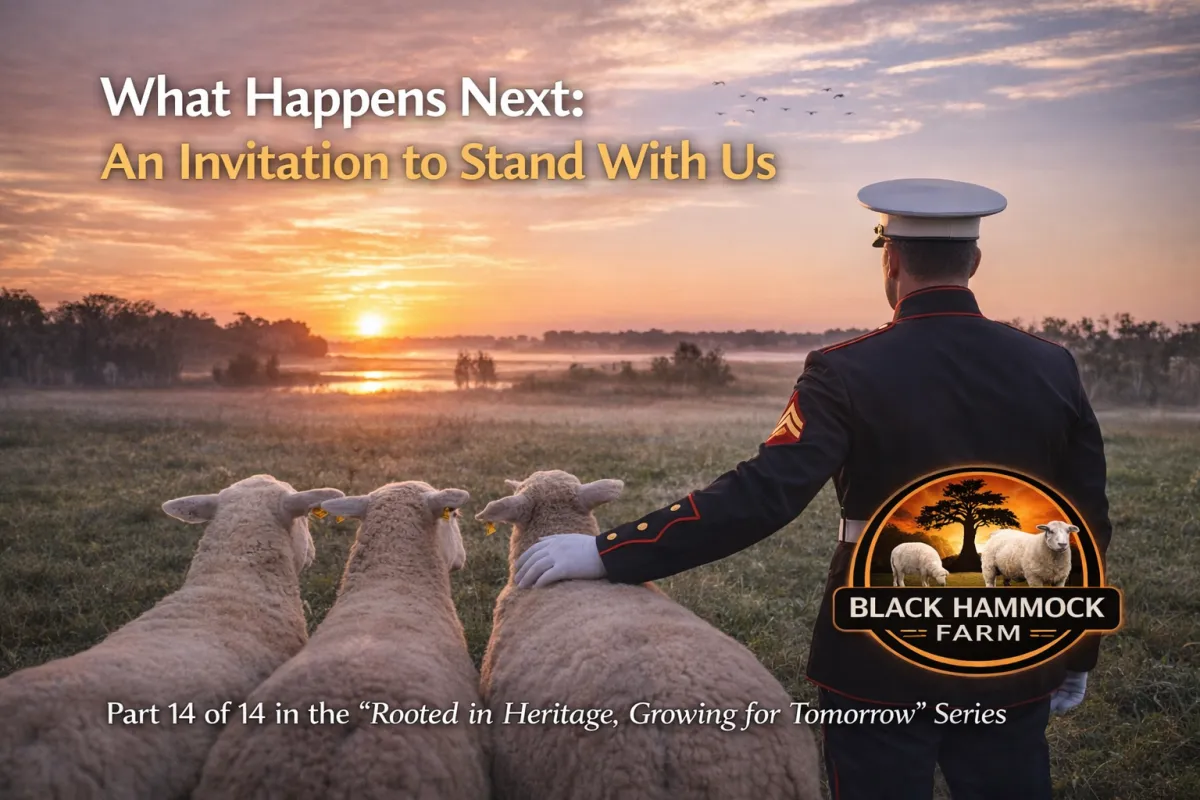
From Service to Stewardship
What Happens Next: An Invitation to Stand With Us
Part 14 of 14 in the "Rooted in Heritage, Growing for Tomorrow" Series
Thirteen weeks ago, I sat down to write the first words of this series.
I didn't know if anyone would read them. I didn't know if sharing our story would make any difference. I only knew that silence felt like surrender—and Marines don't surrender.
Today, as I write these final words before our Value Adjustment Board hearing on March 28th, I know the answer: you read them. You shared them. You reached out with questions, encouragement, and your own stories of connection to the land.
Some of you visited the farm for the first time. Others told me about grandparents who farmed, about childhood memories of collecting eggs, about a longing you couldn't quite name for something more rooted than modern life provides.
You reminded me why this fight matters.
Thank you.
The Journey We've Taken Together
Over these fourteen weeks, we've covered a lot of ground.
We started with why we farm—the "Live, Fresh, Local" philosophy that guides everything we do at Black Hammock Farm. Not just a slogan, but a daily practice of raising animals with care, producing food with integrity, and serving our community with intention.
We explored the heritage of this land—160 years of agricultural history in the Black Hammock region, from the celery fields that once fed America to the artesian wells still visible beneath our pastures. We're not starting something new. We're continuing something that should never have been allowed to fade.
We introduced you to the herd—our Katahdin sheep, chosen specifically for Florida's challenging climate. Baba V. and his ewes, the breeding program we've built with systematic care, the lambs that arrive each season as testament to the cycle continuing.
We sharedthe community connections—families visiting to reconnect with where food comes from, children meeting farm animals for the first time, the Backyard Chicken Program helping neighbors start their own agricultural journeys. The U-Pick Up program. The moments of wonder that happen when people step out of suburban routine and into living agriculture.
We explained Rent-A-Herd—how our sheep provide eco-friendly vegetation management without chemicals, machinery, or fossil fuels. How land clearing becomes a community event. How municipalities across America are discovering what farmers have known for millennia: grazing animals can manage landscapes sustainably.
We documented the conservation potential—Florida's $100 million annual battle against invasive species, the peer-reviewed research showing that strategic grazing controls invasive plants and maintains wetland diversity, the 8,500 acres of protected wetlands around Lake Jesup that could benefit from approaches we're ready to provide.
We honored those who served—the Farmer Veteran Coalition and the healing that agriculture offers veterans seeking purpose after uniform. My own journey from Marine to farmer, from destruction to creation, from serving my country to serving my community in a different way.
We confrontedthe challenge—the agricultural classification denial, the Magistrate who ruled decisively in our favor after reviewing our evidence, the $10,000 in legal fees spent proving what should have been obvious, and the March 28th hearing that will determine our future.
We unpackedthe law—what "bona fide commercial agricultural purposes" actually means, why small doesn't mean illegitimate, and how Florida statute was designed to protect working farms of all sizes.
We extendedthe invitation to collaborate—not as adversaries but as neighbors, recognizing that the county has legitimate responsibilities while asking for consistent application of the law.
We shared the science—the 14-year Florida study on grazing and wetland health, the university research supporting our practices, the evidence that everything we do is grounded in documented best practices.
And last week, we showed youthe stewardship—body condition scoring, rotational grazing, breeding documentation, professional standards. Not claims, but practices. Not words, but actions.
That's the journey. Thirteen weeks of showing you who we are and what we've built.
Now comes the moment of truth.
What's at Stake
I want to be honest with you about March 28th.
An independent Magistrate reviewed our case—the breeding records, the lease agreements, the revenue documentation, the county's own Development Order recognizing our agricultural character. She ruled that Black Hammock Farm meets every requirement of bona fide commercial agriculture under Florida law.
That ruling should have ended this. In most cases, the Value Adjustment Board accepts magistrate recommendations.
But it's not guaranteed. The Board can overturn the Magistrate's finding. They have that authority.
If they uphold the recommendation, Black Hammock Farm continues. We keep building what we've started. More lambs born into careful stewardship. More families reconnecting with agriculture. More conservation grazing research. More community served.
If they overturn it, the math becomes impossible. Residential-level property taxes on agricultural land doesn't work. No small farm's economics survive that equation. We'd face decisions no farmer wants to make.
I'm not telling you this to create drama or manipulate emotions. I'm telling you because it's true, and because the outcome affects more than just our farm.
This Is Bigger Than Black Hammock Farm
Every time a small farm loses this fight, a message gets sent: don't try.
Don't invest in agricultural infrastructure on the urban fringe. Don't believe that the laws designed to protect working farms will actually protect you. Don't imagine that your small operation—however legitimate, however documented, however aligned with statutory requirements—will receive the classification that makes survival possible.
And every time that message gets sent, we lose something irreplaceable.
Not just a farm. Thepossibilityof farms.
Seminole County sits at a crossroads that dozens of Florida counties have already passed. The question isn't whether development will continue—it will. The question is whether agriculture has any place in that future.
Will this be a county where small farms are recognized as community assets? Where agricultural classification is straightforward for operations meeting legal criteria? Where local government partners with farms for services like vegetation management and conservation?
Or will it follow the path of so many others—all farms become memories, all local food comes from somewhere else, all children grow up thinking agriculture is something that happens in distant places?
That choice isn't made all at once. It's made one farm at a time, one classification decision at a time, one Value Adjustment Board hearing at a time.
March 28th is one of those moments. What happens to Black Hammock Farm will signal what's possible—or impossible—for every small agricultural operation in this county.
What You Can Do
If you've followed this series, if you believe small farms matter, if you think communities are stronger when they're connected to the land that sustains them—here's how you can help.
Attend the hearing.
The Value Adjustment Board meets on Friday, March 28th, 2025 at the Seminole County Services Building, 1101 East First Street, Sanford, Florida. Public attendance is permitted.
You don't need to speak. You don't need to do anything except be present. When Board members see community members in the room, it signals that people are paying attention. That this decision matters to more than just one farm family.
If you can be there, please come.
Submit written support.
A brief, respectful letter expressing your support for Black Hammock Farm's agricultural classification can make a difference. Focus on why small farms matter to the community—your own reasons, in your own words.
Letters can be submitted to:
Seminole County Value Adjustment Board 1101 East First Street Sanford, FL 32771
Or email: [Include appropriate email if available]
Keep it simple. Keep it respectful. Personal stories about what local agriculture means to you are more powerful than legal arguments.
Share our story.
Every person who learns about Black Hammock Farm is another voice for agricultural preservation. Share this series—or any post from it—on social media, in community groups, with friends and neighbors.
The more people who understand what's at stake, the harder it becomes to let small farms quietly disappear.
Visit the farm.
If you haven't yet, come see what we do. Walk the pastures. Meet the sheep. Understand viscerally what agricultural classification is designed to protect.
We're located in Oviedo, in the heart of the historic Black Hammock region. Contact us through blackhammockfarm.com to arrange a visit.
Think bigger.
This isn't just about us. What other local institutions deserve community support? What other neighbors are doing important work that might need advocates? What other pieces of your community's character are worth protecting?
Community strength comes from people showing up for each other. If Black Hammock Farm has moved you to show up for us, let that momentum carry forward to other causes that need voices.
Whatever Happens
I need to tell you something important.
Whatever happens on March 28th, the sheep will need feeding on March 29th.
The ewes won't know about Value Adjustment Board decisions. They'll know pasture and weather and the rhythm that's guided their kind for ten thousand years. They'll need water and hay and someone walking the fence line. They'll need the care they've always needed.
And I'll provide it.
If we win, I'll walk the pastures the next morning with gratitude and relief, and then I'll get back to work. More to build. More to improve. More community to serve.
If we don't win, I'll walk the pastures the next morning with grief and determination, and then I'll figure out the next step. The legal process has additional stages. Other options exist. Marines don't quit at the first setback—or the second, or the third.
The farm has survived challenges before. It will survive this one, whatever form survival takes.
But I'd rather not just survive. I'd rather thrive. I'd rather build something that lasts, that serves, that proves what small agriculture can contribute to a community that values it.
That's the future I'm fighting for. That's what March 28th is really about.
A Final Word
I started this series by telling you that I was trained to destroy.
Every Marine is. We're good at it. It's what the job requires.
But there comes a moment—it comes for all of us eventually—when you have to decide what you're going to do with the rest of your life. Whether you're going to keep carrying destruction, or whether you're going to build something different.
Black Hammock Farm is my answer.
Every lamb born here is an act of creation. Every family that reconnects with the land is a small healing. Every acre of invasive species our sheep help control is restoration. Every veteran who finds a moment of quiet in these pastures is redemption.
I was trained to destroy. But I'm spending the rest of my life creating and healing.
That's not just a philosophy. It's a practice. It's what I do every morning when I walk among the ewes, every season when the lambs arrive, every day when the work continues regardless of what's happening in hearing rooms and government offices.
On March 28th, I'll stand before the Value Adjustment Board and make our case one more time. I'll bring the documentation. I'll present the evidence. I'll trust that the system works—that the law means what it says, that the Magistrate's ruling will be upheld, that legitimate agricultural operations receive the classification they're entitled to.
But I won't be standing alone.
I'll carry with me the stories you've shared. The encouragement you've offered. The proof that our community sees value in what we're building.
I'll carry the legacy of every farmer who worked this land before me—the celery growers who broke their backs so families across America could eat, the generations who knew that this soil was meant to produce.
I'll carry the hope of what Black Hammock Farm could become—a model for small agriculture in growing counties, a partner for conservation, a place where creation and healing continue for decades to come.
And I'll carry, as I always do, the oath I swore as a young Marine: to support and defend, to bear true faith, to faithfully discharge my duties.
The duties are different now. But the faithfulness is the same.
Thank you for taking this journey with me. Thank you for caring about farms and land and community. Thank you for standing with us.
Whatever happens next, it has been an honor to share our story.
See you on the other side.
Semper Fi.
— Kip HudakozBlack Hammock FarmOviedo, Florida
March 28th Hearing Information
Date:Friday, March 28, 2025
Location:Seminole County Services Building 1101 East First Street Sanford, FL 32771
Time:[Insert when confirmed]
What to expect:The Value Adjustment Board will review the Magistrate's recommendation regarding Black Hammock Farm's agricultural classification petition. Public attendance is permitted.
From the Pasture:As I write this, the spring lambs are finding their legs in the east pasture. New life, arriving on schedule, indifferent to human anxieties about hearings and outcomes. There's wisdom in that. The cycle continues. The work goes on. Whatever March 28th brings, that much is certain.
Stay Connected:
Website:blackhammockfarm.com
Follow our story on social media
Sign up for updates on the hearing outcome
One Final Request:If this series has meant something to you, I'd love to hear your story. What does local agriculture mean to your family? What memories do you have of farms and land and growing things? What future do you hope for?
Share in the comments, email us, or come tell us in person. Every story matters. Every voice counts.
This isn't the end. It's a beginning—of whatever comes next.
#RootedInHeritage #BlackHammockFarm #LiveFreshLocal #March28th #StandWithUs #SemperFi
1579 Walsh Street Oviedo,
Florida 32765
COMPANY
FARM SERVICES
LIVESTOCK PROGRAMS
FOLLOW US
POWERED BY:
© 2025 Black Hammock Family Farm. All rights reserved.