
Small Call to Action Headline
Black hammock farm'S
Katahdin Sheep Wetlands Management Study
Why This Study Matters
Florida faces a critical challenge in wetland management as invasive species threaten ecosystem integrity across the state. The South Florida Water Management District identifies approximately 200 introduced plant and animal species established in the region, with 66 non-native plant species designated as priorities for control. Current management strategies rely heavily on mechanical removal, prescribed burns, and herbicide applications—methods that are expensive, labor-intensive, and may have unintended ecological consequences.
Simultaneously, livestock grazing in wetland environments remains controversial and understudied, particularly in subtropical climates. While extensive research documents livestock impacts on wetlands, the vast majority focuses on cattle in temperate regions. Research on sheep grazing in subtropical wetlands, specifically using parasite-resistant hair sheep breeds, remains critically limited.
1579 Walsh Street Oviedo,
Florida 32765
COMPANY
FARM SERVICES
LIVESTOCK PROGRAMS
FOLLOW US


POWERED BY:

© 2025 Black Hammock Family Farm.
All rights reserved.
The Participants: The Innovation of Using Katahdin Sheep In WetLAND MANAGEMENT
Katahdin sheep represent a unique opportunity for Florida wetland management due to their specific biological adaptations:
Parasite Resistance: Research demonstrates that Katahdin sheep possess significantly higher parasite resistance than conventional wool breeds. Studies conducted at Virginia Tech and Arkansas showed Katahdin sheep had fecal egg counts 45% lower than Dorper crosses and required substantially less anthelmintic treatment than wool breeds. Their Caribbean hair sheep ancestry provides genetic resistance evolved in hot, humid, high-parasite environments—precisely the conditions present in Florida wetlands.
Climate Adaptation: Katahdin sheep demonstrate well-developed heat tolerance in tropical and subtropical regions. Their hair coat (rather than wool) allows superior thermoregulation in humid conditions where wool breeds experience heat stress. University of Florida research identifies Katahdin as one of six meat breeds demonstrating ability to naturally minimize parasite burdens in Florida conditions.
Selective Grazing Behavior: Sheep exhibit different grazing patterns than cattle. Research indicates sheep nibble grass close to the ground and selectively consume flowers and certain vegetation types. This selective grazing could target specific invasive plant species while minimizing impact on desired native vegetation.
Reduced Wetland Impact: Sheep are lighter and more agile than cattle, causing less soil compaction and trampling damage. Studies in New Zealand and British Columbia specifically noted that sheep grazing can be preferable to cattle in fragile wetland environments vulnerable to poaching (soil damage from hoofprints in wet conditions).
Conservation and Economic Benefits
Vegetation Management Without Chemicals: Multiple studies demonstrate that moderate grazing intensity can increase plant species diversity and control dominant invasive species that exclude less competitive native plants. Research in California vernal pools showed that reintroduced grazing at moderate stocking rates significantly increased both diversity and native cover after just two years. European wetland studies found that patchy, occasionally intense grazing increased protected plant species and habitat heterogeneity while benefiting both conservation and agricultural goals.
Cost-Effective Management: The solar grazing industry demonstrates that sheep can provide effective, economical vegetation management. While mechanical mowing requires expensive equipment, fuel, and risks panel/infrastructure damage, sheep provide continuous low-cost maintenance while generating potential revenue through meat production.
Ecosystem Services: Properly managed grazing can create habitat heterogeneity that benefits wildlife. Research in Hungarian marshes showed increases in wetland bird populations, protected plant species, and patches of open vegetation with grazing intensity gradients. The key is avoiding continuous heavy grazing while allowing patchy, varied grazing pressure.
Carbon Footprint Reduction: Replacing mechanical vegetation management eliminates fossil fuel consumption for mowers while integrating livestock production into ecosystem restoration.
PRELIMINARY HYPOTHESES .
Vegetation Control
Hypothesis: Katahdin sheep grazing at moderate stocking densities (2-4 sheep/acre for 2-4 week periods) will significantly reduce biomass of target invasive species compared to ungrazed control areas, while maintaining or increasing native plant species diversity.
Water Quality
Hypothesis: Moderate-intensity sheep grazing will maintain water quality parameters (turbidity, nitrogen, phosphorus, fecal coliform bacteria) within acceptable ranges for wetland ecosystem health, with impacts significantly lower than documented cattle grazing effects.
SHEEP HEALTH
Hypothesis: Katahdin sheep grazing on Florida wetland vegetation will maintain adequate body condition scores and parasite resistance within acceptable management thresholds, requiring no more than 15% of animals to need anthelmintic treatment during the grazing period.
ECoNOMICAL VIABILITY
Hypothesis: Sheep grazing vegetation management costs will be ≤50% of equivalent mechanical mowing and herbicide application costs over a 12-month period, while producing marketable lamb weight gain.
Biodiversity Impact
Hypothesis: Sheep grazing vegetation management costs will be ≤50% of equivalent mechanical mowing and herbicide application costs over a 12-month period, while producing marketable lamb weight gain.
ETHICAL CONSIDERATIONS & LIMITATIONS .
ANIMAL WELFARE
All sheep management will follow American Veterinary Medical Association guidelines
Monitoring protocols ensure early detection of heat stress or health issues
Access to shade, clean water, and supplemental minerals as needed
Immediate veterinary intervention protocols established
Environmental Protections
Grazing exclusion during critical wildlife breeding/nesting periods
Monitoring for any decline in threatened or endangered species
Adaptive management to respond to unintended impacts
Coordination with Florida Fish and Wildlife Conservation Commission
Study Limitations
Results may be specific to Black Hammock Farm's wetland types and may not generalize to all Florida wetlands
Seasonal variation requires multi-year data collection for robust conclusions
Initial infrastructure investment may limit adoption by other landowners
Weather variability in Florida may affect consistency of grazing schedules
BLACK HAMMOCK FARM NEWS
The Moment a Child Understands the Land
A Place Where Families Reconnect with the Land
Part 4 of 14 in the "Rooted in Heritage, Growing for Tomorrow" Series
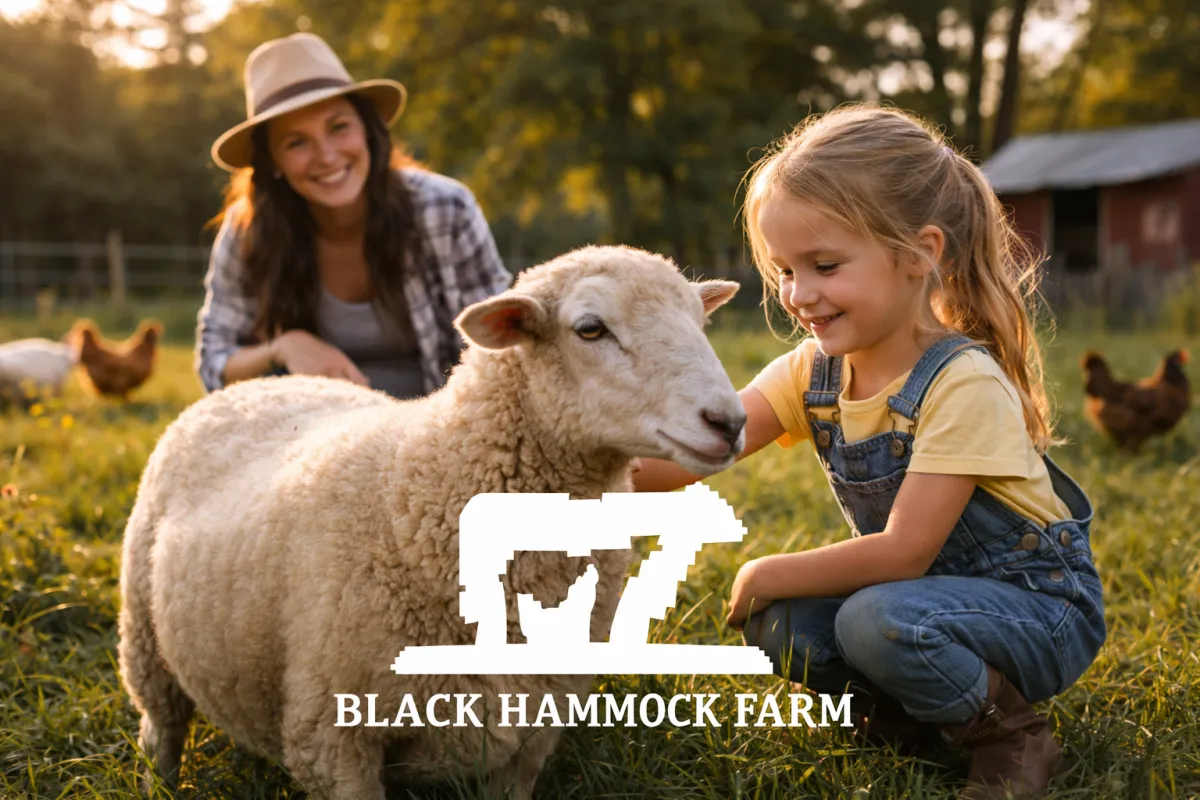
A few months ago, a mother brought her daughter to the farm for the first time. The girl was maybe five years old—old enough to be curious, young enough to be fearless.
She'd never touched a chicken. Never seen a sheep up close. Never held an egg that was still warm.
I watched her crouch beside our Katahdin ewes, her small hand reaching out tentatively. One of the older ewes—patient as always—ambled over and let the girl stroke her woolless coat. The child's face transformed from uncertainty to wonder to something I can only describe as recognition. Like she was remembering something her body had always known but her suburban life had never taught her.
Her mother called me a week later.
"She asks where everything comes from now," she said. "Every meal. She wants to know: did this come from an animal? Did someone grow this? How did it get to our table?"
That conversation—that moment of awakening in a five-year-old—is why we do this.
The Disconnection Crisis
Here's a statistic that should trouble every parent: studies consistently show that a significant percentage of children don't know that hamburgers come from cows, that pickles start as cucumbers, or that French fries begin as potatoes growing in soil.
This isn't their fault. It's the predictable result of a food system that has become invisible. When everything arrives wrapped in plastic, when meals appear through windows and delivery apps, when the journey from farm to table happens entirely out of sight—how would children learn otherwise?
But knowledge isn't all we've lost. Something deeper has disappeared: the felt sense of being part of a living system. The understanding that our survival depends on soil and water and the labor of growing things. The humility that comes from knowing food doesn't originate in grocery stores.
This disconnection doesn't just affect children. Adults feel it too—a vague unease, a nostalgia for something we can't quite name, a hunger that supermarkets can't satisfy.
What Happens at the Farm
When families visit Black Hammock Farm, we don't give them a show. We give them reality.
The chickens aren't performing. They're doing what chickens do: scratching, pecking, establishing their mysterious hierarchies, occasionally producing an egg in the most unlikely places. The sheep aren't props. They're grazing, resting, watching visitors with their characteristic blend of curiosity and wariness.
Children learn to move slowly around animals. They discover that trust is earned. They find out that eggs are warm when they're fresh, that sheep smell like lanolin and grass, that a rooster's crow is much louder in person than on a recording.
Parents often tell me they learn as much as their kids. Many have never been on a working farm. The rhythms of agricultural life—the early mornings, the dependence on weather, the patience required for animals to do what animals do—are as foreign to them as to their children.
That's not a criticism. It's the world we've built. But it's also something we can change, one family at a time.
The U-Pick Up Program
One of our most popular programs is deceptively simple: U-Pick Up.
Families come to the farm and select their own livestock—whether lamb for a holiday celebration, chickens for their backyard flock, or turkeys for Thanksgiving. They don't just order from a website. They meet the animals. They see how they've been raised. They make a choice based on direct experience rather than marketing.
For many, this is the first time they've connected a living animal to the food on their table. It's not always comfortable. Sometimes it raises questions—especially from children—that don't have easy answers.
But I believe those questions matter. Understanding that meat comes from animals that lived, breathed, and had personalities isn't meant to create guilt. It's meant to create respect. When you know where your food comes from, you're less likely to waste it. You're more likely to appreciate the farmers, the animals, and the land that produced it.
The families who participate in U-Pick Up often become our most committed supporters. Not because we've convinced them of anything, but because they've experienced something. Connection creates advocates in ways that arguments never can.
Building Backyard Farmers
Three years ago, we launched our Backyard Chicken Program, and it's grown beyond anything we expected.
The premise is straightforward: we help Central Florida families start and maintain their own small flocks. We provide chicks from our hatchery—heritage breeds selected for temperament, hardiness, and egg production. We offer guidance on coop setup, predator protection, feeding, and health. And we remain available as an ongoing resource when questions arise.
What we've learned is that people are hungry—sometimes desperately—for this knowledge.
First-time chicken owners call us with questions that might seem basic: why is my hen making this noise? Is this egg supposed to look like that? How do I protect them from hawks? Each question represents someone taking responsibility for producing their own food, often for the first time in their family's living memory.
The eggs are almost beside the point.
What matters is the daily ritual: going outside, checking on living creatures that depend on you, collecting something tangible that you'll eat for breakfast. What matters is children learning that responsibility is real, that animals need care regardless of whether it's convenient, that food comes from work.
We call them "backyard farmers" because that's what they're becoming. Not hobbyists—farmers. Small-scale, yes. Part-time, certainly. But genuinely engaged in the ancient work of raising animals for food.
Every backyard flock in Seminole County is a small step toward food resilience. It's a family that understands, in their bones, something about where sustenance comes from. It's a few dozen eggs a week that don't require industrial production, packaging, and shipping.
And perhaps most importantly, it's a generation of children who will grow up knowing that eggs come from chickens, that chickens need care, and that producing food is honorable work.
The Unexpected Visitors
Not everyone who comes to Black Hammock Farm is looking for livestock.
Sometimes people show up just to... be here. To stand in a pasture and watch sheep graze. To breathe air that smells like something other than exhaust and air conditioning. To remember.
Older visitors often have the strongest reactions. They'll tell me about grandparents who farmed, about childhood summers on relatives' properties, about a connection to the land that got paved over somewhere along the way.
"I didn't know I missed this until I was here," one woman told me, tears unexpectedly welling up as she watched our ewes move across the pasture.
I don't fully understand the psychology of it. But I've come to believe that humans have a need for contact with living systems—plants, animals, soil, weather—that our built environment doesn't satisfy. We evolved for hundreds of thousands of years in intimate relationship with the natural world. A century of industrialization and urbanization can't erase that.
When people come to the farm and feel something shift inside them, they're not being sentimental. They're responding to something real.
An Open Door
Black Hammock Farm isn't a petting zoo or a theme park. It's a working agricultural operation with all the mess and unpredictability that implies.
But our door is open.
If you've never seen a lamb take its first wobbly steps, you're welcome here.
If you've forgotten what it feels like to hold a just-laid egg, still warm in your hand, you're welcome here.
If your children think food comes from apps, or if you've lost touch with something your grandparents knew, or if you simply want to spend an hour in a place where the rhythms are slower and the connections are tangible—you're welcome here.
We're not trying to turn everyone into farmers. We're trying to rebuild something that shouldn't have been lost in the first place: the understanding that we are part of the living world, not separate from it.
That understanding starts with experiences. With moments. With a five-year-old reaching out to touch a sheep for the first time.
And it continues, one family at a time, as long as farms like ours exist to provide them.
Next week in Part 5: "Rent-A-Herd: When Sheep Work for the Community"—discover how our Katahdin sheep provide eco-friendly vegetation management across Central Florida, proving that farms can serve neighborhoods in ways that go far beyond food production.
From the Pasture:Our Black Australorp hens are in peak production this month, delivering rich brown eggs daily. These heritage birds—originally developed in Australia for both eggs and meat—are among the most reliable layers we've raised. If you're considering a backyard flock, this breed deserves a spot on your list.
A Question for Parents:Have your children ever been to a working farm? What was the experience like—for them and for you? We'd love to hear your stories in the comments.
Getting Involved:Interested in our Backyard Chicken Program? Want to schedule a family visit? Contact us through blackhammockfarm.com or stop by. We'd love to meet you.
#RootedInHeritage #BlackHammockFarm #LiveFreshLocal #FarmKids #BackyardChickens
1579 Walsh Street Oviedo,
Florida 32765
COMPANY
FARM SERVICES
LIVESTOCK PROGRAMS
FOLLOW US
POWERED BY:
© 2025 Black Hammock Family Farm. All rights reserved.